Algeria
 Egypt
 Libya
 Morocco
 Sudan
 Tunisia
 Benin
 Burkina Faso
 Cabo Verde
 Côte d'Ivoire
 Ghana
 Guinea
 Guinea-Bissau
 Liberia
 Mali
 Mauritania
 Niger
 Senegal
 Sierra Leone
 The Gambia
 Togo
 Cameroon
 Central African Republic
 Chad
 DR Congo
 Equatorial Guinea
 Gabon
 Republic of the Congo
 São Tomé and Príncipe
 Burundi
 Comoros
 Djibouti
 Eritrea
 Ethiopia
 Kenya
 Madagascar
 Malawi
 Mauritius
 Mozambique
 Rwanda
 Seychelles
 Somalia
 South Sudan
 Tanzania
 Uganda
 Angola
 Botswana
 Eswatini
 Lesotho
 Namibia
 South Africa
 Zambia
 Zimbabwe
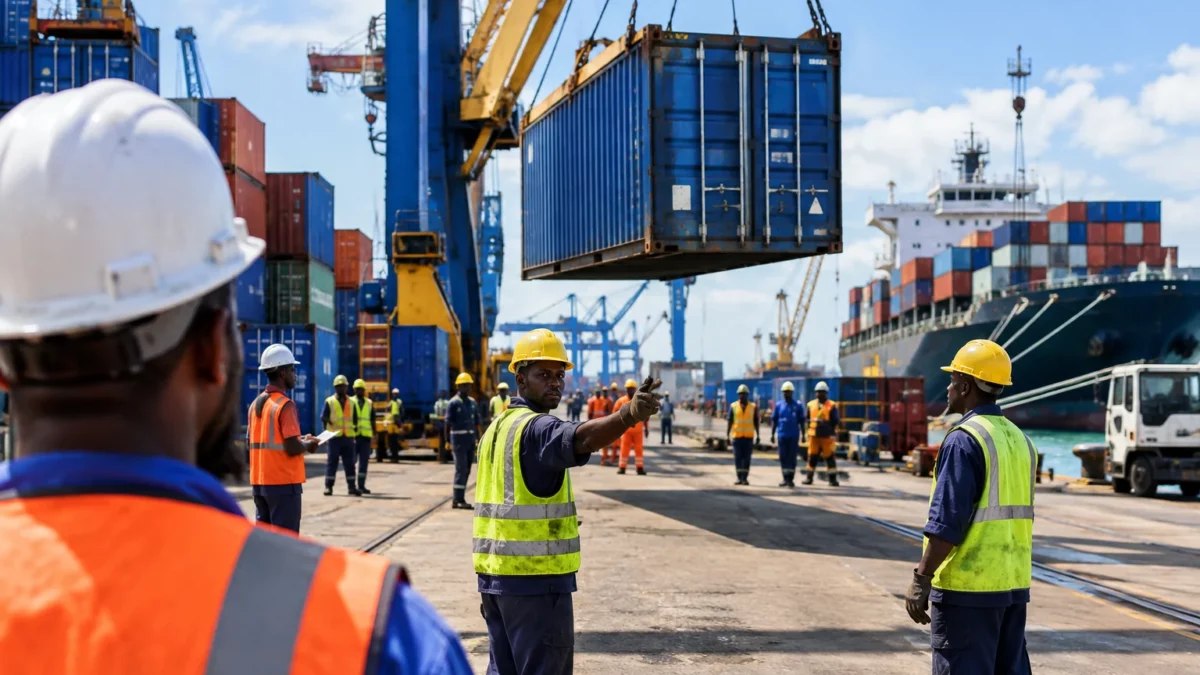
When a ship is waiting in Lagos, the bill does not stop at the port. It can reach manufacturers waiting for raw materials, exporters whose cargoes are delayed and households buying imported goods. For Nigeria, modernising its terminals is therefore also a matter of everyday costs and competitiveness in West Africa.
A port network under pressure from trade
Apapa and Tin Can Island, two complexes in Lagos, handle a major share of Nigeria’s maritime traffic. Their importance is part of a regional system in which the ports of Lagos, Tema in Ghana, Lomé in Togo and Cotonou in Benin compete for cargo and logistics services. The smooth running of operations can therefore influence carriers’ choices and businesses’ access to neighbouring markets.
Demand has grown faster than the facilities’ capacity. According to figures presented by Nigeria’s Minister of Marine and Blue Economy, Adegboyega Oyetola, total port traffic in the country reached 129.3 million tonnes in 2025. The Nigerian Ports Authority, the national port authority, also reported this increase in its operational review. The volume highlights the scale of the challenge, but does not mean that every terminal handles the same share of goods.
A report by the National Institute for Legislative and Democratic Studies, a research body linked to Nigeria’s National Assembly, describes persistent delays at the ports. It cites congestion, fragmented administrative procedures and inadequate road links. The document estimates that losses caused by inefficiencies could reach several billion dollars a year. This is an estimate, not a figure independently verified for the Apapa and Tin Can Island project alone.
Works announced, results still to be measured
The federal government launched the project on 25 November 2026 at Tin Can Island. Valued at about one billion dollars, the programme covers the rehabilitation of quays and berths, channel dredging, access routes and cargo-handling equipment. Operational systems are also to be modernised. The aim is to increase the capacity of the two complexes and reduce bottlenecks in cargo handling.
The financing is based on a £746 million credit facility backed by UK Export Finance, the UK’s export credit agency. Poland’s KUKE is providing reinsurance, while Citibank is acting as a financial partner. The ITB-HITECH joint venture is to carry out the works. The Nigerian Federal Ministry of Finance confirmed the launch and the main terms of the financing arrangement.
Financing, however, guarantees neither that the schedule will be met nor that costs will automatically fall. The authorities will have to report on progress, spending and results. The finance ministry itself stresses that the project’s value will depend on its delivery and measurable outcomes. Useful indicators include ships’ waiting times, cargo dwell times and the cost of storage and demurrage charges.
The benefits will not be the same for everyone. Importers and manufacturers could benefit from more predictable deliveries if delays are reduced. Agricultural or manufacturing exporters could gain if their products reach ships more quickly. In Lagos, better-organised access routes could also limit the impact of lorry traffic. But without customs coordination and improvements to roads and rail links, refurbished quays risk shifting the bottleneck rather than clearing it.
Modernisation extends beyond Lagos’s two terminals
The project comes as Nigeria seeks to distribute more traffic across its facilities. The authorities have also announced upgrades at Onne, Rivers, Delta and Calabar. Meanwhile, the start of construction on the Bakassi deep-water port in Cross River State on 13 November 2026 reflects the ambition to expand port capacity beyond Lagos. These projects are separate: they should not be confused with the Apapa and Tin Can Island programme.
A growing number of announcements does not resolve the question of delivery. A port does not operate in isolation: it needs roads, railways, energy, coordinated customs services and investment to keep its terminals running. Connecting new facilities to the domestic economy will be as important as their theoretical capacity. For areas far from Lagos, better-connected ports could open up alternative trade routes, but this will depend on infrastructure actually being delivered.
At the level of the Economic Community of West African States (ECOWAS), which brings together countries in the region, the performance of Nigerian ports matters for supply chains and cross-border trade. However, improving quays alone will not make Nigeria a more efficient gateway for its neighbours: procedures, tariffs and land links will matter just as much. Monitoring the project will show whether the investment turns promised reductions in delays into tangible gains for businesses and households.