Algeria
 Egypt
 Libya
 Morocco
 Sudan
 Tunisia
 Benin
 Burkina Faso
 Cabo Verde
 Côte d'Ivoire
 Ghana
 Guinea
 Guinea-Bissau
 Liberia
 Mali
 Mauritania
 Niger
 Senegal
 Sierra Leone
 The Gambia
 Togo
 Cameroon
 Central African Republic
 Chad
 DR Congo
 Equatorial Guinea
 Gabon
 Republic of the Congo
 São Tomé and Príncipe
 Burundi
 Comoros
 Djibouti
 Eritrea
 Ethiopia
 Kenya
 Madagascar
 Malawi
 Mauritius
 Mozambique
 Rwanda
 Seychelles
 Somalia
 South Sudan
 Tanzania
 Uganda
 Angola
 Botswana
 Eswatini
 Lesotho
 Namibia
 South Africa
 Zambia
 Zimbabwe
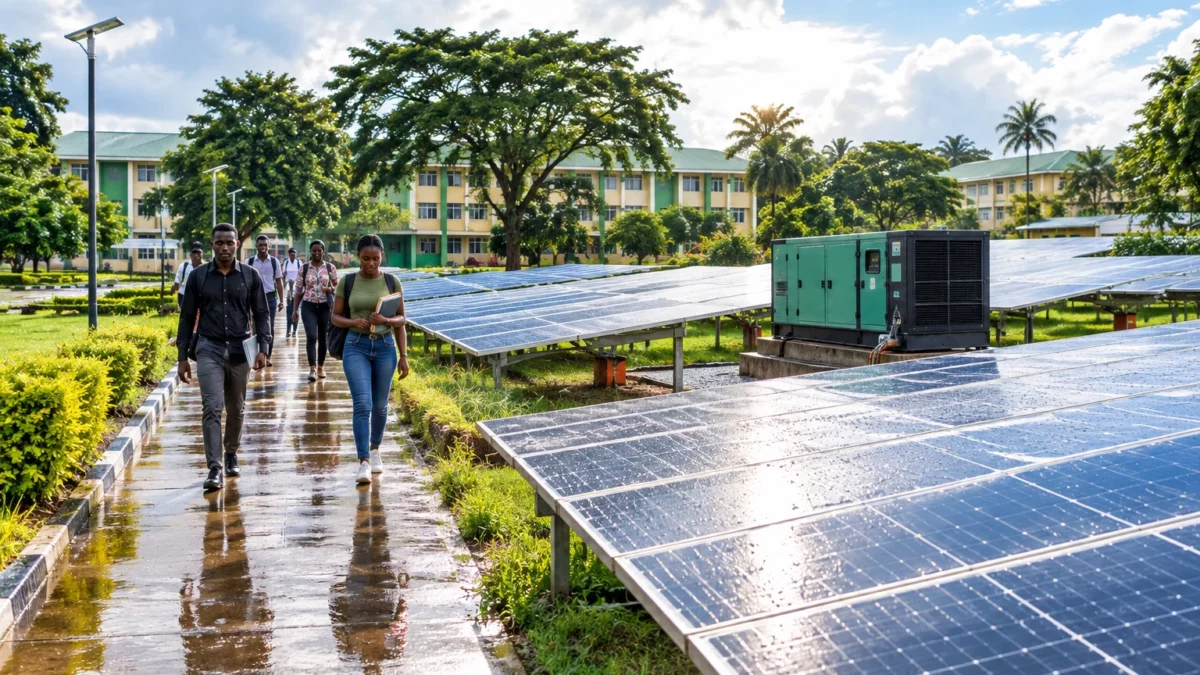
At a university, a power cut means more than classrooms plunged into darkness. It can interrupt a lecture, delay a laboratory experiment or disrupt administrative services. In Umudike, in Abia State, a new hybrid solar power plant is set to reduce dependence on the national grid.
A south-eastern campus with its own power generation
On 25 November 2026, Nigeria’s Minister of Power, Joseph Tegbe, commissioned a 3-megawatt installation at Michael Okpara University of Agriculture. The project is part of the Energising Education Programme (EEP), a federal initiative equipping universities and teaching hospitals with standalone or hybrid power systems. Nigerian media and the pan-African news agency APA reported the commissioning. Tribune Online’s report on the Umudike plant and APA’s report in French confirm the date and location.
The system combines a 3.3-megawatt-peak photovoltaic array — a measure of its theoretical maximum output — with a 3-megawatt electrical output and 2.2-megawatt-hour batteries. The battery can store some of the electricity generated and release it when sunlight is insufficient. The project also includes refurbishment of the internal distribution network, 288 street lights and a renewable energy training centre. These details are provided by the Nigerian Rural Electrification Agency (REA).
According to the authorities, about 20,553 students and 3,500 staff are expected to benefit from a more stable power supply. The system is also expected to take more than 60 diesel generators out of use. This outcome will depend, however, on the maintenance of the panels and batteries, as well as the management of operating costs over time.
Addressing outages without replacing grid reform
The use of local installations responds to a challenge that extends beyond campuses. Nigeria’s electricity grid remains prone to interruptions and partial collapses. In its 2025 assessment, the International Finance Corporation says businesses experience an average of eight hours of power cuts a day. It also estimates that 86% of them own or share a generator. The IFC’s report on Nigeria’s private sector documents these figures and the costs associated with self-generation.
For universities, generators provide a back-up, but running them incurs fuel and maintenance costs. A hybrid solar plant can reduce that bill and make some services less dependent on grid fluctuations. It does not, however, resolve national-level constraints on power generation and transmission, or the financial pressures facing the electricity sector as a whole.
The Umudike installation is part of a broader federal initiative. The Ministry of Education now presents a renewed programme targeting 33 higher education institutions, while the REA documents several phases of the EEP. The programme’s scope and stages are evolving: the figure of 33 institutions does not mean that all of them already have an operational power plant. The Nigerian Ministry of Education’s presentation of the programme describes the intended beneficiaries.
Different effects across uses and locations
On a campus, a more regular power supply can support teaching, laboratories, lighting and administrative services. Students and staff are its first users. The training centre planned for Umudike could also pass on technical skills, provided practical training is actually organised there and the equipment is maintained after commissioning.
Universities are not the only institutions with these needs. The REA has also developed hybrid solar systems for healthcare facilities under the Nigeria Electrification Project, supported by the World Bank. The DARES programme, which focuses on expanding access to decentralised electricity, aims to mobilise state governments and private companies. Institutions far from the most reliable infrastructure can thus benefit from solutions tailored to their sites, but results will depend on funding, maintenance and the ability to integrate installations with local grids.
This shift is taking place amid changes at federal level. Nigeria’s Electricity Act of 2023 expanded the scope for states to regulate certain generation and distribution activities within their territories. It creates further opportunities for decentralised solutions, without removing the role of the national grid or the need for coordination between Abuja, the states and operators.
A Nigerian challenge with resonance across West Africa
Solar power on campuses is a practical response to a daily constraint, but it cannot by itself amount to a policy of universal access. Institutions able to secure funding and manage complex equipment do not represent all communities, particularly in rural areas where access to electricity remains more difficult. The challenge is therefore also to distribute investment and skills beyond the federal institutions already selected.
For Nigeria, West Africa’s largest economy by population, reliable electricity is vital to education, health and economic activity. National initiatives intersect with the ambitions of ECOWAS, the Economic Community of West African States, for regional energy integration. Progress will be measured less by the number of commissioning ceremonies than by the continuity of the service, the cost of electricity to institutions and the actual expansion of projects to hospitals and state governments.