Egypt
 Libya
 Morocco
 Sudan
 Tunisia
 Benin
 Burkina Faso
 Cabo Verde
 Côte d'Ivoire
 Ghana
 Guinea
 Guinea-Bissau
 Liberia
 Mali
 Mauritania
 Niger
 Nigeria
 Senegal
 Sierra Leone
 The Gambia
 Togo
 Cameroon
 Central African Republic
 Chad
 DR Congo
 Equatorial Guinea
 Gabon
 Republic of the Congo
 São Tomé and Príncipe
 Burundi
 Comoros
 Djibouti
 Eritrea
 Ethiopia
 Kenya
 Madagascar
 Malawi
 Mauritius
 Mozambique
 Rwanda
 Seychelles
 Somalia
 South Sudan
 Tanzania
 Uganda
 Angola
 Botswana
 Eswatini
 Lesotho
 Namibia
 South Africa
 Zambia
 Zimbabwe
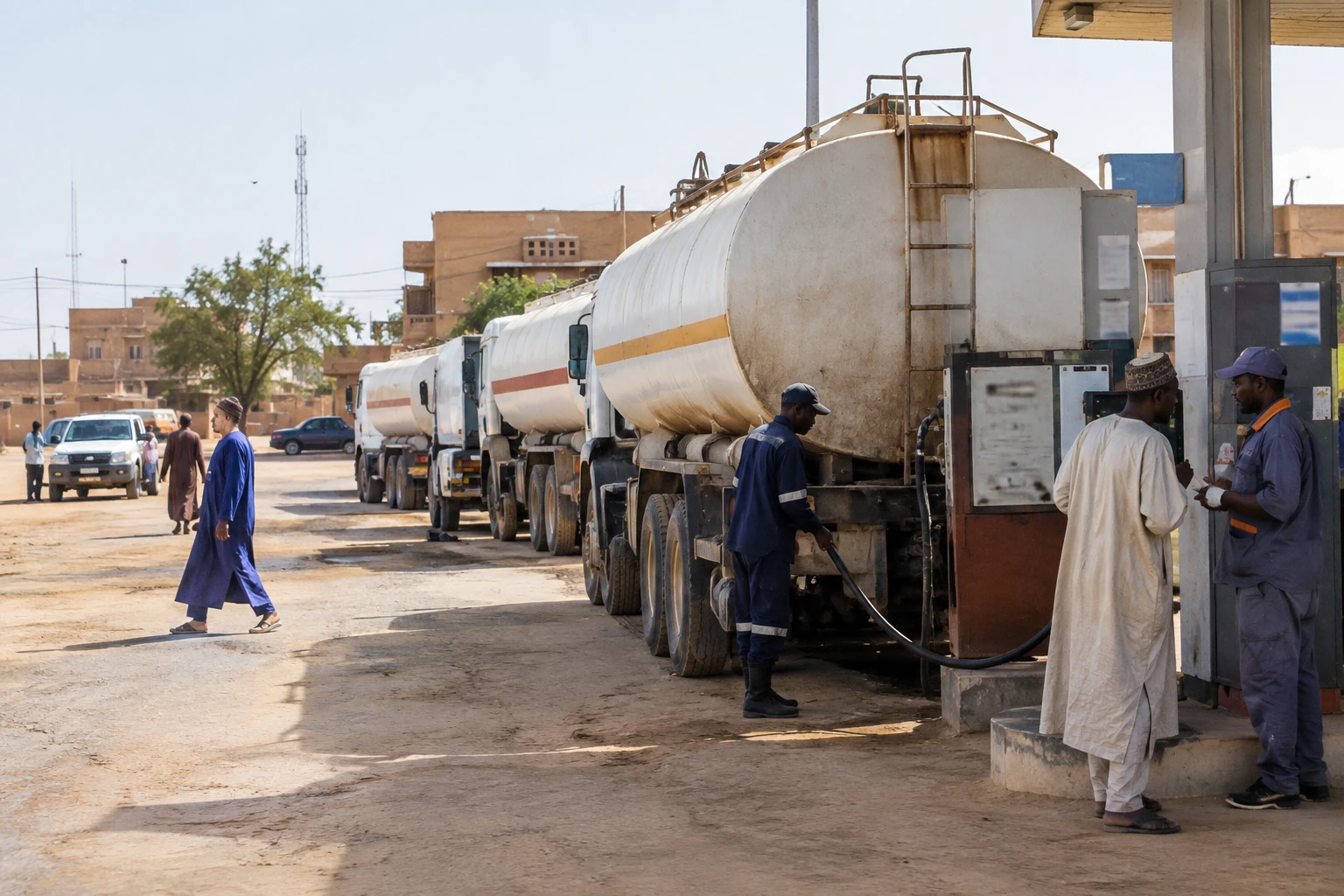
In Agadez, the arrival of fuel from Algeria meets an immediate need. But the reported military escort around the convoy gives the delivery broader significance: it comes as Niamey and Algiers strengthen security and energy co-operation across the Sahara.
A delivery awaited in northern Niger
On 1 November 2026, Niger’s petroleum minister, Hamadou Tini, received 53 tanker trucks in Agadez from Algeria. They were carrying an order placed by the Nigerien Petroleum Products Company (SONIDEP), according to the Nigerien Press Agency. Algeria’s APS news agency reported a cargo of about 1,600 tonnes of petrol, intended to supply the Nigerien market.
Local media described a convoy of about 60 tankers, escorted by Algerian troops and then joined by Nigerien forces at the border. The escort is not detailed in the ANP report on the delivery. It was reported by Aïr Info in Agadez and by Madar, a media outlet based in Niamey. The precise number of tankers therefore varies between reports: the ANP counts 53.
The delivery comes as regional authorities report difficulties with fuel supplies. In Agadez, petrol and diesel are vital for transport, commercial activity, market gardening and mining sites. A shipment can ease pressure in the short term, but cannot on its own guarantee regular supplies in a region far from the main storage centres.
Algiers expands its security commitment
The military dimension has drawn particular attention to the operation. On 25 October, Algerian MPs approved the deployment of units of the People’s National Army to Niger. Algeria’s official APS news agency confirmed the vote. According to available reports, parliamentary authorities presented the decision as linked to protecting energy interests and implementing bilateral agreements.
The approval marks a significant shift in Algeria’s posture, traditionally cautious about military operations beyond its borders. However, the public information consulted specifies neither the size of the units concerned, nor the duration of their presence, nor the precise arrangements for their deployment. Some media reports mention a possible deployment in Niamey and north-eastern Niger, but these details remain to be officially confirmed. They should not be conflated with the reported presence of an escort for the convoy alone.
Geography helps explain some of what is at stake. Northern Niger borders Algeria and Libya. Routes through the area are used for legal trade, as well as smuggling and the movement of armed groups. Securing convoys and energy facilities is therefore a concern for both states, although the available announcements do not support the conclusion that this is part of a broader military operation.
Energy, logistics and bilateral co-operation
Energy ties extend beyond this delivery. SONIDEP and Algeria’s Sonatrach have commercial agreements covering the purchase of petroleum products. In February 2025, Algeria, Niger and Nigeria also revived work on the Trans-Saharan Gas Pipeline, a project intended to carry Nigerian gas to Algeria via Niger.
These projects highlight a reality often less visible than security announcements: the continuity of infrastructure also depends on transport, storage, refining and distribution. Niger produces crude oil, but that does not automatically ensure the availability of all refined fuels. The Algerian delivery could therefore help ease immediate pressure, while storage and transport projects require investment and sustained co-operation.
The effects will not be the same for everyone. Transport operators, businesses and farmers in Agadez need predictable access to fuel. Residents of outlying neighbourhoods and remote communities depend more on regular distribution than on the arrival of a one-off convoy. The authorities’ priority will therefore be to turn this delivery into available stocks and widespread supply, rather than a mere announcement.
A rapprochement in a changing Sahel
This co-operation is taking place in a region where political frameworks are evolving. Niger, Mali and Burkina Faso left the Economic Community of West African States (ECOWAS) on 29 January 2025 and regrouped under the Alliance of Sahel States (AES). Algeria is not part of this confederation, but its border with Niger and its interests in the Sahara give it a direct role in the balance of power in the neighbourhood.
For Niamey, the partnership with Algiers opens a supply route and a channel for security co-operation in the north, complementing its relations with its AES neighbours. For Algiers, it strengthens ties with a country that is a strategic transit point between the Maghreb and West Africa. This convergence does not remove differences in interests; rather, it makes precise agreements on missions, border controls and infrastructure protection all the more necessary.
The next steps will be decisive. The frequency of deliveries, their distribution beyond Agadez and the publication of official details about the deployment approved by the Algerian parliament will all need to be watched. The issue goes beyond the escort of a convoy: it is whether co-operation between Niamey and Algiers can sustainably support Niger’s energy needs while clarifying the presence of foreign troops in the region.