Algeria
 Egypt
 Libya
 Morocco
 Sudan
 Tunisia
 Benin
 Burkina Faso
 Cabo Verde
 Côte d'Ivoire
 Ghana
 Guinea
 Guinea-Bissau
 Liberia
 Mali
 Mauritania
 Niger
 Nigeria
 Sierra Leone
 The Gambia
 Togo
 Cameroon
 Central African Republic
 Chad
 DR Congo
 Equatorial Guinea
 Gabon
 Republic of the Congo
 São Tomé and Príncipe
 Burundi
 Comoros
 Djibouti
 Eritrea
 Ethiopia
 Kenya
 Madagascar
 Malawi
 Mauritius
 Mozambique
 Rwanda
 Seychelles
 Somalia
 South Sudan
 Tanzania
 Uganda
 Angola
 Botswana
 Eswatini
 Lesotho
 Namibia
 South Africa
 Zambia
 Zimbabwe
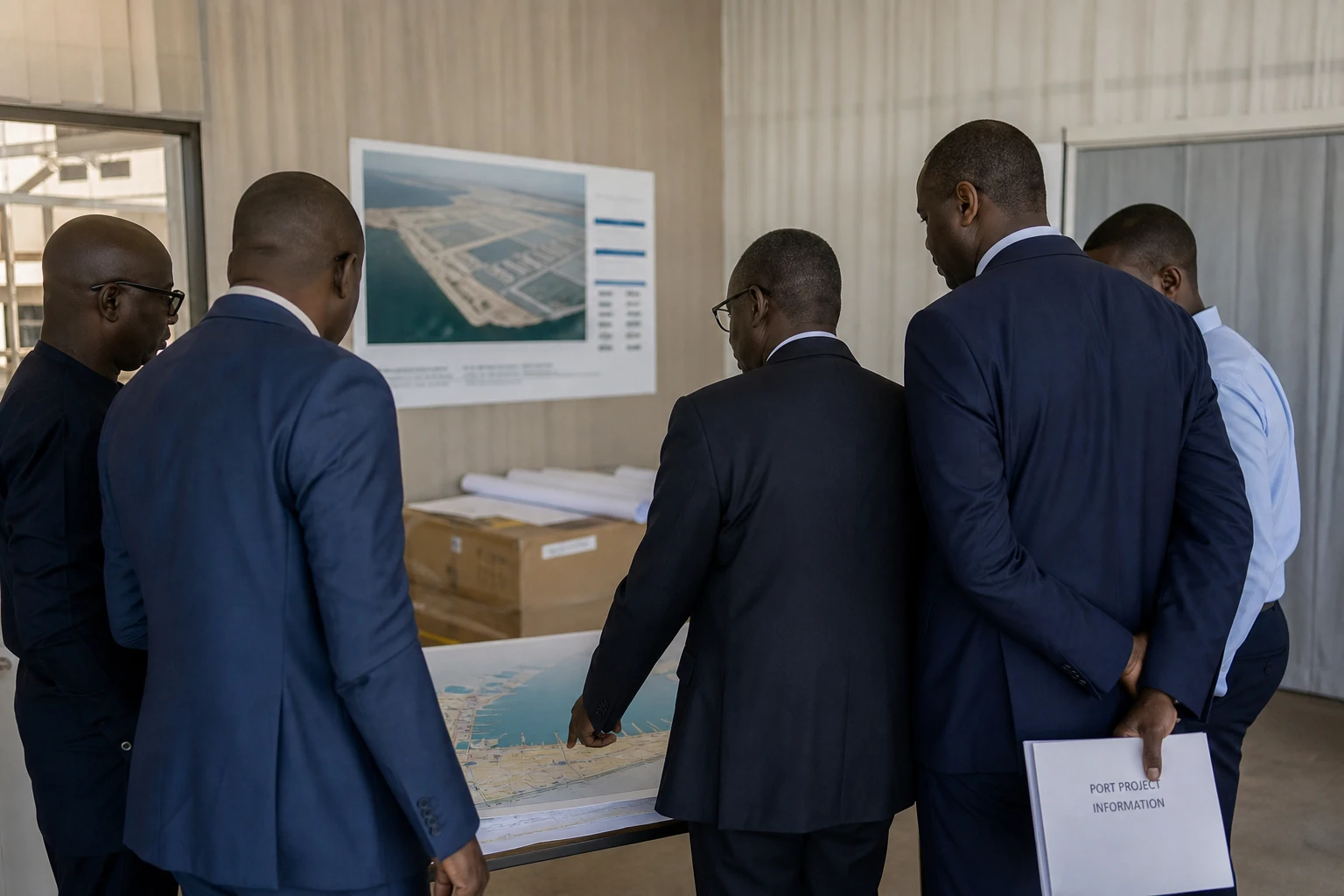
At Ndayane, the port’s future is not decided offshore alone. It also hinges on the role Dakar will play in regional trade.
Senegal is making progress on a project that goes beyond the maritime sphere. At Ndayane, about 50 kilometres from Dakar, the future deep-water port is intended to address a very practical constraint: accommodating ships that the port of Dakar, located in a densely built-up area with limited space, struggles to receive under good conditions. In a sub-region where competition between ports is intensifying, the project’s timetable is already an economic as well as a technical issue.
That is the crux of the matter: who will capture containerised cargo, transshipments and traffic from the hinterland—that is, the continent’s interior? For Senegal, the answer lies in new infrastructure capable of better connecting Dakar, neighbouring Sahelian countries and global shipping routes. For West Africa, it is part of a broader contest between port platforms, as ECOWAS also promotes projects to improve trade competitiveness and access to markets.
Dredging is finished ahead of schedule, changing the next phase of the project
On 27 July 2026, DP World announced the completion of the main dredging works at Ndayane port, 13 months ahead of the original schedule. This milestone allows the next phase to begin sooner: construction of the quays and essential maritime infrastructure. The group says the port is still due to come into operation in 2028.
The work covered a 5-kilometre access channel, a 600-metre turning basin and an 875-metre berthing area, designed for very large container ships. More than 1,000 people were deployed on site, and the project used two large trailing suction hopper dredgers, according to the Emirati group. These details underscore the scale of a project conceived from the outset as a game-changing infrastructure development for Senegal’s Atlantic coast.
The rapid completion of the dredging does not remove the other deadlines. In December 2024, DP World had already described the start of maritime works as the beginning of a major phase of the project, with an announced initial capacity of 1.2 million TEUs a year. The company also says Ndayane port is intended to strengthen Senegal’s role as a logistics hub in West Africa.
Why the port matters for Senegal, and beyond Dakar
The port of Dakar remains a strategic asset. But its limitations are well known. Cargo traffic reached 22,444,599 tonnes in 2022, according to its statistical report, while container traffic continued to grow, reaching 800,000 TEUs in 2023, up from 300,000 TEUs in 2008, according to DP World. This increase points to a dynamic facility, but also one nearing its physical capacity within a tightly packed urban area.
For Senegal’s economy, the new facility could ease logistical pressure on Dakar, streamline imports and support exports. It could also strengthen sectors that depend on port turnaround times, from agribusiness and raw materials to consumer goods supplying urban markets. At the national level, land use is also at stake: a port outside the urban centre leaves more space in the capital for other purposes, while shifting some heavy industrial activity towards the southern coast.
The project’s funding split also says something about the balance of power. In October 2025, APS reported that the project was financed 60% by DP World and 40% by the Senegalese state. This public-private structure puts the government at the heart of strategic decision-making, while drawing on the expertise and capital of an international operator. In a country where the state is seeking to accelerate infrastructure development without sidelining other budget priorities, the equation is decisive.
The expected benefits are not limited to Dakar. Senegalese ports also serve as gateways for the region’s landlocked economies. This is where the West African dimension becomes tangible: a deeper, larger and better-connected port could attract traffic from Mali and other inland markets, while ECOWAS continues to work on the movement of goods and trade competitiveness. In a regional space still fragmented by logistical costs, port reliability is becoming a geopolitical advantage as well as an economic one.
The sequencing remains an open question. Completion of dredging is not delivery, but a shift to a new phase. The coming months will show whether maritime construction progresses at the same pace, whether the 2028 deadline holds, and whether Ndayane becomes the outlet expected for Senegal’s commercial growth. Across Africa, the project highlights a clear trend: ports are no longer mere points of landing. They have become instruments of logistical sovereignty and regional positioning.