Algeria
 Egypt
 Libya
 Morocco
 Sudan
 Tunisia
 Benin
 Burkina Faso
 Cabo Verde
 Côte d'Ivoire
 Ghana
 Guinea
 Guinea-Bissau
 Liberia
 Mali
 Mauritania
 Niger
 Nigeria
 Senegal
 Sierra Leone
 The Gambia
 Togo
 Cameroon
 Central African Republic
 Chad
 DR Congo
 Equatorial Guinea
 Gabon
 Republic of the Congo
 São Tomé and Príncipe
 Burundi
 Comoros
 Djibouti
 Eritrea
 Ethiopia
 Madagascar
 Malawi
 Mauritius
 Mozambique
 Rwanda
 Seychelles
 Somalia
 South Sudan
 Tanzania
 Uganda
 Angola
 Botswana
 Eswatini
 Lesotho
 Namibia
 South Africa
 Zambia
 Zimbabwe
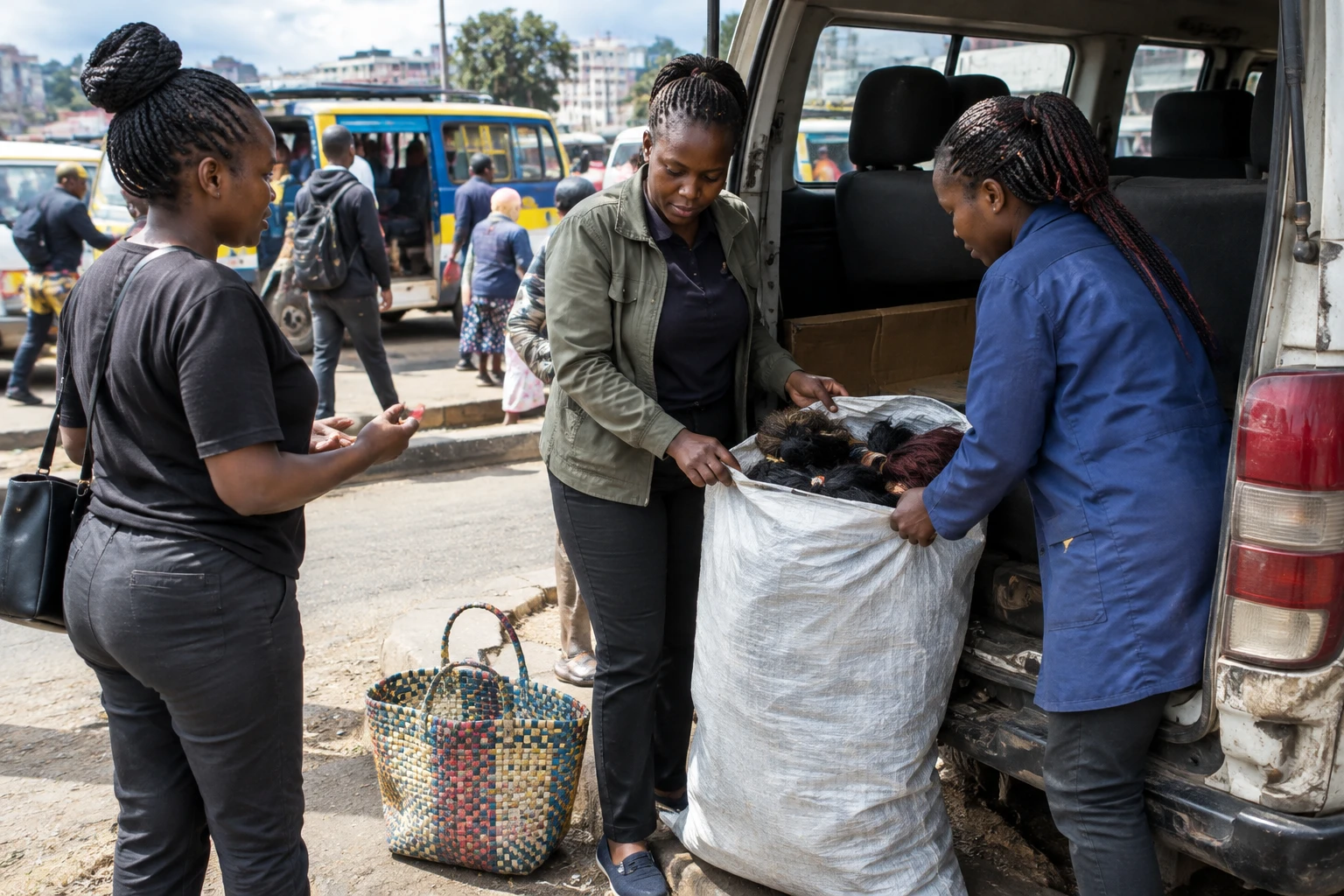
In a Nairobi salon, synthetic hair extensions removed after weeks of braiding can end up with ordinary rubbish. A few streets away, they become the raw material for handwoven bags. This transformation links a waste issue to another, very practical question: how can accessible income be created for women and young people?
An organised collection, from salon to workshop
Queening Afrika, a Kenyan social enterprise, has established a collection network with partner salons. They set aside used extensions. The team then sorts them by colour and texture, rejects those that cannot be reused and prepares the material for craftwork.
Synthetic hair can contain plastic materials. Dumped in rubbish heaps or drains, it does not decompose like organic waste and can contribute to blockages. Collection therefore prevents some of this waste from being dispersed into the environment. It does not, however, solve waste management in a city of several million people on its own.
Co-founder Damaris Kuria explains that the company supplies bags to salons to collect the extensions, then transports them to its workshop. Once prepared, some fibres are braided or woven to make saleable items, including bags. The process depends on the quality of the extensions: not all can be reused.
The report on the initiative says the company collects around 1,000 kilograms of synthetic hair per month. This figure could not be confirmed by a second independent source; it should therefore be understood as information provided about the project, not as an audited measure for the sector in Nairobi.
Income, but also the transfer of skills
The project combines production with training in weaving techniques. More experienced artisans pass on their skills to younger women. This matters in a labour market where informal work plays a major role, but incomes and social protection often remain uncertain.
Joyce Gitau, an employment and youth employability adviser at Plan International Kenya, estimates that around ten young women earn an income from Queening Afrika. She says these earnings help cover daily expenses, rent and children’s schooling. This account describes the project’s impact on its participants; on its own, it does not show that the jobs are stable or that the company can quickly increase production.
The distinction is important. Recycling creates an economic activity, but it does not automatically guarantee regular wages, sustainable markets or social protection. For participants, the project’s value will also depend on demand for the items made, their selling price and the continuity of collections.
Kenya’s challenge: turning policy into local practice
Kenya has incorporated the circular economy into its waste management policy: this model aims to reuse materials and limit reliance on the “produce, consume, throw away” approach. In late October 2026, the ministry responsible for the environment said it had approved a draft national strategy and implementation plan for 2027-2032. The document was still being finalised and was due to be revised before its planned launch.
The strategy identifies plastic waste and packaging among its priority sectors. Hair extensions are not listed as a dedicated sector. Queening Afrika’s case nevertheless illustrates a broader issue: small-scale recovery initiatives can complement public systems, provided they have reliable collection networks, markets and a safe working environment.
In Nairobi, as in other Kenyan cities, waste management also depends on counties, private companies and informal waste collectors. Local environmental justice organisations point out that these workers contribute to sorting and recovering materials, but often remain poorly recognised and exposed to precarious conditions. An inclusive recycling policy must therefore ensure that formalisation or the concentration of contracts does not deprive them of their livelihoods.
A local experiment with relevance across East Africa
Kenya is a member of the East African Community (EAC), which brings together several countries in the region and encourages cooperation on the environment and waste management. Products, recovered materials and skills cross borders; collection and recycling rules can therefore have regional reach, particularly for businesses seeking to expand their markets.
For Queening Afrika, the next steps will first take place locally: maintaining partnerships with salons, ensuring consistent product quality and providing artisans with sustainable pay. Nationally, implementation of the circular economy strategy announced for 2027-2032 will show what place small businesses and informal workers will have in recovery policies.
The project will not transform Kenya’s waste system on its own. It does, however, show how a frequently overlooked material can enter a value chain, with potential environmental benefits and income. The challenge will be to sustain that chain without mistaking a promising initiative for a general solution.