Algeria
 Egypt
 Libya
 Morocco
 Sudan
 Tunisia
 Benin
 Burkina Faso
 Cabo Verde
 Côte d'Ivoire
 Ghana
 Guinea
 Guinea-Bissau
 Liberia
 Mali
 Mauritania
 Niger
 Nigeria
 Senegal
 Sierra Leone
 The Gambia
 Togo
 Cameroon
 Central African Republic
 Chad
 DR Congo
 Equatorial Guinea
 Gabon
 São Tomé and Príncipe
 Burundi
 Comoros
 Djibouti
 Eritrea
 Ethiopia
 Kenya
 Madagascar
 Malawi
 Mauritius
 Mozambique
 Rwanda
 Seychelles
 Somalia
 South Sudan
 Tanzania
 Uganda
 Angola
 Botswana
 Eswatini
 Lesotho
 Namibia
 South Africa
 Zambia
 Zimbabwe
Between Kinshasa and Nairobi, a presidential handshake is not enough to ease disagreements over the war in the east of the Democratic Republic of the Congo. But it can reopen diplomatic channels that people in affected regions need, as regional initiatives have multiplied without ending the violence.
A rapprochement under African mediation
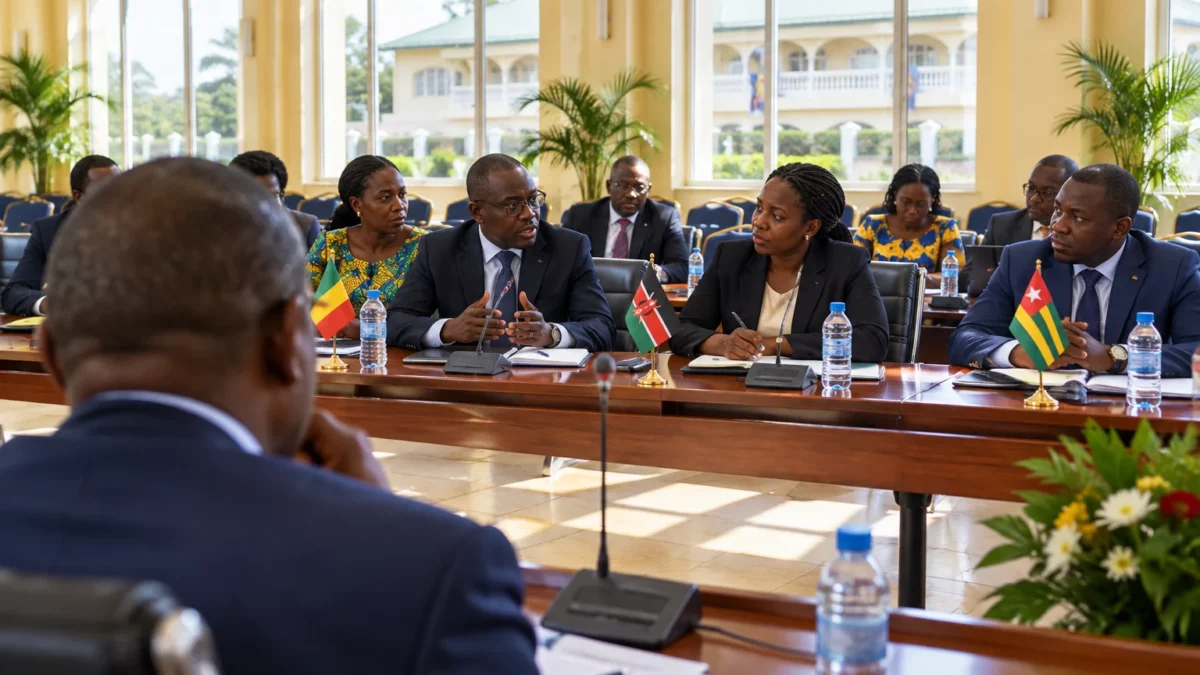
On 22 November 2026, Presidents Félix Tshisekedi and William Ruto met in Oyo, Republic of the Congo, with Denis Sassou-Nguesso and Faure Gnassingbé. The Togolese president of the Council is acting as mediator appointed by the African Union in the crisis in eastern DRC. The four-way meeting aimed to reduce tensions between Kinshasa and Nairobi and discuss peace, security and cooperation.
The two leaders agreed to work towards the full restoration of diplomatic relations. Congolese media also report an agreement on the return of ambassadors and the resumption of regular consultations. These announcements are political commitments: their practical implementation remains to be seen.
The rapprochement comes amid deep-seated grievances. Félix Tshisekedi has criticised William Ruto over the conduct of the Nairobi process and what he considers to be an attitude favourable to Rwanda. The Kenyan president has rejected these accusations. The disagreement is therefore as much about trust between leaders as it is about how peace efforts should be conducted.
The Nairobi process, between diplomacy and mistrust
Launched in 2022 under the auspices of the East African Community (EAC), the Nairobi process combined political dialogue with security initiatives. It notably provided for consultations with armed groups and the deployment of a regional force. At the time, EAC heads of state called for a ceasefire and political solutions in North Kivu, South Kivu and Ituri.
But Kinshasa and Nairobi have not always understood the process in the same way. An analysis by the Centre for Strategic and International Studies, based in part on interviews conducted in the region, notes that Congolese authorities expected the regional force to play a more direct role in countering armed groups. On the Kenyan side, its role was understood more as a mission of mediation and separating forces. This mismatch fuelled mistrust.
Relations also deteriorated after the Congo River Alliance (AFC), a political and military movement linked to M23 according to the centre’s analysis, was established in Nairobi in 2023. Kinshasa protested against the announcement being made on Kenyan soil. The episode heightened Congolese suspicions, while Nairobi defended political freedoms in Kenya. Allegations of external support for armed groups remain highly sensitive and must be attributed to those who make them.
What normalisation could change
The return of ambassadors, if it happens, would restore an official channel between the two capitals. Regular consultations could facilitate exchanges on security, diplomatic matters and economic interests. They would also provide a means of addressing disagreements without allowing every incident to turn into a bilateral crisis.
The stakes extend beyond presidential palaces. Relations between the two countries affect traders, businesses and people travelling in a region where borders and economic networks are closely linked. CSIS research highlights the importance of Kenyan commercial interests in the DRC, particularly in the banking sector. More predictable relations could help formal economic actors; they do not, however, guarantee either the security of trade or an improvement in daily life in the eastern provinces.
For people in North Kivu, South Kivu and Ituri, the priorities remain the protection of civilians, access to services and an end to the fighting. A thaw between presidents can support diplomacy, but it cannot replace local dialogue mechanisms or the security and justice measures needed on the ground. Displaced people and directly affected communities cannot be reduced to a bargaining chip between states.
A test for regional mediation efforts
Oyo brings together leaders from Central, East and West Africa around a dispute involving the Great Lakes region. African Union mediation, EAC initiatives and other diplomatic efforts will need to complement one another rather than compete. For the DRC, an EAC member since 2022, regional cooperation remains essential, but its credibility depends on taking its sovereignty and security concerns into account.
The summit’s significance will therefore be measured by actions: the effective return of ambassadors, the resumption of consultations and the two governments’ ability to maintain dialogue despite their differences over the peace process. It will also be important to see whether this easing of tensions facilitates coordination among mediators and concrete progress for people in the east. In Oyo, the leaders reopened a diplomatic door; the work begins after the meeting.