Algeria
 Egypt
 Libya
 Morocco
 Sudan
 Tunisia
 Benin
 Burkina Faso
 Cabo Verde
 Côte d'Ivoire
 Ghana
 Guinea
 Guinea-Bissau
 Liberia
 Mali
 Mauritania
 Niger
 Nigeria
 Senegal
 Sierra Leone
 The Gambia
 Togo
 Cameroon
 Central African Republic
 Chad
 DR Congo
 Equatorial Guinea
 Gabon
 Republic of the Congo
 São Tomé and Príncipe
 Burundi
 Comoros
 Djibouti
 Eritrea
 Ethiopia
 Kenya
 Madagascar
 Malawi
 Mauritius
 Rwanda
 Seychelles
 Somalia
 South Sudan
 Tanzania
 Uganda
 Angola
 Botswana
 Eswatini
 Lesotho
 Namibia
 South Africa
 Zambia
 Zimbabwe
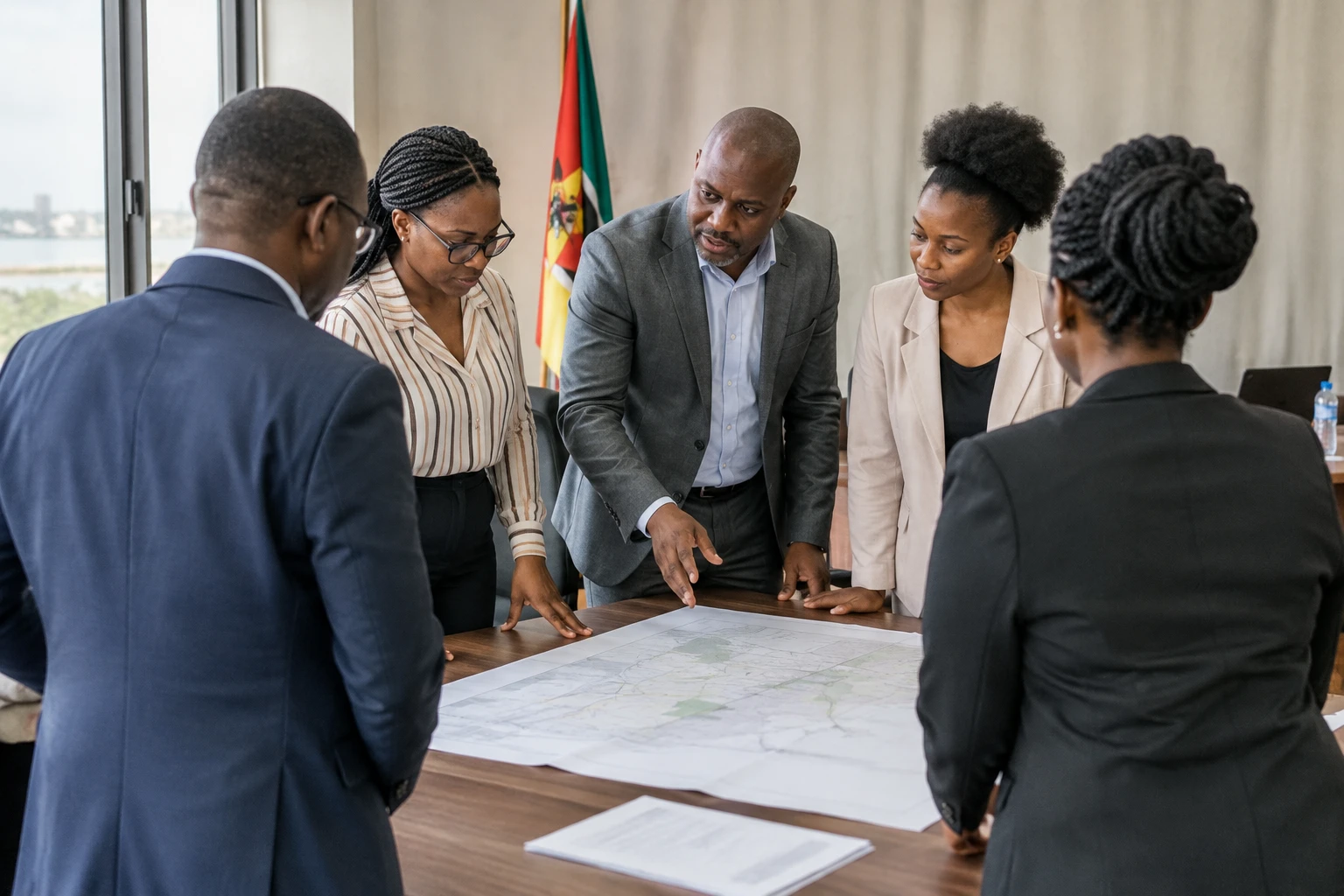
Connecting an isolated community to the national grid is not always the quickest or least expensive solution. In Mozambique, the choice between power lines, mini-grids and solar panels is becoming central to meeting the promise of universal access by 2030.
Planning based on local conditions
The country is combining two approaches. The national grid is being expanded and extended where homes and businesses can be served efficiently. Elsewhere, mini-grids or individual solar systems can provide electricity without waiting for long power lines to be built.
This equation is particularly important in rural areas, where distances and dispersed settlements make connections more difficult. It also affects local institutions and small businesses: a health centre, a school or a workshop does not have the same needs as a household. Useful planning must therefore take account of both geography and how electricity is used.
Mozambique is part of a regional trend in which energy access also depends on cross-border trade and infrastructure. The Southern African Development Community (SADC), a regional organisation of which the country is a member, is seeking to strengthen energy co-operation among its member states. But major generation and interconnection projects do not replace solutions suited to remote communities.
Maps to guide investment
On 7 November 2026, the Minister of Mineral Resources and Energy, Estevão Tomás Rafael Pale, presented a national geospatial plan for least-cost electrification and an integrated monitoring platform in Maputo. The plan compares several options for communities: grid extension or densification, mini-grids and standalone solar systems. The platform brings together data, interactive maps and dashboards to monitor projects and better co-ordinate public institutions. The report on the presentation of the geospatial tools and the official presentation of the electrification platform describe this approach.
The tool does not, by itself, connect households to electricity. It helps compare options and guide funding more effectively. Identified projects still need to undergo field checks, feasibility studies and technical, environmental and social assessments. The map points to a planning option, not a guarantee that a project will be delivered.
Mozambique’s Ministry of Energy announced an electricity access rate of 70.3% in the first half of 2026. The figure, presented in Maputo at a sector meeting, was also reported by Mozambican media outlet B NEWS. The government attributes progress to grid expansion and off-grid solutions under the Energia para Todos programme, launched in 2018 with the goal of universal access by 2030. The ministry sets out the access rate and national programme.
The challenge: funding connections to the last mile
The National Energy Compact developed under Mission 300 sets an ambitious course: 4.9 million additional connections and $18.6bn to be mobilised for the sector, including about $8.7bn expected from the private sector. These sums cover a broader energy effort than household connections alone. They nevertheless show the scale of the funding that must be raised before 2030.
Off-grid needs account for a significant share of this trajectory. Sustainable Energy for All (SEforALL), a partner in developing the plan, estimates that 2.5 million connections could be made off-grid, requiring investment of about $1.1bn. Solar home systems and mini-grids can serve communities that the national grid cannot reach quickly or at a sustainable cost. SEforALL outlines off-grid connection needs.
The National Energy Fund (FUNAE) plans to build 363 mini-grids over ten years under PROMIR. The programme is valued at about $250m and has around $94m for its launch, including $60m provided by the state. The European Union, the World Bank, KfW, Sweden and Belgium are among the partners cited by FUNAE. The National Energy Fund outlines the PROMIR programme and its initial financing.
For the authorities, joint planning can reduce the risk of funding unsuitable equipment or overlapping projects. For investors, clearer data and priorities can make projects easier to assess. But profitability is not the only criterion: in sparsely populated communities, the cost per connection can remain high, even though electricity is essential for public services and economic activity.
Implementation: the next test
The transition from maps to construction sites will determine the real impact of these tools. Data quality, infrastructure conditions, maintenance costs and households’ ability to pay for electricity will all need to be assessed. Continuity of service matters as much as the initial connection. In rural areas, productive uses — food preservation, pumping, processing or digital services — can also increase the economic value of installations.
Mozambique will also need to align local electrification with regional generation and interconnection projects. SADC provides a framework for energy co-operation, but progress towards the 2030 goal will also be measured in villages and neighbourhoods that remain without service. The 70.3% figure marks official progress; the millions of connections still planned are a reminder that the challenge now lies as much in delivery, funding and service quality as in planning.