Algeria
 Egypt
 Libya
 Sudan
 Tunisia
 Benin
 Burkina Faso
 Cabo Verde
 Côte d'Ivoire
 Ghana
 Guinea
 Guinea-Bissau
 Liberia
 Mali
 Mauritania
 Niger
 Nigeria
 Senegal
 Sierra Leone
 The Gambia
 Togo
 Cameroon
 Central African Republic
 Chad
 DR Congo
 Equatorial Guinea
 Gabon
 Republic of the Congo
 São Tomé and Príncipe
 Burundi
 Comoros
 Djibouti
 Eritrea
 Ethiopia
 Kenya
 Madagascar
 Malawi
 Mauritius
 Mozambique
 Rwanda
 Seychelles
 Somalia
 South Sudan
 Tanzania
 Uganda
 Angola
 Botswana
 Eswatini
 Lesotho
 Namibia
 South Africa
 Zambia
 Zimbabwe
In Morocco, a football tournament is also an organisational test
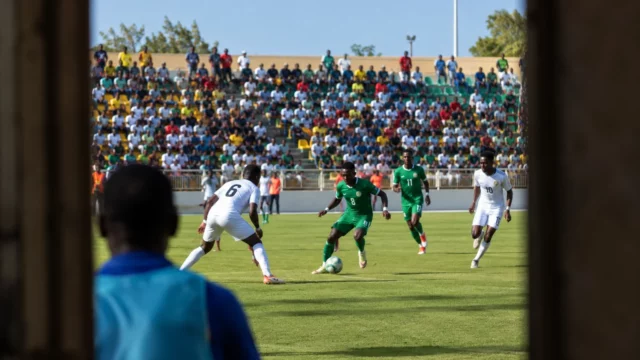
In Rabat, the ball never arrives alone. It brings stadiums, schedules, hotels, transport and pressure that extends well beyond the pitch. For Morocco, the 2026 Women’s Africa Cup of Nations is not just a sporting showcase. It is also a test of capacity, less than four years before the 2030 men’s World Cup, which the kingdom will co-host with Spain and Portugal.
The event is part of a wider continental trend. The Confederation of African Football has confirmed that the 2026 edition will bring together 16 national teams for the first time in this expanded format, with matches in Rabat and Casablanca. The tournament will run from 26 July to 16 August 2026 and serve as Africa’s qualifying competition for the 2027 Women’s World Cup. The four semi-finalists will qualify directly for the World Cup, while the losing quarter-finalists will remain in contention through the intercontinental play-offs.
Sixteen teams, four groups and an already clear pecking order
The draw produced four groups of four. Hosts Morocco will face Algeria, Senegal and Kenya in Group A. In Group B, South Africa will meet Côte d’Ivoire, Burkina Faso and Tanzania. Group C will bring together Nigeria, Zambia, Egypt and Malawi. Finally, Group D will pit Ghana against Cameroon, Mali and Cape Verde.
The format is straightforward. The top two teams in each group will advance to the quarter-finals. The competition will then move to a knockout bracket, with elimination matches leading up to the final. CAF has also confirmed that matches will kick off at fixed times, 17:00 GMT and 20:00 GMT, except for the final, scheduled for 19:00 GMT.
The opening programme gives a sense of the tournament’s scale. On 26 July, Algeria will play Senegal at Rabat’s Olympic Stadium at 17:00 GMT. Later that evening, Morocco will take on Kenya at the Stade Moulay El Hassan at 20:00 GMT. The group stage will run until 6 August. The quarter-finals will follow on 8 and 9 August, the semi-finals on 12 August, then the third-place play-off and final in mid-August.
Rabat and Casablanca at the heart of an upgrade
The tournament’s geography says much about Morocco’s current trajectory. Five stadiums have been selected: three in Rabat and two in Casablanca. They are the Stade Moulay El Hassan, the Olympic Stadium and Stade Al Madina in Rabat, as well as Stade Larbi Zaouli and Stade Moulay Rachid in Casablanca. The competition is therefore concentrated in two urban centres, which are easier to secure and connect than the five cities used for the previous edition.
This choice is not incidental. It reflects a broader strategy to modernise Morocco’s sporting infrastructure. The country has already undertaken numerous renovation projects and logistical adjustments ahead of major events. In this approach, stadiums are no longer just venues for matches. They are tools for projecting the country internationally, as well as spaces for fans and families to move through, well beyond match days.
The schedule has also been designed with broadcasts and African audiences in mind. In Moroccan time, kick-offs will take place in the evening, at 18:00 or 21:00. This will improve visibility across the continent, where demand for better-exposed women’s competitions continues to grow. The increase in prize money, now $1 million for the winners, also shows that CAF is seeking to bring the tournament into line with more ambitious standards.
Favourites carry sporting and symbolic responsibility
On paper, Nigeria remain the benchmark. The Super Falcons arrive as defending champions, with ten continental titles and an experienced squad. South Africa, champions in 2022, also have considerable collective strength. Morocco, meanwhile, are playing at home and have a team that has already reached the final in each of the past two editions. These three countries form the leading group of serious contenders.
The Moroccan context, however, deserves a nuanced reading. Women’s football has gained visibility, resources and support in the country, but it has yet to bring Morocco the same level of success as the men’s team. Jorge Vilda’s presence in the dugout adds another dimension: Morocco have chosen a coach accustomed to the highest international standards to make the most of the opportunity. The list of 26 players called up has been made public by the Royal Moroccan Football Federation, a sign that preparations are already under way.
For Ghana, Zambia, Côte d’Ivoire, Cameroon and Mali, the challenge is different. It is not just about targeting a trophy. They need to reach a new level of consistency, squad depth and organisation. In a 16-team tournament, the gap between established powers and improving sides can sometimes narrow quickly. But it rarely closes in 90 minutes.
An African competition with global reach
The 2026 Women’s Africa Cup of Nations is therefore about more than a continental title. It serves as a gateway to the 2027 World Cup, increasing its political and sporting significance. In North Africa as in southern Africa, in West Africa as in Central Africa, every match counts twice: it shapes the tournament standings and could open a path to Brazil.
For Morocco, the stakes go beyond the national team. A well-run tournament would reinforce its position among African countries capable of staging major events with consistent infrastructure, a well-managed schedule and a recognised hosting record. Across the continent, this edition will also show whether the rise of African women’s football now rests on a stable group of countries able to compete with the best, or whether progress remains fragile and dependent on a few strong generations.
On 26 July in Rabat, the tournament will therefore open a chapter that extends well beyond its 34 matches. It will say something about the place of women’s football among Africa’s sporting priorities, Morocco’s organisational capacity and how the continent is already preparing for what comes after 2026.