
 Egypt
 Libya
 Morocco
 Sudan
 Tunisia
 Benin
 Burkina Faso
 Cabo Verde
 Côte d'Ivoire
 Ghana
 Guinea
 Guinea-Bissau
 Liberia
 Mali
 Mauritania
 Niger
 Nigeria
 Senegal
 Sierra Leone
 The Gambia
 Togo
 Cameroon
 Central African Republic
 Chad
 DR Congo
 Equatorial Guinea
 Gabon
 Republic of the Congo
 São Tomé and Príncipe
 Burundi
 Comoros
 Djibouti
 Eritrea
 Ethiopia
 Kenya
 Madagascar
 Malawi
 Mauritius
 Mozambique
 Rwanda
 Seychelles
 Somalia
 South Sudan
 Tanzania
 Uganda
 Angola
 Botswana
 Eswatini
 Lesotho
 Namibia
 South Africa
 Zambia
 Zimbabwe
A tight group with little margin for error
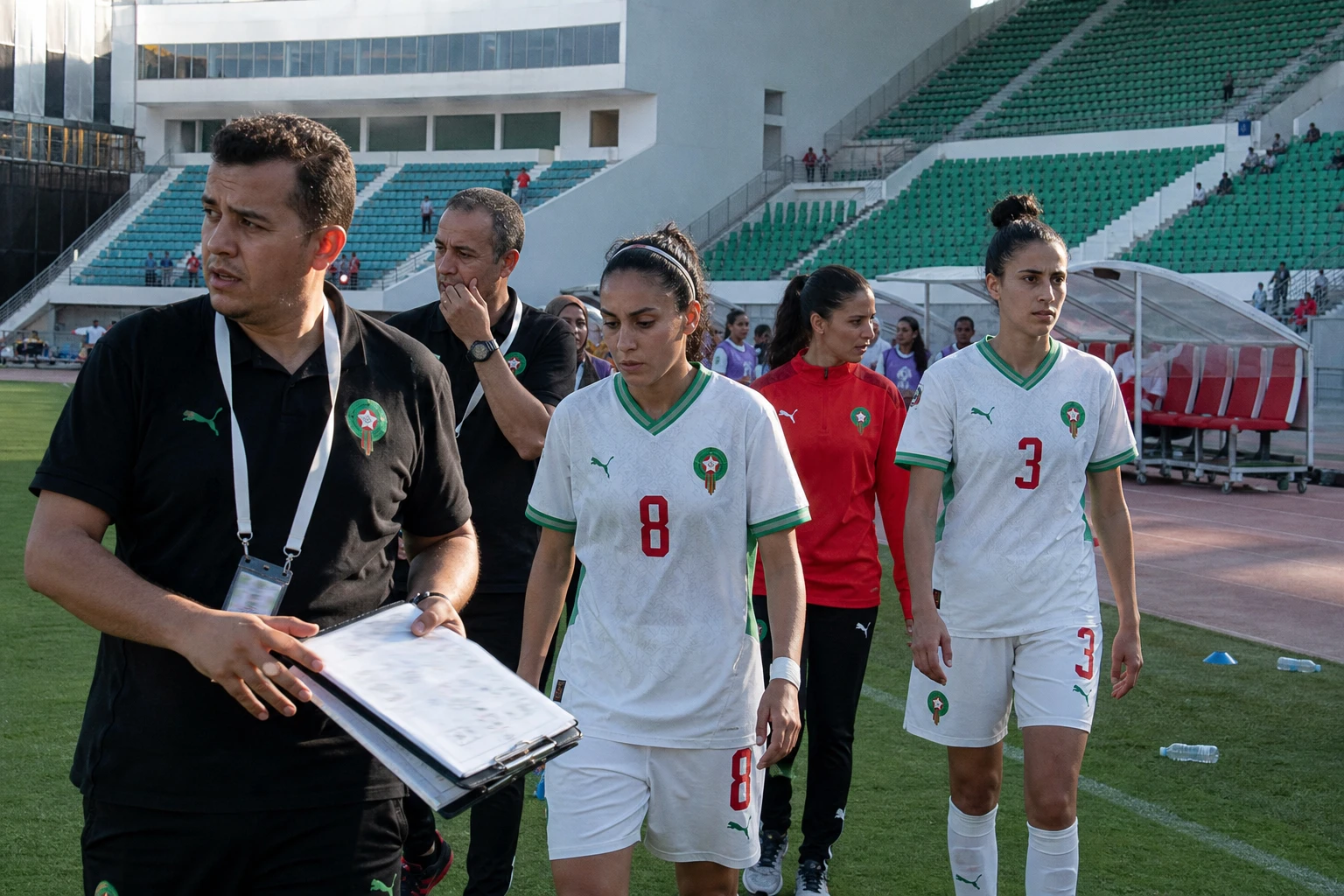
In Morocco, a group-stage campaign can sometimes turn on very little. A draw can secure qualification, but it also says something more: control, discipline and management of the tempo. In Rabat, the Atlas Lionesses chose that path, keeping a firm grip on their final Group A match without wavering.
The 2026 Women’s Africa Cup of Nations is being held in Morocco from 25 July to 16 August 2026, with Rabat as the base for Group A. The 14th edition of the competition brings together 16 African teams, an expanded format that reflects the rise of women’s football across the continent.
Morocco finish top, Algeria follow, Senegal bow out
Morocco finished top of Group A with 7 points, ahead of Algeria in second place with 6. Senegal took third place with 4 points, while Kenya ended the group without a point. At the end of the third matchday, Senegal and Morocco drew 0-0, enough to confirm the host country’s first place.
The CAF’s official schedule had this match taking place in Rabat, at the same time as Kenya-Algeria, on a final matchday charged with sporting tension. Morocco had already taken a strong step towards qualification after its first two matches, while Algeria had also secured its place in the quarter-finals before the group’s final kick-off.
| Team | Points | Record | Goals for | Goals against |
|---|---|---|---|---|
| Morocco | 7 | 2 wins, 1 draw | 5 | 0 |
| Algeria | 6 | 2 wins, 1 loss | 4 | 1 |
| Senegal | 4 | 1 win, 1 draw, 1 loss | 1 | 2 |
| Kenya | 0 | 3 losses | 0 | 7 |
The standings tell the story of a very closely contested group, but one that unfolded very differently for each team. Morocco progressed without conceding. Algeria built its qualification on a convincing start. Senegal paid dearly for an opening defeat. Kenya, meanwhile, played three matches without scoring, quickly running out of room for manoeuvre in a short competition.
What the result means for Rabat and the region
For Morocco, the significance goes beyond the scoreboard. In a country that has made women’s football a focus for visibility and investment, finishing top of the group at home reinforces an established sporting momentum. Morocco has hosted and organised several major CAF events in recent years, and Rabat is increasingly emerging as a centre of gravity for continental football.
For Senegal, elimination in the group stage does not erase its progress, but it is a reminder of a simple reality: in a group where every goal counts, attacking efficiency matters as much as defensive solidity. Senegal leave the tournament with just one goal scored, a statistic that sums up their difficulty in turning passages of play into a tangible advantage.
Algeria’s campaign also deserves close attention. Algeria qualified from a group in which it managed to pick up points early, in a tournament that underlines the growing competition between teams from North and West Africa. This depth is good news for the competitiveness of African women’s football, but it also increases pressure on federations: preparation, schedules, coaching and continuity are becoming decisive.
The regional context gives this group stage wider significance. Morocco is part of North Africa, where sporting rivalries often intersect with different institutional trajectories, while Senegal continues to establish itself as a footballing nation in West Africa. The Women’s Africa Cup of Nations acts as a barometer here: it measures the gap between sporting projects, squad depth and the ability to play three matches in fewer than ten days.
A signal for the continent, beyond the quarter-finals
The rest of the tournament will show whether Morocco can turn this controlled group campaign into a deep run. The objective is clear: the quarter-finals and then the semi-finals will require each team to manage both the pressure of results and physical fatigue. In a Women’s Africa Cup of Nations expanded to 16 teams, squad depth now matters as much as the starting talent.
Across Africa, this matchday confirms a clear trend: women’s football can no longer be seen as a mere appendage to the men’s competitions. It is now shaping hierarchies, ambitions and sporting policies. For states, federations and players, the question is no longer simply how to take part. It is how to endure, impose a style and stand up to increasingly well-prepared opponents.



