
 Algeria
 Egypt
 Libya
 Sudan
 Tunisia
 Benin
 Burkina Faso
 Cabo Verde
 Côte d'Ivoire
 Ghana
 Guinea
 Guinea-Bissau
 Liberia
 Mali
 Mauritania
 Niger
 Nigeria
 Senegal
 Sierra Leone
 The Gambia
 Togo
 Cameroon
 Central African Republic
 Chad
 DR Congo
 Equatorial Guinea
 Gabon
 Republic of the Congo
 São Tomé and Príncipe
 Burundi
 Comoros
 Djibouti
 Eritrea
 Ethiopia
 Kenya
 Madagascar
 Malawi
 Mauritius
 Mozambique
 Rwanda
 Seychelles
 Somalia
 South Sudan
 Tanzania
 Uganda
 Angola
 Botswana
 Eswatini
 Lesotho
 Namibia
 South Africa
 Zambia
 Zimbabwe
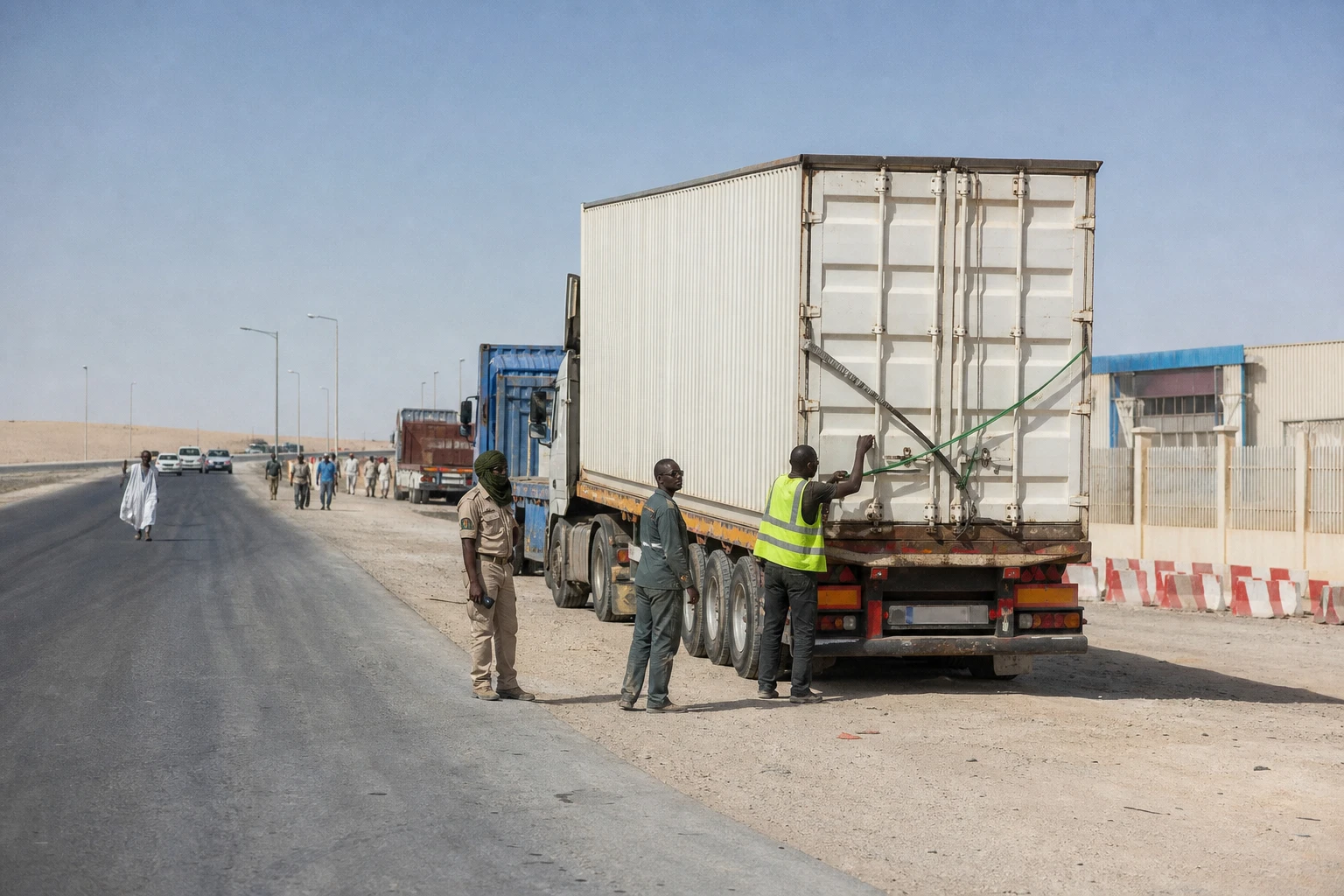
At the western edge of the Sahara, only a few hundred kilometres already separate Morocco’s and Mauritania’s road networks. Their modernisation could, however, change the movement of goods between the Atlantic, Mauritania and Sahelian markets. For transport operators, the stakes are concrete: reduce delays, make journeys safer and render border crossings more predictable.
A strategic road link between Nouakchott and Nouadhibou
Morocco and Mauritania signed a framework agreement in Rabat on Monday 21 September 2026 for the rehabilitation and widening of the road linking Nouakchott and Nouadhibou. The agreement covers a route of about 480 kilometres, via kilometre point 55, and is intended to ensure better continuity with Morocco’s road network.
The document was signed by Nizar Baraka, Morocco’s Minister of Equipment and Water, and Ely Ould El Veirik, Mauritania’s Minister of Equipment and Transport. The meeting also covered the development of infrastructure projects with strategic significance, according to official Moroccan and Mauritanian communications.
The road in question is the Mauritanian national route serving Nouakchott, the capital, and Nouadhibou, the country’s main economic and port centre. It is also the land extension of the route through the El Guerguerat crossing in southern Morocco, before entering Mauritania.
The agreement presentation by the Mauritanian News Agency focuses on improving movement between the two countries. The works are intended in particular to make travel easier for transport operators and support trade, investment and economic cooperation.
The land extension of the Atlantic strategy
For Rabat, the agreement goes beyond the renovation of a single road. It is part of a policy of connecting with West Africa, built around port infrastructure, road links and economic partnerships.
Morocco is seeking to link its maritime hubs more efficiently with areas further inland on the continent. Tanger Med already plays a major role in maritime trade and transhipment. The corridor to Mauritania is intended to extend this capacity towards West African and Sahelian markets.
This approach aligns with Morocco’s Atlantic Initiative. Presented as a framework for cooperation with African countries that have limited or no access to the sea, it is intended in particular to facilitate their access to port and logistics infrastructure on the Atlantic coast.
The project is of particular interest to the landlocked economies of the Sahel. Mali, Niger and Burkina Faso depend on external corridors to receive some of their imports and ship their exports. In practice, a more reliable road between Morocco and Mauritania could offer an alternative to routes already in use from the ports of the Gulf of Guinea.
However, infrastructure alone is not enough. Customs delays, transport costs, transit rules, cargo insurance and the security situation will also affect the corridor’s competitiveness. Operators will compare these factors before changing their routes.
Competition also comes from Algeria
Mauritania occupies a central position in this reshaping of trade routes. It links North Africa to West Africa along the Atlantic coast. It is therefore being courted by both Morocco and Algeria, which are seeking to strengthen their access to markets in the region.
Algiers and Nouakchott are also advancing the Tindouf–Zouérate road link. The project is intended to connect south-western Algeria with north-eastern Mauritania over a distance of around 800 kilometres, according to Mauritania’s Ministry of Equipment and Transport. The official Mauritanian source describes the road as a future major link between the two countries.
Algerian authorities have also announced a free-trade zone near the Mauritanian border. The project goes hand in hand with plans to increase trade and organise more trade fairs and meetings between business operators. The stated aim is to create a gateway to African markets through Mauritania.
This momentum does not mean the two corridors will immediately compete on equal terms. The Moroccan route builds on a link already integrated into the Atlantic network and on the proximity of Nouadhibou. The Algerian route opens a connection into the Sahara’s interior, but it will still have to prove its ability to handle regular commercial flows.
Different effects for different stakeholders
For transport operators, widening the road could improve safety and reduce disruption caused by the condition of the carriageway. Logistics companies could also plan their schedules more effectively, provided border procedures keep pace with the works.
For Mauritania, the stakes are twofold. Nouakchott can strengthen its role as a transit hub between North and West Africa. Nouadhibou, for its part, could benefit from increased flows of goods, services and investment linked to transport.
The benefits will not, however, be the same across the country. Formal businesses and major operators will have greater access to the resources needed to use the corridor. Small traders, independent transport operators and businesses outside major centres will be more dependent on the cost of formalities and access to services along the route.
People living along the route could also benefit from new services, rest areas and commercial activity. But these gains will depend on how the facilities are planned. An international road can stimulate local economies without guaranteeing an equitable distribution of income.
A test for regional economic integration
The project is taking place in an area where borders remain crucial to trade. Mauritania belongs to the Arab Maghreb Union, while its economic ties also bring it closer to West Africa. It has trade relations in particular with countries along the Senegal River and the economies of the Sahel.
At the continental level, these corridors illustrate a broader trend: infrastructure is becoming an instrument of cooperation, but also of economic positioning. The African Continental Free Trade Area, which aims to facilitate trade between African countries, will depend in part on the quality of these roads, their border posts and their transit rules.
The next step will therefore be practical rather than symbolic. The timetable for the works, their financing, priority sections and mechanisms for coordination between administrations will need to be specified. The corridor’s actual usage and the response of transport operators will also need to be monitored.
Between Rabat, Nouakchott and Algiers, the competition is not just about laying kilometres of tarmac. It is about the ability to give African businesses reliable access to ports, markets and regional logistics chains. Mauritania lies at the heart of this new contest to build connections.



