
 Algeria
 Egypt
 Libya
 Sudan
 Tunisia
 Benin
 Burkina Faso
 Cabo Verde
 Côte d'Ivoire
 Ghana
 Guinea
 Guinea-Bissau
 Liberia
 Mali
 Mauritania
 Niger
 Nigeria
 Senegal
 Sierra Leone
 The Gambia
 Togo
 Cameroon
 Central African Republic
 Chad
 DR Congo
 Equatorial Guinea
 Gabon
 Republic of the Congo
 São Tomé and Príncipe
 Burundi
 Comoros
 Djibouti
 Eritrea
 Ethiopia
 Kenya
 Madagascar
 Malawi
 Mauritius
 Mozambique
 Rwanda
 Seychelles
 Somalia
 South Sudan
 Tanzania
 Uganda
 Angola
 Botswana
 Eswatini
 Lesotho
 Namibia
 South Africa
 Zambia
 Zimbabwe
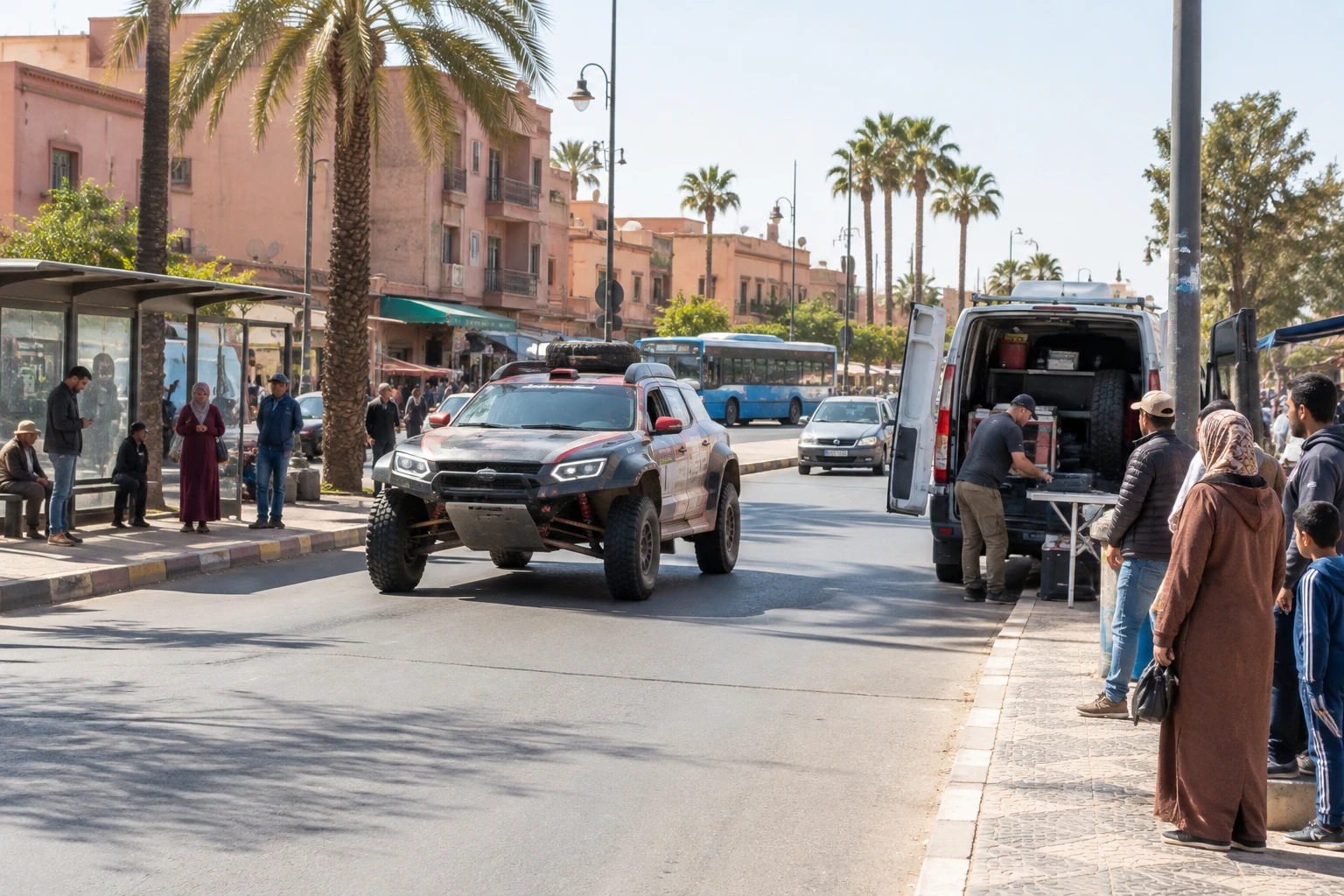
For Morocco, hosting a major international race means more than plotting a route. It requires mobilising teams, organising transport and ensuring the safety of competitors and residents alike. In January 2027, the Dakar rally-raid will cross the country after starting in Portugal, in an edition moved outside Saudi Arabia.
A route between the Algarve and Marrakech
The 49th edition is scheduled to run from 9 to 23 January 2027, subject to approval by the International Automobile Federation. The sporting start will take place in Loulé-Faro, Portugal. After a prologue and a first special stage in the Algarve, competitors will travel by boat to Morocco, heading for Nador.
The programme then includes eleven stages on Moroccan territory and a rest day in Agadir. The announced route covers a total of 7,824 kilometres, including 4,341 kilometres of special stages, or timed sections. The finish is scheduled for Marrakech. These details appear in the presentation published by the Dakar organisers and have also been reported by the Automóvel Club de Portugal, the event’s partner in Portugal.
The announced route will link several Moroccan regions. From the Oriental region in the north-east, the race is set to pass through Bouarfa, then Zagora and Agadir. It will then head south, including through areas around Smara and Dakhla, before turning back towards Marrakech. Operational details and permits therefore remain crucial to confirming that each stage can go ahead as planned.
Morocco, familiar ground for rally-raid
This return is not to unfamiliar territory. Morocco already hosts the Rallye du Maroc, a round of the World Rally-Raid Championship, and has experience organising motor competitions. Portugal also has a championship event, organised with the support of the Automóvel Club de Portugal. This shared experience helped make it possible to put a replacement solution in place within a tight schedule.
The Dakar left Africa after the cancellation of the 2008 edition, which was linked to security concerns. The race was then held in South America from 2009 to 2019, and in Saudi Arabia from 2020. The rally is therefore returning to the African continent, but it is not resuming its former Paris-Dakar route: the 2027 edition is built around Portugal and Morocco.
This distinction also matters for the host country. The announced route involves regions far from Rabat, the capital, and the main urban centres. Logistics, services and any resulting benefits will not automatically be distributed equally among cities, rural areas and local businesses.
Potential benefits, practical constraints
For the municipalities along the route, the event could generate temporary business for accommodation, restaurants, transport and technical service providers. It could also raise the profile of areas less prominent on international tourism circuits. But these benefits will depend on how much spending actually takes place locally and on the role given to Moroccan companies in organising the event.
A race on this scale also requires public and private resources: security, emergency services, road and bivouac management, team coordination and protection of the areas crossed. The organisers have announced six different bivouacs. The passage of numerous fast-moving vehicles therefore raises issues around traffic, noise and the environment, particularly for communities living near the route. Consultation and prevention arrangements will be as important as the sporting spectacle.
The event’s relocation is primarily a response to a security and scheduling decision. On 25 October, Amaury Sport Organisation and the Saudi Motorsport Company announced that the 2027 edition would not be held in Saudi Arabia, citing regional events. They said at the time that the rally would return to the Kingdom in 2028 for its 50th edition. The statement does not detail the specific risks behind the change. This general wording should therefore not be turned into an assessment or a more precise explanation than the established facts support.
An African round in a world championship
Dakar 2027 is set to open the season of the FIA and FIM World Rally-Raid Championships, governed by the international automobile and motorcycle federations. For Morocco, the stakes therefore go beyond hosting a high-profile competition: the country also aims to strengthen its place in a sporting calendar in which organisers are looking for terrain, infrastructure and partners capable of hosting long events.
This regional significance does not mean that the event represents Africa as a whole. The route remains a competition organised between two countries, with local benefits still to be measured. The contrast between a European start and a long stretch in Morocco nevertheless highlights African countries’ ability to host international sporting events, while raising a central question: what share of the value created will remain in the host communities?
The next points to watch are final approval of the dates by the sporting authorities and confirmation of local arrangements along the route. The Automóvel Club de Portugal said that scrutineering and initial operations would be concentrated in the Algarve and Baixo Alentejo, before the transfer to Morocco. For the Moroccans concerned, the tangible results will then be reflected in how the event is organised on the ground, the involvement of local service providers and the management of its impact on residents.



