Algeria
 Egypt
 Libya
 Sudan
 Tunisia
 Benin
 Burkina Faso
 Cabo Verde
 Côte d'Ivoire
 Ghana
 Guinea
 Guinea-Bissau
 Liberia
 Mali
 Mauritania
 Niger
 Nigeria
 Senegal
 Sierra Leone
 The Gambia
 Togo
 Cameroon
 Central African Republic
 Chad
 DR Congo
 Equatorial Guinea
 Gabon
 Republic of the Congo
 São Tomé and Príncipe
 Burundi
 Comoros
 Djibouti
 Eritrea
 Ethiopia
 Kenya
 Madagascar
 Malawi
 Mauritius
 Mozambique
 Rwanda
 Seychelles
 Somalia
 South Sudan
 Tanzania
 Uganda
 Angola
 Botswana
 Eswatini
 Lesotho
 Namibia
 South Africa
 Zambia
 Zimbabwe
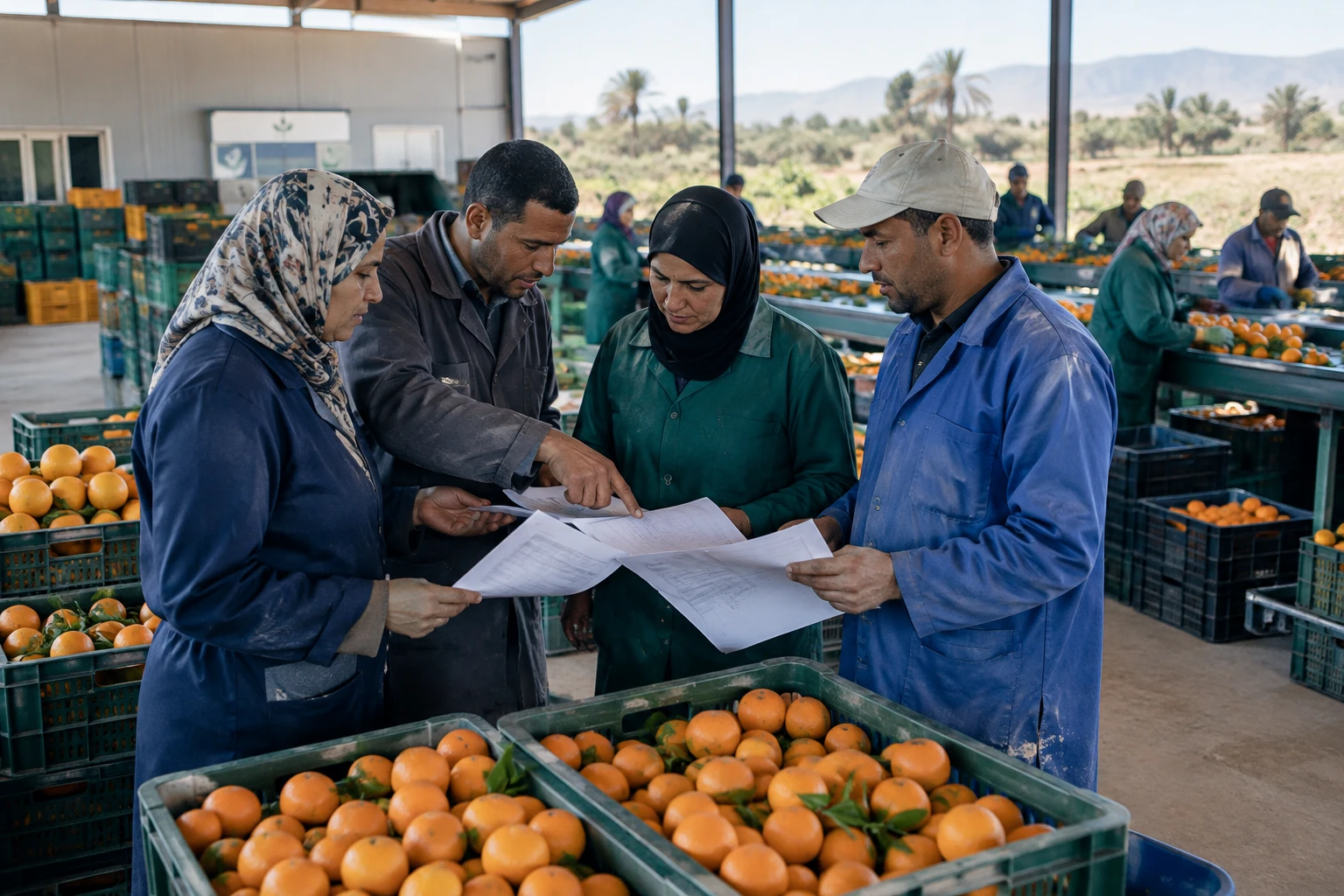
Can a cooperative work with public authorities without losing control over its decisions? In Morocco, the question touches on governance rules, access to support schemes and members’ ability to hold their elected representatives to account.
A principle of autonomy enshrined in the rules
The debate takes on particular significance in the Souss region, where agricultural and agri-food cooperatives connect producers, employees and markets. In Taroudant, COPAG illustrates the economic importance an organisation founded by a group of farmers can attain. But a cooperative’s size or success is not enough to establish whether it is independent — or not.
In Morocco, Law No. 112-12 governs cooperatives and incorporates seven internationally recognised cooperative principles. The fourth is autonomy and independence. It does not prohibit relations with the state: it requires agreements, external funding and partnerships to preserve the democratic control of members.
The distinction is essential. A meeting with a governor, an administration or an elected official does not, in itself, prove a loss of autonomy. The practical question is who sets priorities, who approves agreements and how members can hold their representatives to account.
Official appearances are not enough to draw conclusions
An opinion piece about a cooperative in Taroudant describes its president’s repeated appearances alongside local authorities at public ceremonies, including the Eid prayer. The author sees this as evidence of political proximity that could weaken the organisation’s independence.
This is an accusation and an interpretation. Available evidence does not make it possible to establish independently that the cooperative in question has lost its autonomy, or that its members have been deprived of their decision-making power. Regular contact with public officials is not enough to substantiate these claims. Observable facts, formal rules and judgements about a political relationship must be distinguished.
The word “makhzen”, used in Moroccan debate to refer to state power and its administrative networks, carries historical and political weight of its own. It can shed light on criticism of the concentration of power, but it is no substitute for evidence. To assess a specific situation, it is necessary to examine bylaws, meeting minutes, funding decisions and internal oversight mechanisms.
The state also supports the cooperative sector
The Office for the Development of Cooperation (ODCO), a public body tasked with supporting the sector, provides legal guidance and capacity-building, among other services. Its board of directors includes several state representatives, including the Ministry of the Interior, as well as institutions and representatives of the cooperative sector.
This composition shows that cooperatives operate in a framework where public authorities and member organisations interact. It does not, in itself, prove interference in the management of any individual organisation. It does, however, raise a legitimate governance question: how can public support be kept transparent while ensuring cooperatives retain control over their choices?
For smaller organisations, public services can facilitate their creation, access to legal information and professionalisation. For larger organisations, the challenges multiply: negotiating funding, structuring product processing, accessing markets and representing a large membership. In both cases, the quality of internal rules matters as much as external relations.
Member oversight is at the heart of the issue
Autonomy is measured first and foremost in day-to-day operations. Can members take part in assemblies, vote, consult documents and challenge decisions? Do leaders report on partnerships and the use of resources? Do internal elections allow for genuine changes in leadership? These are the factors that make it possible to assess governance, rather than visible proximity to an authority alone.
The effects of inadequately scrutinised governance would not be the same for everyone. Producer-members may be subject to decisions they have not approved. Employees and operational managers have to work within the choices made by leaders. Public partners, meanwhile, may provide resources or institutional access, but their support should not replace collective decision-making.
Conversely, transparent cooperation with public authorities can help an organisation consolidate its activities, provided members set the terms. The issue, then, is not to cut cooperatives off from the state. It is to maintain a clear line of accountability between public partnerships and internal democratic power.
An issue for Morocco that goes beyond Taroudant
The debate concerns the role of the collective economy in Morocco’s regional development. In agricultural regions, cooperatives can organise production, strengthen members’ bargaining power and create value beyond individual farms. Their strength, however, depends on rules that work in practice, not just principles set out in legislation.
The question also matters across Africa. In several countries, cooperatives work with administrations, local authorities and funding programmes. The international principle of autonomy offers a common benchmark: partnerships are compatible with the cooperative identity if members retain democratic control. For Morocco, the next things to watch are therefore concrete: transparent decision-making, member participation and the ability of cooperative bodies to account for their actions.