
 Algeria
 Egypt
 Libya
 Sudan
 Tunisia
 Benin
 Burkina Faso
 Cabo Verde
 Côte d'Ivoire
 Ghana
 Guinea
 Guinea-Bissau
 Liberia
 Mali
 Mauritania
 Niger
 Nigeria
 Senegal
 Sierra Leone
 The Gambia
 Togo
 Cameroon
 Central African Republic
 Chad
 DR Congo
 Equatorial Guinea
 Gabon
 Republic of the Congo
 São Tomé and Príncipe
 Burundi
 Comoros
 Djibouti
 Eritrea
 Ethiopia
 Kenya
 Madagascar
 Malawi
 Mauritius
 Mozambique
 Rwanda
 Seychelles
 Somalia
 South Sudan
 Tanzania
 Uganda
 Angola
 Botswana
 Eswatini
 Lesotho
 Namibia
 South Africa
 Zambia
 Zimbabwe
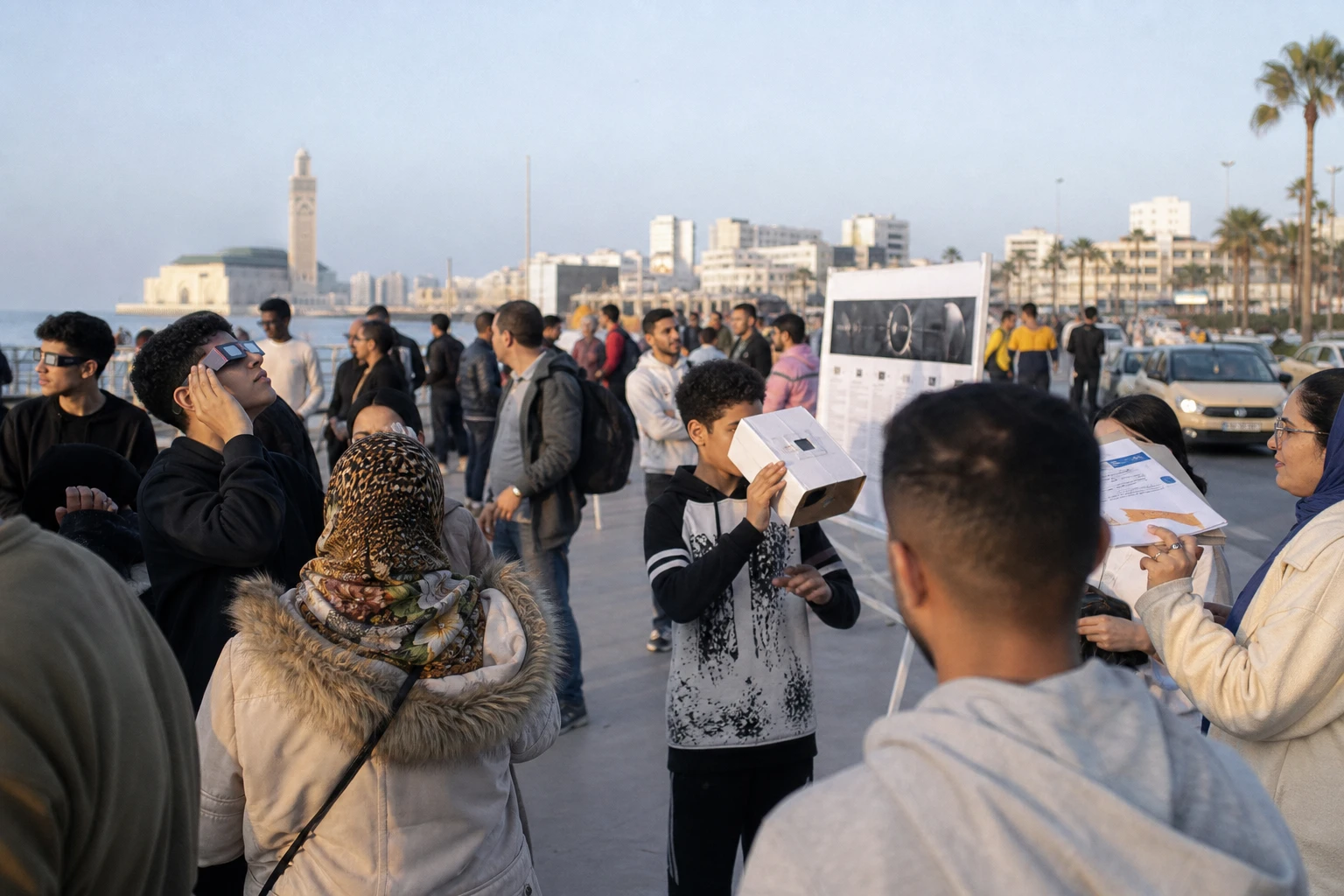
An evening when the sky becomes a public talking point
In Casablanca, sunset will not be the only moment to look forward to this Wednesday, 12 August 2026. In the late afternoon, Moroccans curious about science, as well as casual passers-by, will see a rare phenomenon turn daylight into a clear, delicate solar crescent. In major cities, moments like this take astronomy out of the laboratory and bring it into the street.
Morocco is not in the path of totality for the eclipse on 12 August 2026. But it is among the places where the Sun will be partially obscured in the evening, visible from the Atlantic coast and across a large part of the Kingdom. In Casablanca, astronomical calculations put the start at around 18:48, the maximum at 19:43 and the end at around 20:19 or 20:20, depending on the estimates consulted. The maximum obscuration will reach about 89% of the solar disc.
Morocco on the global eclipse map
On 12 August 2026, totality will be visible elsewhere, notably in Spain, Iceland and parts of the North Atlantic. Morocco’s interest is different but real: the Kingdom is in the zone of partial visibility, making it a sought-after viewing location for the public and amateur researchers alike. NASA also says that the next major total eclipse visible in North Africa will take place on 2 August 2027, with a path that will pass through Morocco, among other places.
The 2026 event therefore serves as a dress rehearsal. In Moroccan scientific circles, next year’s event is already seen as a showcase for science outreach, astronomical observation and welcoming the public. The country has already begun preparing for this period with several public-engagement initiatives in Casablanca and elsewhere.
What is planned in Casablanca
A supervised viewing event has been announced in Casablanca by the Attarik Foundation, a Casablanca-based organisation devoted to meteorites, planetary science and astronomy. The organisation said it had received a very large number of requests, and that places quickly sold out. It has also prepared observation glasses that meet the standards, an essential point for a phenomenon that should never be viewed with the naked eye without suitable protection.
The foundation also recalls a simple rule: to view an event like this safely, people must use filters designed for the Sun or use indirect projection, for example with a piece of cardboard pierced with a small hole and a white surface. Ordinary sunglasses are not enough. NASA’s guidance is clear: it is never safe to look directly at a partial eclipse without specific protection.
For events of this kind, public demand quickly outstrips the organisers’ capacity. This says something broader about Casablanca and, beyond it, urban Morocco: there is an appetite for science, but access to well-supervised events remains limited. When an astronomical phenomenon becomes a neighbourhood outing, a beach or seafront promenade becomes a space for shared science education.
An educational challenge as much as a spectacle
The point is not only to admire a celestial event. It is also to explain calmly what is happening. A solar eclipse occurs when the Moon passes between the Earth and the Sun. Depending on where one is, the Sun may be completely obscured or only partially covered. Morocco will see mainly a partial eclipse, while totality will be confined to a narrow path crossing other countries.
For teachers, families and pupils, the event has a double benefit. First, it makes the sky easier to understand. Second, observing it offers an entry point to concepts that are often abstract: orbit, alignment, shadow, trajectory and duration. Events like this give science communication access to ground that textbooks do not always manage to reach. The Attarik Foundation’s work is rooted in this approach, bringing science to the general public and young people.
There is another, less visible concern too: safety. Eclipse observations are often an opportunity to remind people that curiosity is no excuse for carelessness. Certified glasses, solar filters and projection methods protect the eyes from exposure that can cause lasting damage to the retina. US scientific authorities have stressed this point for years, and the advice remains the same for everyone.
What this event says about Morocco and the region
On Wednesday, 12 August 2026, Morocco will not simply be a country looking at the sky. It will also be a country preparing to turn the event into a shared learning experience. In a regional context where scientific cooperation remains uneven, events like this show that astronomy outreach can also be a tool for attracting interest, education and raising the country’s profile. Casablanca, Rabat and other Moroccan cities have a role to play as a bridge between the public and disciplines that are still too little seen.
The continental significance is clear: North Africa will be at the heart of the 2027 eclipse, and Morocco will be among the countries most exposed to this major astronomical event. Until then, the partial eclipse on 12 August will serve as a full-scale test. It will measure the ability of scientific institutions, community organisations and the media to turn a rare event into shared knowledge, without sensationalism or folklore.
The next date to watch is therefore 2 August 2027. But the evening of 12 August 2026 will already say a great deal: about the place of science in Moroccan public life, the public’s interest in astronomy and how Casablanca can become, for a moment, a continental viewing stage.



