
 Algeria
 Egypt
 Libya
 Sudan
 Tunisia
 Benin
 Burkina Faso
 Cabo Verde
 Côte d'Ivoire
 Ghana
 Guinea
 Guinea-Bissau
 Liberia
 Mali
 Mauritania
 Niger
 Nigeria
 Senegal
 Sierra Leone
 The Gambia
 Togo
 Cameroon
 Central African Republic
 Chad
 DR Congo
 Equatorial Guinea
 Gabon
 Republic of the Congo
 São Tomé and Príncipe
 Burundi
 Comoros
 Djibouti
 Eritrea
 Ethiopia
 Kenya
 Madagascar
 Malawi
 Mauritius
 Mozambique
 Rwanda
 Seychelles
 Somalia
 South Sudan
 Tanzania
 Uganda
 Angola
 Botswana
 Eswatini
 Lesotho
 Namibia
 South Africa
 Zambia
 Zimbabwe
On European supermarket shelves, labels already tell a political story
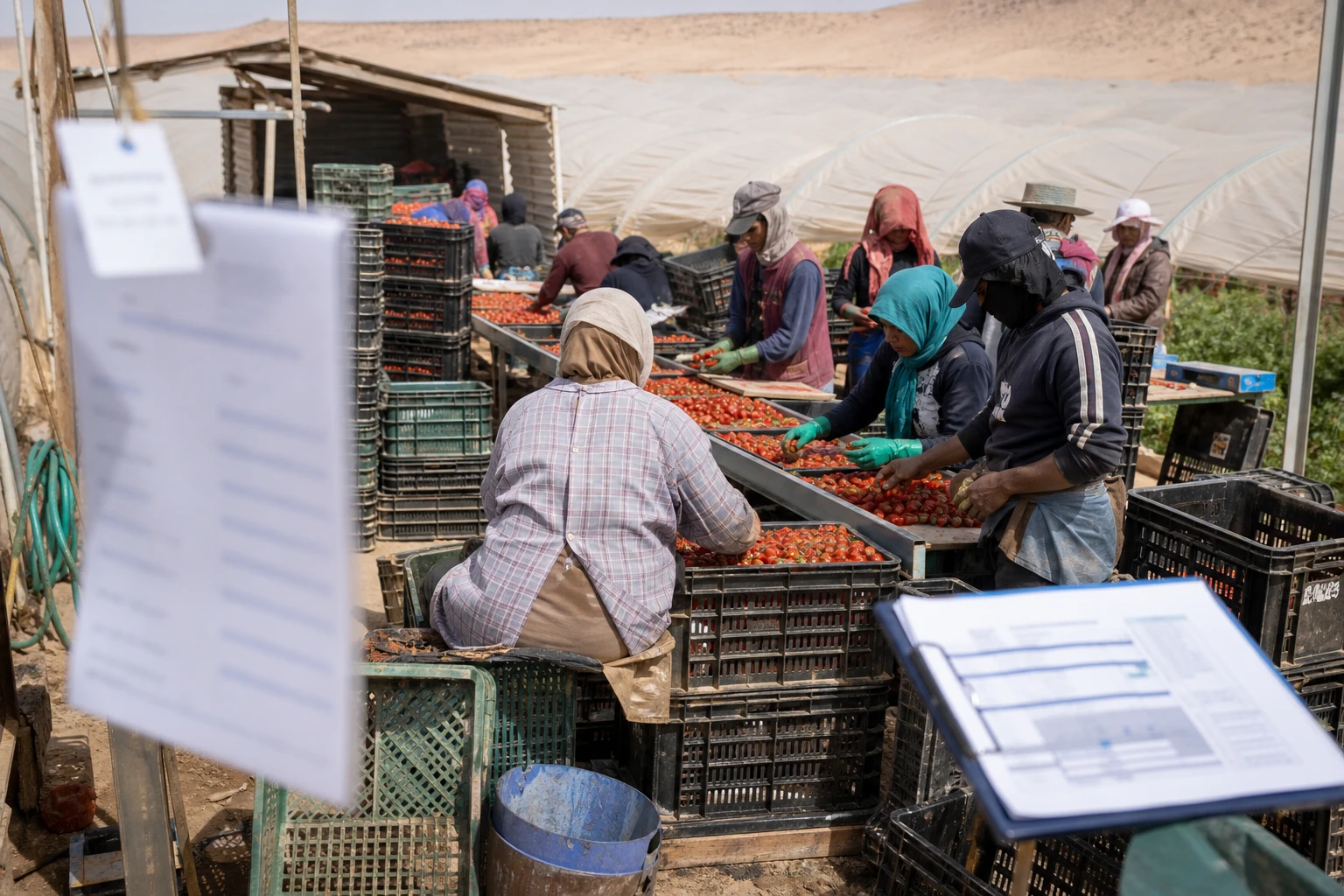
A punnet of cherry tomatoes contains more than just a price. It also offers a reading of territory, trade and law. This is particularly true of fruit and vegetables grown in Western Sahara and sold on the European market, where origin labelling has become a sensitive issue for producers, retailers and consumers. The issue also concerns Morocco, whose capital Rabat defends the economic integration of its southern provinces as part of its development path.
The case goes far beyond cherry tomatoes. It touches on Western Sahara’s place in EU-Morocco trade, how the European Union applies its own consumer information rules, and agricultural investment around Dakhla. It also has wider implications for North Africa, bringing together customs policy, food security, irrigation, energy and export strategy in an Atlantic region that has become increasingly contested.
What EU law says, and what it means at the Union’s borders
The starting point is a court ruling. On 4 October 2024, the Court of Justice of the European Union ruled in case C-399/22 that melons and tomatoes harvested in Western Sahara must be labelled as originating in « Western Sahara », not « Morocco ». In other cases related to the EU-Morocco agreement, the Court also confirmed that Western Sahara is treated separately from Morocco under EU law.
Brussels then opted for a practical solution. Delegated Regulation (EU) 2025/2652, adopted on 16 October 2025 and published in the Official Journal on 23 December 2025, stipulates that fruit and vegetables grown in Western Sahara and placed under the control of Moroccan customs authorities must be labelled not « Morocco », but with the name of the region where they were harvested: « Dakhla Oued Ed-Dahab » or « Laâyoune-Sakia El Hamra ». The text applies to labelling within the Union and follows on from Decision 2/2025 of the EU-Morocco Association Council, signed on 3 October 2025.
France subsequently translated this rule into operational guidance. On 23 July 2026, the Directorate General for Competition Policy, Consumer Affairs and Fraud Control (DGCCRF) and customs authorities published a note stating that the two regional names must be used throughout the marketing process, without abbreviation, addition or replacement by « Morocco » or « Western Sahara » in the relevant documents. This clarification matters because the same goods may be described differently on the shelf, on the packaging, on the invoice or in the customs declaration.
Between French food sovereignty and Moroccan supply, margins remain the deciding factor
The debate is not only legal. It is also commercial. A report by France’s General Council for Food, Agriculture and Rural Areas (CGAAER), published by the French agriculture ministry, notes that in 2023 France imported around 530,000 tonnes of Moroccan tomatoes and exported around 300,000 tonnes of tomatoes, mainly to other European countries. It also points out that a significant share of Moroccan volumes enters France before being re-exported to Germany, the Netherlands or Belgium. In other words, France is not only an end market; it is also a logistics hub.
The report highlights another issue: Moroccan tomatoes, particularly smaller varieties and cherry tomatoes, weigh on competition on supermarket shelves, especially during the domestic growing season. The EU-Morocco customs mechanism provides for quotas and tariff preferences designed for a different market structure. The report’s authors consider that this framework offers European producers inadequate protection in high-value segments. This explains why retailers are constantly weighing up French and Moroccan products against the margin earned per centimetre of shelf space.
In shops, then, the label does not settle the matter. It may meet the requirement to provide information without resolving differences in margins, stock turnover or customer perceptions. This is where the issue takes on practical significance for French market gardeners, as well as Moroccan operators, who have built an export-oriented supply chain around Dakhla, backed by major investment in water and logistics.
In Dakhla, agriculture is also about development and recognition
Morocco has been investing in this area for several years. The Agency for Agricultural Development, a public body under the authority of Morocco’s agriculture ministry in Rabat, describes a 5,200-hectare project in Dakhla irrigated with desalinated seawater and powered by wind energy. In June 2026, it issued a tender for 35 projects covering 1,090.1922 hectares at Bir Anzarane, in Oued Ed-Dahab province. These figures are not an abstract promise: they describe an agricultural area in the process of being developed.
For Rabat, this investment is part of an explicit development strategy for the southern provinces. For critics of the scheme, it raises questions about consent and the fair sharing of benefits in a territory that the United Nations has kept on its list of Non-Self-Governing Territories since 1963. This tension lies at the heart of the case. It does not disappear because an EU regulation opts for a more precise regional designation.
Western Sahara therefore remains a place where the economy is moving faster than political consensus. European courts have restated the legal limits. The Commission has found a labelling solution. Morocco, meanwhile, is continuing its agricultural projects in Dakhla. Amid these three dynamics, consumers see a label on a punnet; the actors involved see a power struggle over land, water and trade.
The next steps will play out on two fronts. First, there are appeals still pending before the General Court of the European Union against the 2025 decisions and the labelling regulation. Second, there is the coming winter campaign, when tomato shipments from southern Morocco and Western Sahara return to European supply chains. At that point, the question will not simply be where the tomatoes come from. It will also be how the Union, Morocco and national producers balance legal compliance, market access and stable supplies.



