Algeria
 Egypt
 Libya
 Morocco
 Sudan
 Tunisia
 Benin
 Burkina Faso
 Cabo Verde
 Côte d'Ivoire
 Ghana
 Guinea
 Guinea-Bissau
 Liberia
 Mali
 Mauritania
 Niger
 Nigeria
 Senegal
 Sierra Leone
 The Gambia
 Togo
 Cameroon
 Chad
 DR Congo
 Equatorial Guinea
 Gabon
 Republic of the Congo
 São Tomé and Príncipe
 Burundi
 Comoros
 Djibouti
 Eritrea
 Ethiopia
 Kenya
 Madagascar
 Malawi
 Mauritius
 Mozambique
 Rwanda
 Seychelles
 Somalia
 South Sudan
 Tanzania
 Uganda
 Angola
 Botswana
 Eswatini
 Lesotho
 Namibia
 South Africa
 Zambia
 Zimbabwe
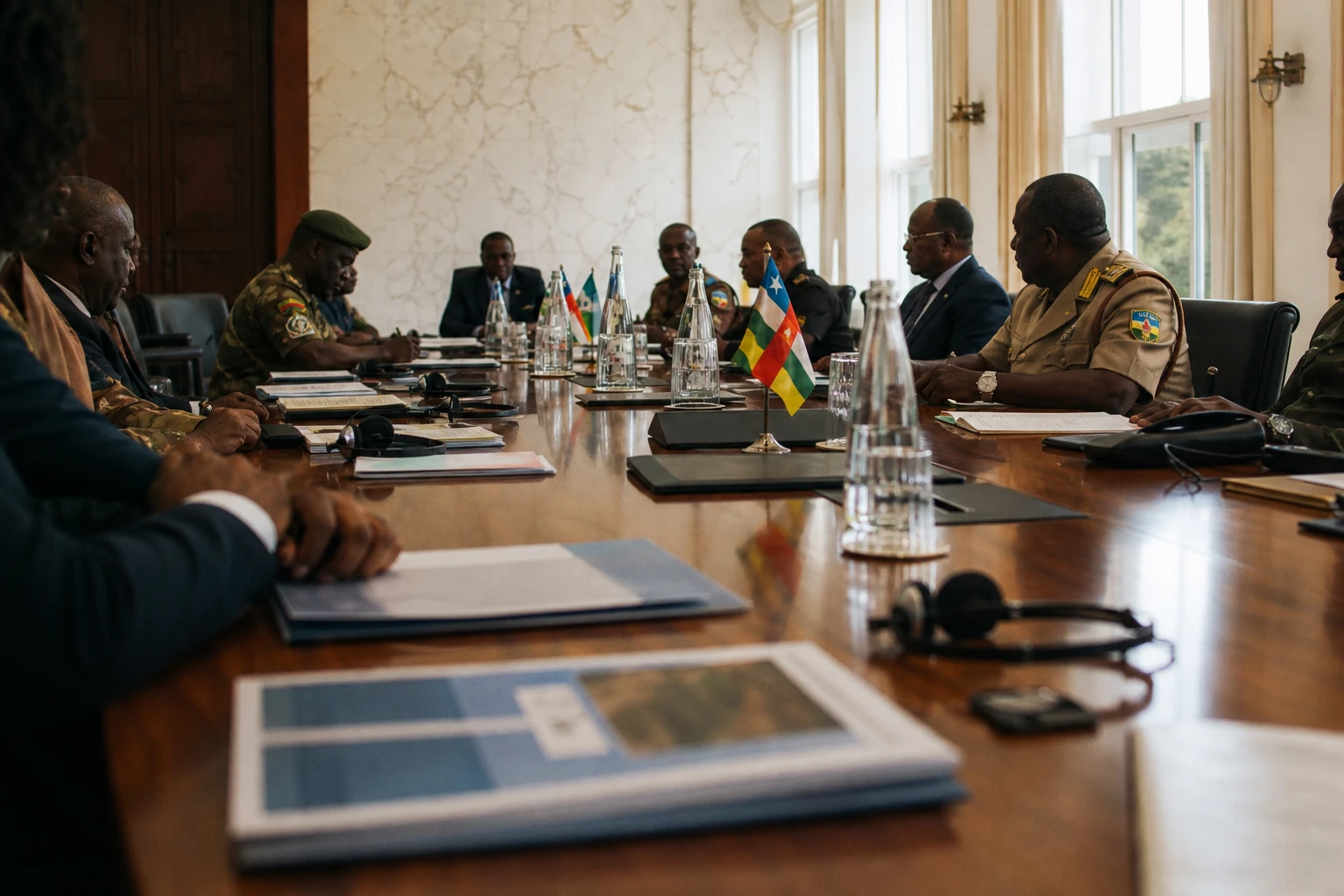
In Birao, the state seeks to regain control after the shock of Am-Dafok
In the north-east of the Central African Republic, a journey of a few dozen kilometres can be enough to measure the gap between the presence of the state and its absence. Around Birao, the capital of Vakaga, security remains fragile, roads are exposed and the border with Sudan weighs on daily life as much as on military balances. It was in this context that Prime Minister Félix Moloua chose to travel to Birao after the attack on 30 June in Am-Dafok.
Vakaga is one of the country’s most sensitive prefectures. It lies on the edge of cross-border trade, refugee movements and the movements of armed groups. For several months, MINUSCA has maintained joint patrols there with the Internal Security Forces, and before the attack it had reported efforts to improve security around Birao and Am-Dafok. This presence illustrates a simple fact: in this area, civilian protection still depends largely on coordination between the Central African authorities and UN partners.
What is known about the attack and the visit
On 30 June 2026, MINUSCA condemned an attack in Am-Dafok, a locality about 60 kilometres north-east of Birao and close to the Sudanese border. The Mission said armed elements affiliated with the Popular Front for the Renaissance of the Central African Republic, the Democratic Movement for the Rally of the Central African People, as well as other unidentified groups, had targeted the locality and fired on a MINUSCA temporary operating base. It also reported numerous injuries, without publishing a consolidated toll at that stage.
In the following days, the situation triggered an influx of displaced people around Birao and the UN base. On 15 July, MINUSCA said the crisis remained fragile and unpredictable, although relative calm had been observed from 5 July. It also said that more than 17,000 people had sought refuge near the temporary base in Am-Dafok, where humanitarian needs had become immediate: shelter, water, healthcare, food and protection.
It was against this backdrop that Félix Moloua travelled to Birao, accompanied by several government members, according to Central African and African media that reported the visit on 20 July 2026. The stated aim was to reassure residents and reaffirm the state’s presence in Vakaga. In an official statement carried by MINUSCA, the government also said it intended to strengthen its security arrangements in the area through the gradual deployment of the Central African Armed Forces, increased patrols and closer cooperation with partners on the ground.
A political response, but also a logistical and social test
The visit is more than symbolic. In the Central African Republic, official trips to border areas often serve to show that the state has not abandoned the territory’s remote regions. In Birao, the stakes are tangible: to restore a minimum level of trust after an attack that highlighted the vulnerability of the north-east, and to facilitate the return of administrative services, healthcare and commercial traffic. In a border town, even a brief security disruption quickly leads to higher prices, shortages and greater pressure on host families and displaced people alike.
The Central African government also has a direct political interest in this show of presence. Since his reappointment in May 2026, Félix Moloua has led an executive that must maintain institutional stability, manage security emergencies and prepare an already busy political agenda. The general policy statement presented to the National Assembly in early July won the confidence of MPs, evidence that a policy of continuity remains dominant at the top of the state for now. But this continuity is not enough to dispel concerns in the most exposed prefectures.
On the ground, the challenge goes beyond the military response alone. MINUSCA recalled that, after the attack, thousands of people gathered around its base and depended on the rapid delivery of humanitarian aid. On 15 July, the Mission said it had delivered more than three tonnes of relief supplies to Am-Dafock, followed by a further tonne and a half to Birao, despite the constraints of the rainy season. This reveals another aspect of the crisis: when roads become uncertain, security, health and logistics become intertwined.
What this episode says about the CAR and the region
The Am-Dafok incident is a reminder that security in the Central African Republic remains tied to its borders. To the east, its proximity to Sudan gives Vakaga particular strategic importance in an area through which refugees, traders and armed groups also pass. In this kind of setting, Bangui’s authority is measured not only by the holding of a cabinet meeting or a speech to MPs. It is measured by its ability to keep the road between the capital and the periphery open.
This episode also has regional significance. The Central African Republic belongs to CEMAC, the economic and monetary community of Central Africa, where border crises have always had effects beyond a single country. When an area such as Am-Dafok becomes unstable, cross-border trade, population movements and security cooperation are all affected. In the short term, the points to watch are the consolidation of security arrangements in Birao and the progress of displaced people’s return. In the longer term, the question is whether the state can maintain a lasting presence in Vakaga and establish mechanisms to prevent a local attack from turning into a prolonged crisis.