Algeria
 Egypt
 Libya
 Morocco
 Sudan
 Tunisia
 Benin
 Burkina Faso
 Cabo Verde
 Côte d'Ivoire
 Ghana
 Guinea
 Guinea-Bissau
 Liberia
 Mali
 Niger
 Nigeria
 Senegal
 Sierra Leone
 The Gambia
 Togo
 Cameroon
 Central African Republic
 Chad
 DR Congo
 Equatorial Guinea
 Gabon
 Republic of the Congo
 São Tomé and Príncipe
 Burundi
 Comoros
 Djibouti
 Eritrea
 Ethiopia
 Kenya
 Madagascar
 Malawi
 Mauritius
 Mozambique
 Rwanda
 Seychelles
 Somalia
 South Sudan
 Tanzania
 Uganda
 Angola
 Botswana
 Eswatini
 Lesotho
 Namibia
 South Africa
 Zambia
 Zimbabwe
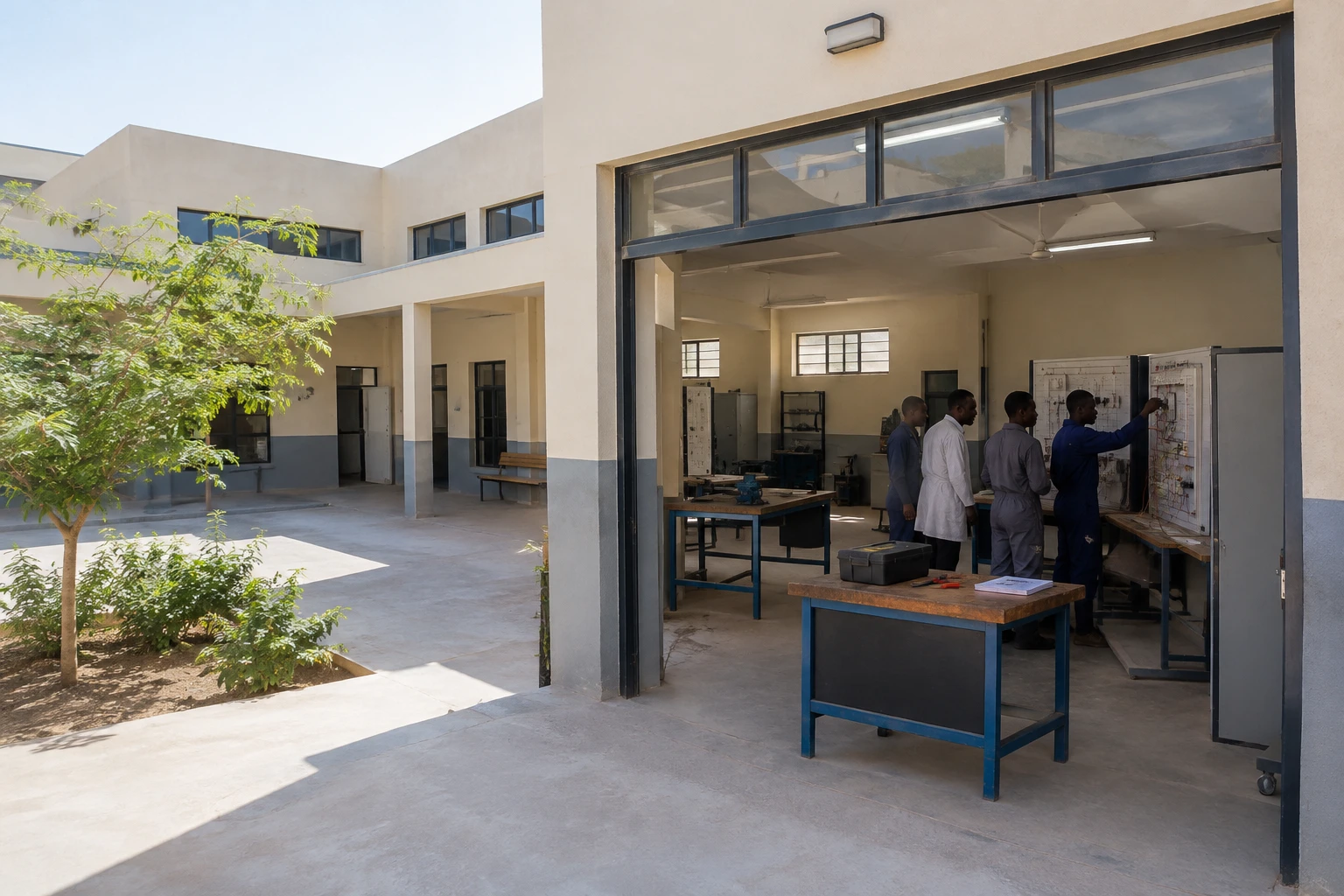
A technical qualification can open the door to a workshop, a mine or a factory. But it does not guarantee a job. In Mauritania, the challenge is now to bring training rooms closer to the places where skills are actually needed.
In Nouakchott, a school set to work with businesses
On 2 November 2026, Mauritania and France signed a €4 million memorandum of understanding to modernise Nouakchott’s Industrial Technical Education and Vocational Training School. The funding, estimated at around 180 million new ouguiyas, is intended to support equipment, trainers and the adaptation of courses to market needs. The Mauritanian News Agency reports that the project is targeting professions including refrigeration, electrical work, welding and carpentry. The official Mauritanian statement on funding for the industrial school says Expertise France will implement it over three years.
The planned change is therefore not limited to replacing equipment. The project also provides for the development of internships and apprenticeships, combining classroom lessons with work experience in a company. This approach can help students acquire practical skills and understand the requirements of a job before graduating. It does, however, depend on companies agreeing to take on trainees and educational institutions monitoring the quality of their learning.
The agreement comes at a time when the Mauritanian authorities are seeking to strengthen vocational training. The National Programme for the Development of the Education System covers 2023-2030, while another project focused on youth training and employment was launched in Nouakchott in April 2026, with €43.5 million in funding announced by the Islamic Development Bank. These initiatives underline the scale of the task, but their results will also depend on tracking graduates and the availability of sustainable jobs.
Mining programmes offer opportunities, but outcomes are uneven
Work-based training already exists in some sectors. On 20 October 2026, Tasiast, operated by Canadian group Kinross, announced that it had taken on 60 apprentices for a 12-month programme in mechanics, electrical work and welding. The company says it received more than 1,885 applications. These figures come from Kinross and describe its own programme; they show the interest it has generated, but do not on their own measure the employment outcomes of all young Mauritanians. Details of Tasiast’s 2026 apprenticeship programme have been published by the company.
In Zouérate, in the north of the country, the National Industrial and Mining Company (SNIM) set up a technical training centre in 2012, offering courses leading in particular to the Certificate of Professional Aptitude (CAP) and the Higher Technician Certificate (BTS). The company says it recruited 351 young people in 2025, compared with 185 in 2024. This total refers to young people recruited by SNIM and does not specify how many graduated from the centre. It should therefore not be interpreted as an employment rate following training. SNIM’s published recruitment and training data offer a snapshot of this route into employment.
These examples illustrate real potential, but do not resolve the question of access to jobs for everyone. The 2024 Education Sector Analysis, carried out with support from UNESCO’s International Institute for Educational Planning, identifies difficulties in entering the workforce and calls for better alignment between vocational training and job opportunities. The sector report cites an employment rate of 22.5% for graduates who left Nouakchott’s industrial school in 2020 and were surveyed in 2022. This figure relates to a specific cohort and institution: it does not automatically describe the situation across all programmes or among current graduates. UNESCO’s report on Mauritania’s education sector places these results within a broader assessment.
The real test will be the quality of the jobs created
For young people, the challenge is not simply to obtain a certificate or complete an internship. It is to secure a job that matches the skills they have acquired and offers prospects for advancement. Businesses, for their part, need technicians able to work with their equipment and to their standards. Apprenticeships can bring these expectations closer together, provided training programmes are developed with several employers and do not depend on a single sector.
The concentration of examples in mining also highlights the question of how opportunities are distributed. The needs of a mining operation are not those of a repair workshop, a refrigeration company or a construction site. Over-specialised training can limit job prospects if recruitment slows. Conversely, transferable technical skills, combined with supervised internships, can serve several industries. For young people living outside Nouakchott and the mining hubs, access to institutions, equipment and host companies also matters.
The regional context reinforces this need. Mauritania belongs to the Arab Maghreb Union and is an associate member of ECOWAS, a West African economic and political cooperation organisation. Its economy and training sectors are therefore part of exchanges that extend beyond national borders. Skills mobility, recognition of qualifications and the needs of the extractive, industrial and logistics sectors make training that is both locally relevant and recognised across the region valuable.
The €4 million agreement provides a framework and resources, but its impact cannot be assessed solely by the equipment delivered. It will be necessary to know how many internships are offered, which specialisms are actually available, what proportion of graduates find jobs and how long those jobs last. Regular publication of these indicators would make it possible to compare institutions and adjust programmes with poor employment outcomes. For now, the gap between the low rate reported in Nouakchott and the recruitment figures announced by some companies mainly shows that results vary widely according to training paths and employers.