Algeria
 Egypt
 Libya
 Morocco
 Sudan
 Tunisia
 Benin
 Burkina Faso
 Cabo Verde
 Côte d'Ivoire
 Ghana
 Guinea
 Guinea-Bissau
 Liberia
 Mali
 Niger
 Nigeria
 Senegal
 Sierra Leone
 The Gambia
 Togo
 Cameroon
 Central African Republic
 Chad
 DR Congo
 Equatorial Guinea
 Gabon
 Republic of the Congo
 São Tomé and Príncipe
 Burundi
 Comoros
 Djibouti
 Eritrea
 Ethiopia
 Kenya
 Madagascar
 Malawi
 Mauritius
 Mozambique
 Rwanda
 Seychelles
 Somalia
 South Sudan
 Tanzania
 Uganda
 Angola
 Botswana
 Eswatini
 Lesotho
 Namibia
 South Africa
 Zambia
 Zimbabwe

Nouakchott is moving forward, but the road remains long
In Nouakchott, digital transformation is no longer a conference slogan. It has become a test of credibility for the Mauritanian state: serving people faster, protecting data better and reducing dependence on paper-based procedures. In this area, the country is seeking partners that have already made progress. The Sultanate of Oman is one such useful reference, because it combines a higher standard of online public services with a more structured cybersecurity policy than Mauritania.
This approach is part of a broader trend. For several years, Mauritania and its international partners have viewed digital technology as a lever for administrative modernisation, data sovereignty and economic attractiveness. The United Nations Development Programme has also been supporting Mauritania on digital governance since the launch of the first sectoral reforms, with an emphasis on inclusion, institutional architecture and public services.
Bilateral cooperation that also acts as a catalyst
On Wednesday 29 July, in Nouakchott, Mauritania’s Minister of Digital Transformation and Administrative Modernisation, Ahmed Salem Ould Bede, received an Omani delegation led by Ali bin Amer Al-Shadhani, Undersecretary at Oman’s Ministry of Transport, Communications and Information Technology. Discussions focused on digital transformation, cybersecurity, digital infrastructure and online public services, with a simple aim: to share Omani expertise and strengthen the capabilities of Mauritania’s administration.
The meeting was not an isolated event. In November 2024, the two countries had already agreed to activate a memorandum of understanding and turn their closer ties into concrete projects, particularly in cybersecurity, the digital economy and the modernisation of public administrations. In Nouakchott, this cooperation is therefore taking the form of technical work, not just diplomacy.
The choice of Oman is no accident. In the United Nations E-Government Survey 2024, Oman ranks 41st globally with an EGDI score of 0.8576, while Mauritania is 165th with 0.3491. In other words, there is a real gap between the two countries in the maturity of digital services, online access and technical architecture.
What the rankings say, and what they do not
The ranking does not measure everything, but it provides a useful snapshot. The same report places Oman in a far higher category than Mauritania. The cybersecurity gap is also telling. The International Telecommunication Union says its Global Cybersecurity Index assesses five areas: legal frameworks, technical measures, organisation, capacity development and cooperation. On this basis, Oman is cited among the best-prepared countries, while Mauritania remains behind, despite progress on the legal front.
This matters for Mauritania because state digitalisation is only worthwhile if citizens trust the services. Data hosting, platform security and service continuity are no longer theoretical questions. In late June, the launch of Mauritania’s national cloud was presented as a major step towards reducing reliance on foreign hosting solutions and strengthening the country’s autonomy. A few days earlier, the ministry had already stressed that the national cloud should secure data and improve the availability of digital services.
The Mauritanian government is also highlighting other milestones: a Tier III data centre, an expanding national fibre-optic network, a general cybersecurity framework and several digitalisation projects. According to public statements by the ministry reported by the Mauritanian News Agency, more than 4,000 kilometres of fibre-optic cable have been added to an existing network, bringing its total length to about 7,000 kilometres. The announcement illustrates an important reality: the challenge is not only administrative but also infrastructural.
A reform affecting the state and the real economy
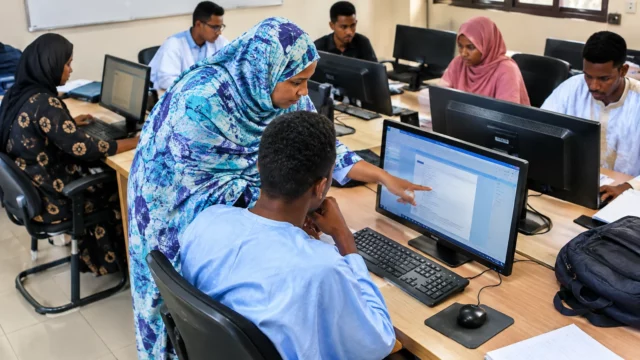
For the authorities, digital technology should shorten delays, reduce queues, improve the tracking of procedures and make the administration easier to navigate. For citizens, the stakes are even more tangible: accessing documents, tracking an application, paying for a service or submitting a request without relying on intermediaries. For businesses, especially small enterprises in the formal and informal sectors, this means fewer hidden costs and better access to public procurement, payments and government services.
But the transition will not automatically benefit everyone. Connected urban areas are moving ahead faster than remote regions. Better-equipped central government departments can absorb change more easily than decentralised services. And without improving the skills of public officials, lawyers, technicians and users, digitalisation risks creating a faster administration for a minority and a more opaque one for everyone else. The UNDP also stressed in 2021 the importance of a whole-of-government approach and capacity-building to prevent digital transformation from widening existing gaps.
Mauritania nevertheless has some advantages. The country has undertaken legislative reforms, notably on the identification of subscribers to electronic services, to better regulate cyber use and strengthen national security. It is also organising workshops on cybercrime and digital trust, a sign that the authorities understand that a digital service without a framework of trust remains vulnerable.
West African relevance, with a perspective shaped by Nouakchott
In West Africa, digital transformation has become an almost essential area for cooperation. Mauritania and Senegal, for example, worked in 2024 on a framework agreement covering digital transformation, innovation and administrative modernisation. Mauritania therefore has an interest in building more links, to the north and south, without tying its strategy to a single partner.
The continental significance is clear. The country is seeking to align itself with African standards for digital governance, as the African Union has for several years been advancing a continental strategy for digital technology and public services. From this perspective, closer ties with Oman are not simply an opening to the Gulf; they are a way for Nouakchott to save time, gain experience and lay firmer foundations for its own digital sovereignty.
What happens next will hinge on one very concrete point: the Mauritanian administration’s ability to turn these discussions into visible services. The challenge is no longer just to sign agreements. It is to ensure that Mauritanian citizens, in Nouakchott and across the rest of the country, see a difference in their day-to-day dealings with the state.