Algeria
 Egypt
 Libya
 Morocco
 Sudan
 Tunisia
 Benin
 Burkina Faso
 Cabo Verde
 Côte d'Ivoire
 Ghana
 Guinea
 Guinea-Bissau
 Liberia
 Mali
 Niger
 Nigeria
 Senegal
 Sierra Leone
 The Gambia
 Togo
 Cameroon
 Central African Republic
 Chad
 DR Congo
 Equatorial Guinea
 Gabon
 Republic of the Congo
 São Tomé and Príncipe
 Burundi
 Comoros
 Djibouti
 Eritrea
 Ethiopia
 Kenya
 Madagascar
 Malawi
 Mauritius
 Mozambique
 Rwanda
 Seychelles
 Somalia
 South Sudan
 Tanzania
 Uganda
 Angola
 Botswana
 Eswatini
 Lesotho
 Namibia
 South Africa
 Zambia
 Zimbabwe
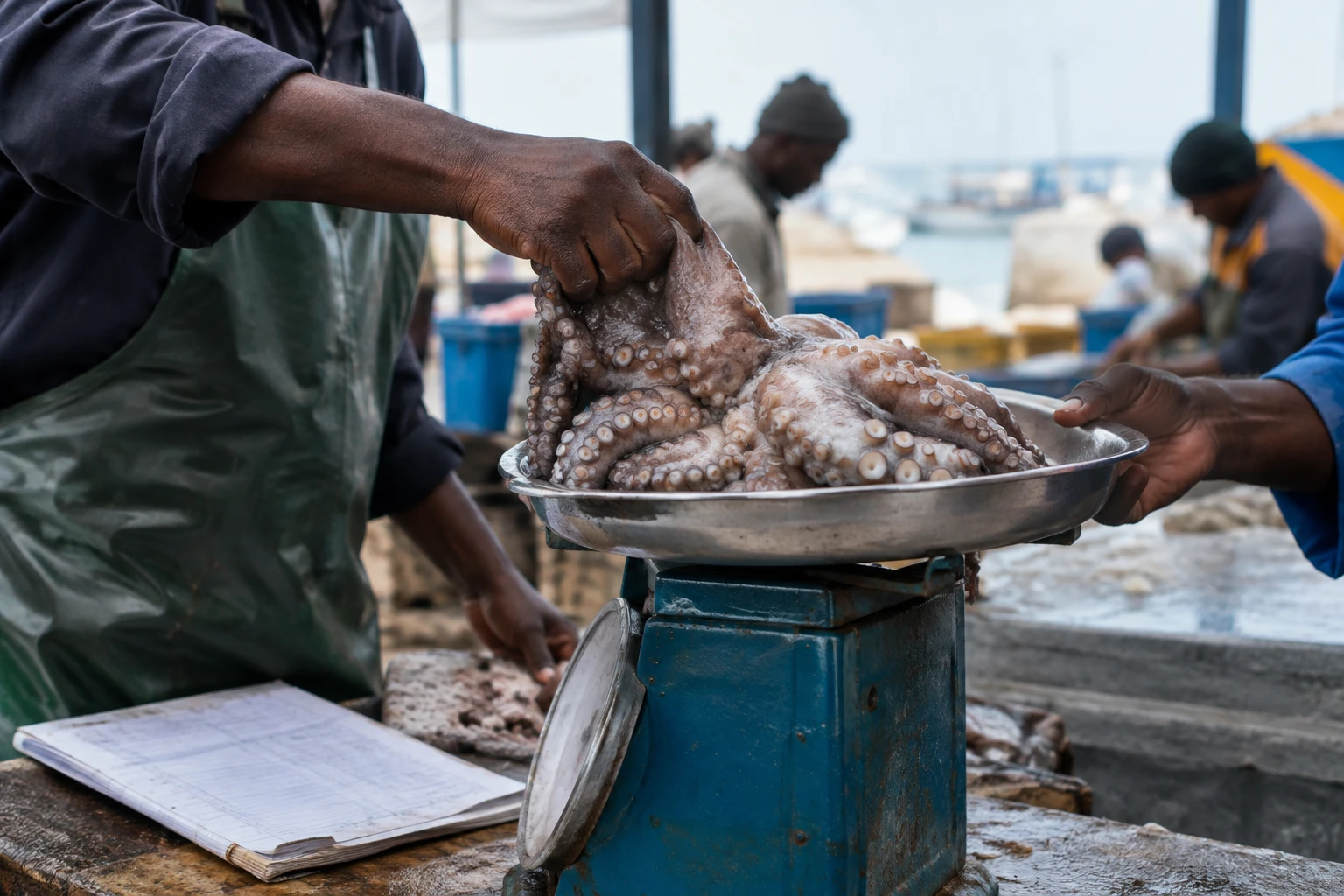
When a fishery closes, the sea gains time to replenish its resources. But in Nouakchott and Mauritanian ports, this ecological respite also means days without catches or income for some fishers and fish traders. The closure of the octopus fishery, a major export species, therefore raises a practical question: how can the stock be protected without leaving the most vulnerable people in the industry to bear most of the cost?
A closure designed around the octopus’s life cycle
In autumn 2024, the Mauritanian authorities suspended cephalopod fishing in national waters. A ministerial announcement reported on 25 September said the closure would take effect on 1 October. The measure covered octopus fishing and deep-sea bottom fishing in particular, with exceptions for some activities targeting crustaceans and black hake. Further orders were to provide details. The report on the announcement of the closure in Mauritania therefore does not confirm that it took effect on 10 October, a date cited in some accounts of the event.
The decision is based on scientific advice from the Mauritanian Institute of Oceanographic Research and Fisheries (IMROP). Common octopus breeds throughout the year, with two particularly active periods, in spring and autumn. According to the institute, biological closures aim to protect these breeding and recruitment phases—that is, the arrival of young individuals in the exploitable population. IMROP’s note on the state of the octopus stock also points out that the species has a short lifespan and grows rapidly.
Protecting young octopuses matters directly to future catches. In a monitoring survey published by IMROP in 2021, individuals weighing less than 500 grams accounted for 39% of the catches observed in the areas studied. This finding describes that specific survey; on its own, it is not an estimate of the situation in 2024. The data from this scientific survey nevertheless illustrate the value of monitoring catch sizes and changes in the stock.
Different effects on different occupations
At the Cité Plage market in Nouakchott, artisanal fishers say the closure does not affect all crews in the same way. Some can switch to other permitted species, such as squid or coastal fish. Others, who specialise in catching octopus, have fewer immediate alternatives. For them, the closure can mean a halt to their work, with no guarantee of replacement income.
Fish traders, who buy catches in bulk before selling or processing them, are also affected by the decline in landings. Their expenses do not necessarily stop when fishing does: transport, ice, fuel and the running costs of sales outlets continue to weigh on them. Professionals interviewed in accounts of the period also criticised what they considered uneven enforcement between small vessels and large ships. This allegation must remain attributed to the people concerned; the material consulted does not make it possible to measure its extent or verify each alleged infringement.
Enforcement is central to the issue. A closure genuinely protects the resource only if it applies to different categories of fishers and infringements can be detected both at sea and on landing. Otherwise, those who comply with the rules risk bearing the loss of income alone, while pressure on the stock continues. The public data consulted provide no detailed account of inspections carried out during this period.
More processing, a fairer share of value
The debate goes beyond the length of a biological rest period. Representatives of the processing sector called for access to the resource to be reorganised and for quotas that would allow local factories to operate. Their argument concerns added value: exporting raw octopus generates revenue, but creates less value and fewer local activities than processing it in Mauritania. However, the available material does not independently confirm the number of factories or the exact proportion of octopus exported without processing.
This demand highlights an economic trade-off. Reserving more catches for domestic operators could support jobs and processing in Mauritania. But quotas alone cannot guarantee that the stock will recover: they must be based on scientific assessments, transparent rules and catch monitoring. IMROP conducts observation surveys and notes that octopus yields have fluctuated sharply. Management must therefore balance businesses’ needs, the survival of artisanal fishing occupations and the resource’s capacity to replenish itself.
Access agreements for Mauritanian waters also fuel debate about economic sovereignty and control of resources. However, the different timeframes must be distinguished: contrary to what the debate in autumn 2024 suggested, the fisheries protocol between the European Union and Mauritania covered the period from 15 November 2021 to 14 November 2026. The European Union says it authorised European vessels to access several fisheries, within limits set out in the protocol, in return for a financial contribution. The official terms of the EU-Mauritania agreement should not be confused with the permits granted to Senegalese pirogues.
On this second matter, the Fisheries Transparency Initiative in Mauritania records a Mauritanian-Senegalese protocol renewed in June 2024 for one year, until July 2025. This information does not, on its own, confirm the figures of 250 pirogues and 50,000 tonnes cited by one professional during the debate at the time. Those numbers must therefore remain attributed and cannot be presented as verified quotas. The transparency report on fisheries agreements in 2024 puts this protocol in the context of the broader set of arrangements governing access to national waters.
A West African issue of stock management
Mauritania is an important player in West African Atlantic fisheries. Marine resources and fishing activities link coastal communities, the markets of Nouakchott and Nouadhibou, processors and neighbouring countries. National decisions therefore have effects beyond the country’s borders, but they are not all governed by a single regional rule: bilateral agreements and national measures regulate part of the access to these waters.
For Mauritanians, the immediate question is whether the closure will be accompanied by fair enforcement and solutions for workers who depend most on octopus. In the longer term, the credibility of management will be measured by the quality of scientific data, the transparency of quotas and changes in catches after fishing resumes. Protecting the stock and preserving incomes are not opposing goals; they nevertheless require rules that apply to everyone and a clearer distribution of the value generated by fishing.