Algeria
 Egypt
 Libya
 Morocco
 Sudan
 Tunisia
 Benin
 Burkina Faso
 Cabo Verde
 Côte d'Ivoire
 Ghana
 Guinea
 Guinea-Bissau
 Liberia
 Mali
 Niger
 Nigeria
 Senegal
 Sierra Leone
 The Gambia
 Togo
 Cameroon
 Central African Republic
 Chad
 DR Congo
 Equatorial Guinea
 Gabon
 Republic of the Congo
 São Tomé and Príncipe
 Burundi
 Comoros
 Djibouti
 Eritrea
 Ethiopia
 Kenya
 Madagascar
 Malawi
 Mauritius
 Mozambique
 Rwanda
 Seychelles
 Somalia
 South Sudan
 Tanzania
 Uganda
 Angola
 Botswana
 Eswatini
 Lesotho
 Namibia
 South Africa
 Zambia
 Zimbabwe
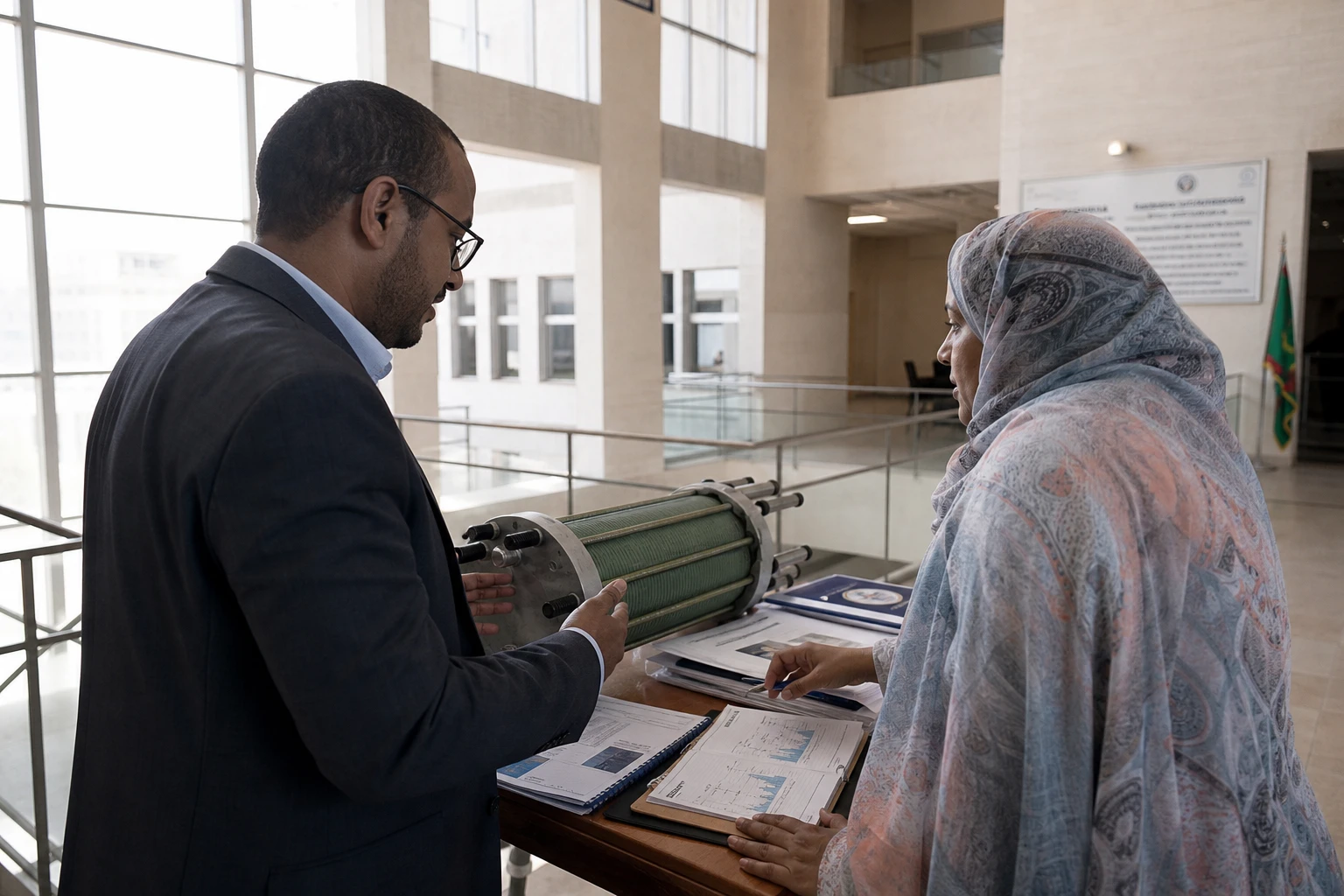
In Nouakchott, green hydrogen is gradually moving from announcements to industrial studies. Megaton Moon, a project led by Danish developer GreenGo Energy, has strengthened its technical set-up with the arrival of Chinese equipment maker Shuangliang.
The stakes go beyond signing a partnership. For Mauritania, the challenge is to turn its recognised solar and wind potential into an industrial activity capable of producing and exporting, and eventually supplying other sectors of the national economy.
A new stage ahead of the investment decision
Megaton Moon is being developed south of Nouakchott in partnership with the Mauritanian state. GreenGo Energy plans to ramp up the project in phases, with initial production targeted for the early 2030s.
As part of this, Shuangliang is to contribute to the design of the hydrogen production systems. The Chinese group will also take part in feasibility studies and the integration of the various equipment: renewable electricity, electrolysis, water treatment and ammonia production.
Electrolysis separates hydrogen and oxygen using electricity. When powered by renewable sources, it makes it possible to produce so-called “green” hydrogen without directly using fossil fuels.
The partnership is also expected to prepare the FEED. This detailed engineering phase sets out the design of the facilities, the equipment required, estimated costs and the main technical parameters ahead of a final investment decision.
GreenGo Energy describes this stage as a way to take Megaton Moon from concept to a more bankable project. For investors, the distinction is essential. An announced capacity does not yet guarantee that a plant will be built.
Planned capacity on the scale of an industrial complex
At full capacity, Megaton Moon is to comprise 6 gigawatts of electrolysis, 6.8 gigawatts of onshore wind and 6.3 gigawatts of solar photovoltaics. The project targets annual production of around 4 million tonnes of green ammonia.
Ammonia can be used as a fertiliser. It can also carry hydrogen in a form that is easier to store and export. This approach addresses the difficulty of transporting pure hydrogen over long distances.
The first phase would be much smaller. It envisages 500 megawatts of electrolysis, 600 megawatts of wind and 600 megawatts of solar photovoltaics. GreenGo Energy estimates green ammonia production at around 355,000 tonnes a year for this stage.
However, the figures released by the partners are not entirely consistent. Mauritania’s Ministry of Energy has referred to a first phase of close to 339,000 tonnes a year. The difference may be explained by technical assumptions or changes to the scope of the project.
GreenGo Energy’s timetable provides for a detailed engineering phase in 2027, a final investment decision in 2028 and initial production around 2031. No definitive financing has been announced at this stage.
Shuangliang’s role in the technology chain
Shuangliang is part of a Chinese group specialising in energy equipment. The company manufactures, among other things, alkaline electrolysers, a technology already used in several industrial hydrogen projects.
Its involvement could help GreenGo Energy refine its choice of equipment and how it is integrated. It is also expected to provide more robust data on operating costs, water consumption and the reliability of the facilities.
The Chinese group is already involved in a green fertiliser project in Kenya, where two electrolysis systems with a stated capacity of 1,000 normal cubic metres per hour are to be supplied. This African reference lends industrial credibility, although it does not determine whether Megaton Moon will secure financing.
For Mauritania, the challenge will be to turn this foreign expertise into local skills. GreenGo Energy has announced training and professional development programmes. Their reach will depend on their funding, duration and the role actually given to Mauritanian workers and businesses.
Mauritania faces the financing challenge
The country has a major geographical advantage. Its solar and wind resources are abundant, while its Atlantic coast provides access to foreign markets. Nouakchott is seeking to attract investment in energy, mining and local processing.
The government has adopted a framework dedicated to green hydrogen and presents the sector as a lever for economic diversification. The aim is not to limit exports to electricity or raw materials, but also to produce fertilisers, steel and other derivatives.
This strategy nevertheless faces several constraints. The facilities will need power lines, roads, ports, desalinated water and storage capacity. Connections to existing infrastructure will be crucial to prevent an export project from remaining disconnected from domestic activities.
Water will be under particular scrutiny. Electrolysis uses purified water, while Mauritania already faces pressure on this resource. The developers will therefore have to demonstrate that desalination, discharge management and industrial consumption remain compatible with the needs of the population and agricultural activities.
A test of Africa’s hydrogen ambitions
Megaton Moon is part of a regional race. Several projects have been announced in Mauritania, Morocco, Egypt, Namibia, South Africa and Kenya. They target ammonia, synthetic fuels and heavy industry in particular.
Most, however, remain at preparatory stages. According to the International Energy Agency, 31 African projects could bring low-carbon hydrogen production to 1.2 million tonnes by 2030. Only one had reached a final investment decision in the assessment published in 2026.
This gap highlights the difference between announced capacity and financed capacity. High capital costs, uncertainty over buyers and a lack of suitable infrastructure are slowing decisions. Developers must also secure sufficiently long-term offtake contracts to guarantee their revenues.
Mauritania has not been a member of ECOWAS since 2000. Its regional footing therefore relies more on the Arab Maghreb Union, its relations with West Africa and its partnerships with Europe and the Gulf states. Megaton Moon could strengthen its position as a crossroads between Atlantic, Saharan and European markets.
The next milestone will be to clarify the project’s technical and financial scope. The FEED expected in 2027 will make it possible to assess whether the announced capacities can be turned into viable facilities. For Mauritania, as for the rest of the continent, this is when its industrial ambition will truly begin to be measured.