
 Algeria
 Egypt
 Libya
 Morocco
 Sudan
 Tunisia
 Benin
 Burkina Faso
 Cabo Verde
 Côte d'Ivoire
 Ghana
 Guinea
 Guinea-Bissau
 Liberia
 Mali
 Mauritania
 Niger
 Nigeria
 Senegal
 Sierra Leone
 The Gambia
 Togo
 Central African Republic
 Chad
 DR Congo
 Equatorial Guinea
 Gabon
 Republic of the Congo
 São Tomé and Príncipe
 Burundi
 Comoros
 Djibouti
 Eritrea
 Ethiopia
 Kenya
 Madagascar
 Malawi
 Mauritius
 Mozambique
 Rwanda
 Seychelles
 Somalia
 South Sudan
 Tanzania
 Uganda
 Angola
 Botswana
 Eswatini
 Lesotho
 Namibia
 South Africa
 Zambia
 Zimbabwe
A case that goes beyond one man
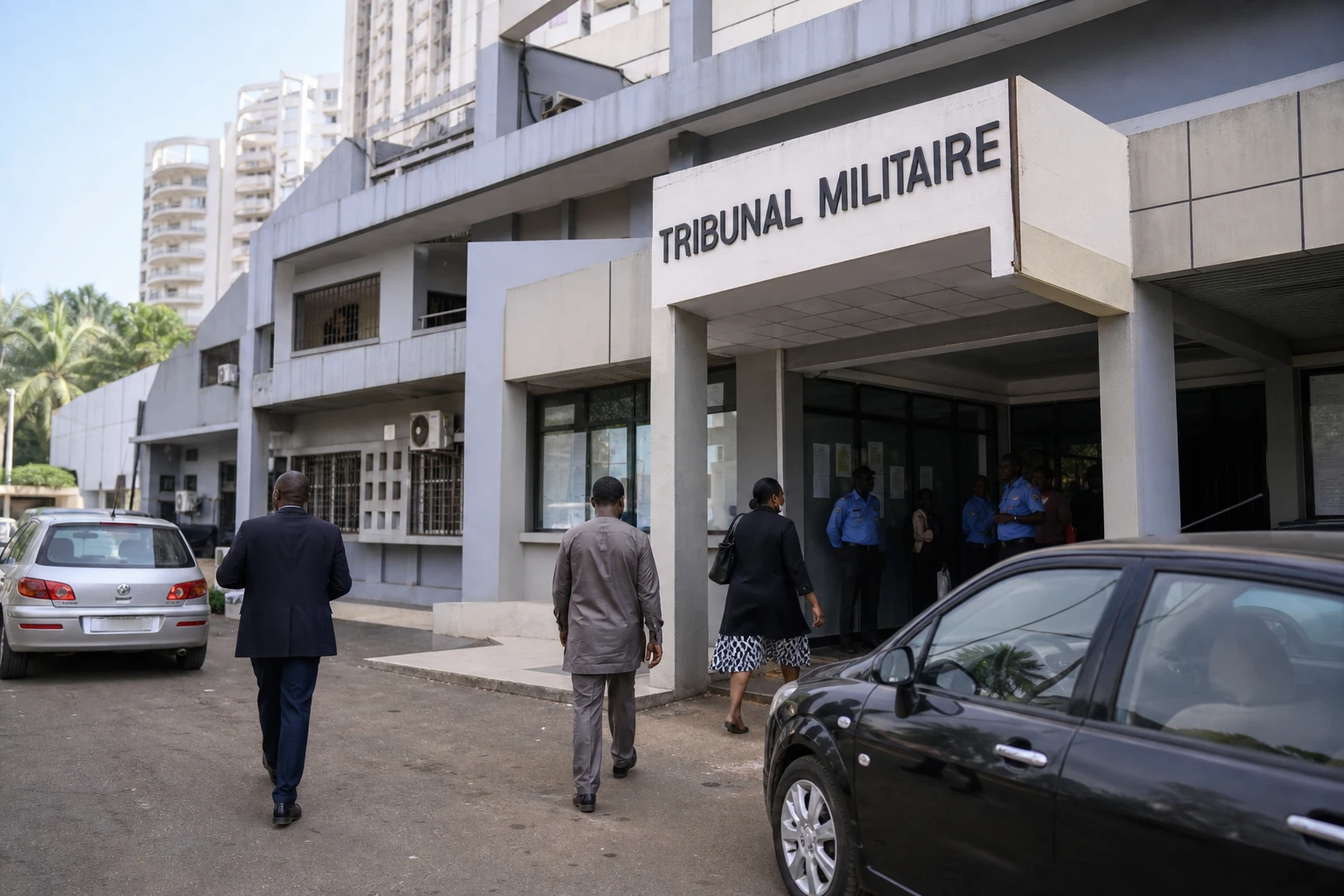
In Cameroon, the Martinez Zogo case remains a test of credibility for the military justice system and for the protection of critical voices. Three years after the journalist was abducted in Yaoundé, the proceedings are no longer focused solely on the alleged perpetrators. They also examine the chain of responsibility, right at the top of the intelligence services.
The country is following the case closely because it touches on two sensitive issues at once: press freedom and the management of the security apparatus. Cameroon, a Central African state and member of CEMAC, is already facing security tensions in several regions. In this context, a trial linked to the murder of a widely listened-to radio host takes on national, as well as regional, significance.
On 14 July 2026, before Yaoundé’s military court, Colonel Jean-Pierre Otoulou recounted the first stages of the investigation opened after Martinez Zogo’s disappearance. According to several consistent reports, he described evidence which, in his view, placed former DGRE chief Léopold Maxime Eko Eko at the centre of a possible awareness of the events. The hearing later resumed in a tense atmosphere, with the defence disputing any direct evidence that the former intelligence chief had given an order.
Otoulou cited several clues. First, the way Eko Eko allegedly directed investigators towards Jean-Pierre Amougou Belinga, presented as one of the main defendants. Then, the failure to open an internal investigation at the DGRE between the journalist’s abduction, the report of his disappearance and the arrest of Justin Danwe, then the service’s director of operations. Finally, an expert report on phones attributed to Eko Eko, of which only three were reportedly handed over, although he declared that he had ten.
The civil parties believe these elements form a serious body of evidence. Their lawyers argue that the former intelligence chief was not merely a distant superior, but an actor who failed to take the necessary measures to prevent the fatal outcome. The defence maintains that there is no material evidence or reliable testimony showing that he gave any order. It stresses the changing nature of Justin Danwe’s statements; he was long presented as a central link in the case.
What the trial says about Cameroon today
To understand the significance of this trial, it is necessary to return to the beginning. Martinez Zogo, whose real name was Arsène Salomon Mbani Zogo, was abducted on 17 January 2023 in Yaoundé. His body was found on 22 January 2023 at Ebogo III, on the outskirts of the capital, bearing severe signs of abuse. This reminder of the facts is important, because it triggered the wave of public outrage and the opening of a judicial investigation followed well beyond Cameroon.
As host of the programme “Embouteillages” on Amplitude FM, he spoke about corruption, public affairs and the exercise of power. From the first days, his death was seen as a grave attack on press freedom. Human Rights Watch and the African Commission on Human and Peoples’ Rights called for serious investigations, while African bodies reiterated the need to protect journalists.
The case then took on significant institutional weight. In March 2024, Yaoundé’s military court committed 17 people for trial, including Eko Eko, Justin Danwe and Jean-Pierre Amougou Belinga. Hearings on the merits began on 1 September 2025, after lengthy procedural debates. Then, in June 2026, the court showed images of the torture for the first time, a moment that made a deep impression on public opinion and heightened the gravity of the case.
This chronology highlights an essential point: the trial is not limited to identifying the perpetrators. It also requires an examination of how security services respond when a journalist disappears, how chains of command operate, and how far an institution can be held to account when suspicions reach its highest levels. In Central Africa, where the balance between state security and civil liberties often remains sensitive, this kind of proceeding quickly becomes a political as well as a judicial barometer.
For victims’ families and the journalistic profession, the stakes are tangible. The question is whether the accusations will stop with the perpetrators or extend to the actual decision-makers. For the authorities, the challenge is the opposite: to show that a case involving powerful officials can be investigated to the end without special protection. For the public, finally, the case says something about trust in institutions, in Yaoundé as well as in the country’s other major cities.
A Cameroonian case with African significance
The Martinez Zogo trial goes beyond Cameroon because it touches on a recurring continental question: how can journalists be kept safe when their investigations intersect with political, economic or security interests? The African Union and the African Commission on Human and Peoples’ Rights have already stressed, in other settings, that media protection is central to Africa’s public sphere. The Yaoundé case gives concrete form to that principle.
It also resonates in a regional environment where CEMAC states share challenges relating to governance, the circulation of information and institutional trust. The fact that the case is being heard by a military court in the Cameroonian capital adds another dimension: beyond the alleged crime, the role of the security apparatus in public order is under scrutiny.
What happens next will depend on the ability of Yaoundé’s military court to reach a decision on the basis of verifiable evidence, without being trapped by competing narratives. The next hearings will have to determine whether the evidence cited against the former DGRE chief stands up to cross-examination. This is where part of the case’s significance will be decided, in Cameroon as in other African countries where press and security cases often intersect in the same areas of uncertainty.



