
 Algeria
 Egypt
 Libya
 Morocco
 Sudan
 Tunisia
 Benin
 Burkina Faso
 Cabo Verde
 Côte d'Ivoire
 Ghana
 Guinea
 Guinea-Bissau
 Liberia
 Mali
 Mauritania
 Niger
 Nigeria
 Senegal
 Sierra Leone
 The Gambia
 Togo
 Cameroon
 Central African Republic
 Chad
 DR Congo
 Equatorial Guinea
 Gabon
 Republic of the Congo
 São Tomé and Príncipe
 Burundi
 Comoros
 Djibouti
 Eritrea
 Ethiopia
 Kenya
 Madagascar
 Malawi
 Mauritius
 Mozambique
 Rwanda
 Seychelles
 Somalia
 South Sudan
 Tanzania
 Uganda
 Angola
 Botswana
 Eswatini
 Lesotho
 Namibia
 Zambia
 Zimbabwe
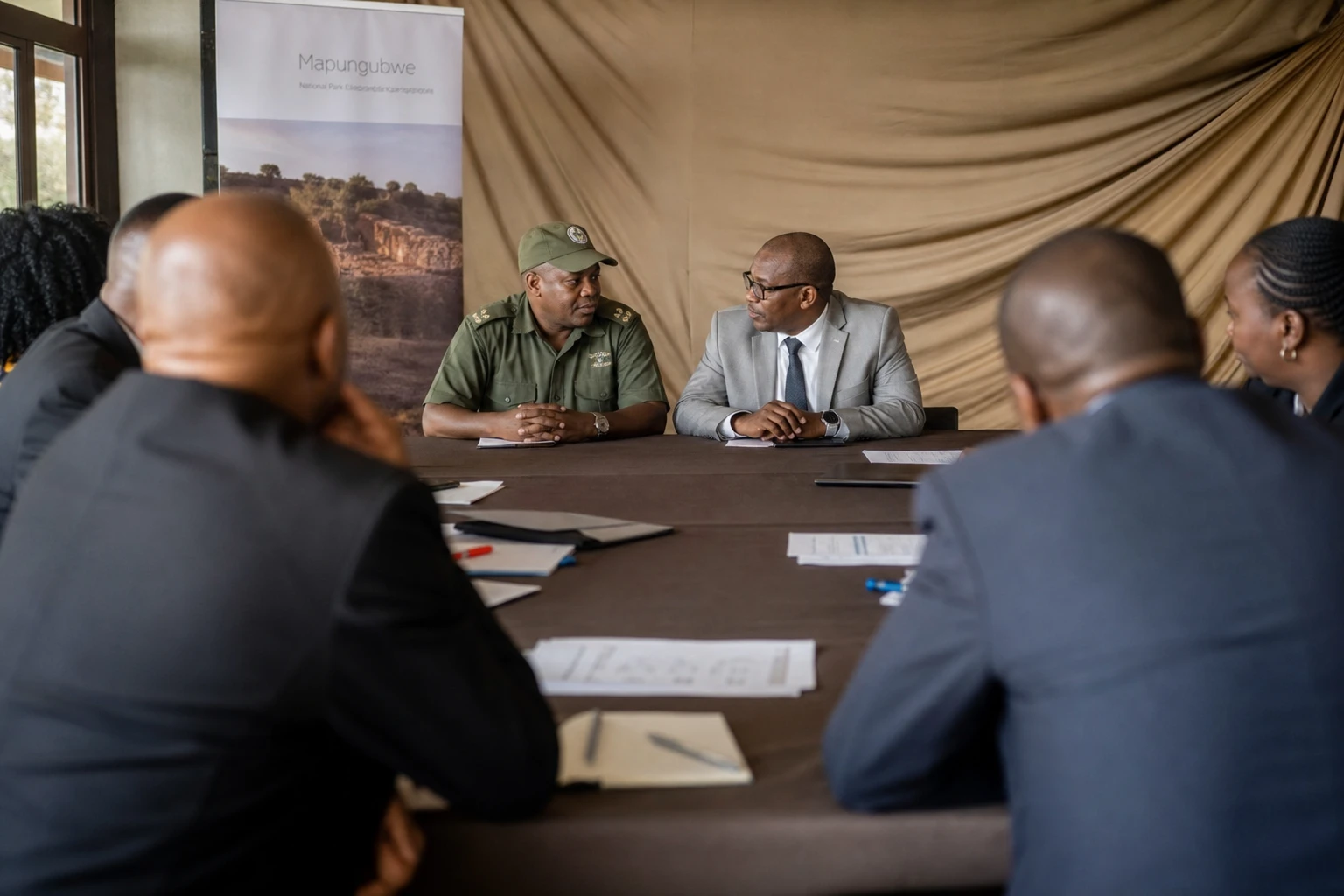
At the meeting point of three countries, a legacy that goes beyond the past
At first glance, Mapungubwe is a landscape of savannah and cliffs in the north of Limpopo. In reality, it is one of the most revealing places in the political history of southern Africa. Here, traces of an ancient power now sit alongside a national park, ecological corridors and a tourist destination of considerable heritage value. The site is a reminder that a territory can be a place of memory, a resource and a living space all at once.
For South Africa, the challenge is twofold. Pretoria must protect a heritage site listed by UNESCO as a World Heritage Site while supporting a local economy built on conservation, research and tourism. For the region, Mapungubwe is also a borderland site shared with Botswana and Zimbabwe, in an area where questions of biodiversity, the movement of species and cross-border cooperation are tangible, not theoretical.
An African kingdom, far-reaching trade and a complex social structure
Reference sources date Mapungubwe’s rise to between 900 and 1300 AD, with the emergence of southern Africa’s first great indigenous kingdom. UNESCO describes a major political centre, organised around royal hills, residential areas and trade networks that linked the continent’s interior to the ports of the Indian Ocean, and then to Arabia, India and China.
This long-distance economy was not based on a static image of Africa, but on control of routes, resources and social hierarchies. Gold and ivory were exchanged for glass beads, fabrics and Chinese porcelain. At Mapungubwe, the separation between the elites who lived on the hill and the communities below also points to a stratified society, with centralised forms of power long before colonisation.
The golden rhino, held in the collections of the University of Pretoria, has become the emblem of this sophistication. The institution’s website notes that this unique piece belongs to a wider collection of gold artefacts associated with the Mapungubwe excavations and the region’s early state societies.
A national park, and a space for conservation and movement
Mapungubwe National Park was proclaimed in 1998, and the cultural landscape was listed as a World Heritage Site in 2003. SANParks says the park was subsequently renamed Mapungubwe National Park and officially opened on 24 September 2004, South Africa’s Heritage Day. This timeline says something about the country’s heritage policy: making the past a public asset, while also using it to support environmental protection.
The site is more than its ruins. SANParks says Mapungubwe is still home to large wildlife, including elephants and leopards, as well as rich birdlife, with 447 bird species recorded in the park and 25 mammals listed on the visitor sightings list. Management of the site must therefore balance tourist access, conservation and ecological security in a sensitive environment at the heart of a cross-border corridor.
The park is also actively managed. SANParks has announced renovation work at Leokwe Camp and Mazhou Campsite in 2026, a sign that this is not a static museum but a living facility that requires maintenance and investment. For visitors, this may mean temporary disruption. For local residents and operators, it is above all about the quality of the visitor experience, road access and economic benefits.
What Mapungubwe says about South Africa today
Mapungubwe is not only a major archaeological site. It is also a test of South Africa’s ability to protect its heritage without severing it from its territory. SAHRA, the South African agency responsible for managing heritage resources, places the site within the framework of the National Heritage Resources Act and emphasises protection, community consultation and the promotion of national heritage. In other words, the question is not only what should be preserved, but with whom and for whom.
In Limpopo, this balance matters greatly. The province benefits from more than its image. It also gains from jobs linked to guides, accommodation, research, park services and local supply chains. Nationally, Mapungubwe offers a showcase for a different reading of South African history: one in which South Africa does not begin in 1652 or in colonial archives, but in ancient forms of statehood, trade and social organisation.
The issue is also regional. The site lies where South Africa, Botswana and Zimbabwe meet, in an area where landscapes, wildlife and cultural heritage call for ongoing cooperation. UNESCO also notes that today’s borders do not align with the history of the ancient kingdom. This makes Mapungubwe a useful focus for SADC, the Southern African Development Community, which is increasingly emphasising links between heritage, tourism and cross-border conservation.
A continental significance that goes beyond the ruins
Mapungubwe’s significance extends beyond South Africa. The site is a reminder of how early African societies took part in the economic networks of the Indian Ocean. It also shows that political power, urbanisation and symbolic prestige have deep roots on the continent. This perspective matters because it continues to challenge accounts that reduce African history to the colonial period alone.
At a continental level, Mapungubwe also speaks to climate and adaptation. UNESCO and SAHRA link the kingdom’s decline to a combination of climate change and the reshaping of trade routes around 1300. For Africa today, the lesson is clear: a territory’s resilience depends on water, trade, institutions and how a state protects its cultural landscapes. At Mapungubwe, this ancient past continues to shed light on very contemporary choices.



