Algeria
 Egypt
 Libya
 Morocco
 Sudan
 Tunisia
 Benin
 Burkina Faso
 Cabo Verde
 Côte d'Ivoire
 Ghana
 Guinea
 Guinea-Bissau
 Liberia
 Mali
 Mauritania
 Niger
 Nigeria
 Senegal
 Sierra Leone
 The Gambia
 Togo
 Cameroon
 Central African Republic
 Chad
 DR Congo
 Equatorial Guinea
 Gabon
 Republic of the Congo
 São Tomé and Príncipe
 Burundi
 Comoros
 Djibouti
 Eritrea
 Ethiopia
 Kenya
 Malawi
 Mauritius
 Mozambique
 Rwanda
 Seychelles
 Somalia
 South Sudan
 Tanzania
 Uganda
 Angola
 Botswana
 Eswatini
 Lesotho
 Namibia
 South Africa
 Zambia
 Zimbabwe

At Ampasindava, in north-western Madagascar, a mining permit has reached an important milestone. But a permit guarantees neither the construction of a mine nor benefits for local residents. The rapprochement with Washington will therefore be measured less by announcements than by investment actually committed, jobs created and the share of value retained in the country.
Strategic minerals, with more steps still to come
On 12 October 2026, Harena Rare Earths announced the formalisation of the exploitation permit for its Ampasindava project. This administrative advance is not an immediate green light for work to begin: the company says environmental permits and social management plans are still required before the first pilot infrastructure is built. The company’s announcement on the Ampasindava permit also states that support from the DFC, the US development finance agency, could amount to as much as $4.84m to prepare the project.
This funding is intended, in particular, to support studies and a pilot phase. It is not yet financing for a large-scale industrial operation. The distinction matters: a pilot plant tests processes and their feasibility, while building and starting up a mine requires further capital, permits and agreements with the communities concerned. The DFC describes its support as assistance for developing the project, which could help move it towards a feasibility study. The DFC’s presentation of Ampasindava also sets out US interest in supply chains less dependent on China.
Rare earths are a group of metals used, among other things, in magnets for certain electronic equipment, electric vehicles and defence systems. For the US, diversifying supply addresses an industrial and strategic concern. For Madagascar, the challenge is to turn external interest into public revenue, local skills and economic activity that goes beyond extraction.
Revenue forecasts put forward for Ampasindava — $220m in royalties and $320m in corporate income tax — remain company projections, not income secured for the Malagasy state. They will depend on the project going ahead, its output, prices and the tax regime applied. Nearby communities, meanwhile, will also need to understand the expected effects on water, land, jobs and infrastructure before the project is scaled up.
Two projects, two models of processing
Ampasindava is not the only mining project linked to US interests. At Toliara, in the south-west, the project run by Energy Fuels under the name Vara Mada had its government suspension lifted in November 2024. The decision allowed administrative and technical work to resume, but does not in itself amount to a final investment decision. The company acquired the project in October 2024 and is still seeking to establish a development framework with the authorities.
The two projects envisage different roles for local processing. Harena plans to extract and carry out initial processing in Madagascar, before shipping the intermediate product for further treatment. Energy Fuels, for its part, plans to send Vara Mada’s monazite concentrate to its facility in Utah. This difference will affect industrial jobs, skills transfer and the value added on the island. It also makes negotiations over tax, social and environmental obligations central.
The extractive sector already contributes to the Malagasy economy, but the benefits of a project are not automatically shared between the state, companies and host areas. In Antananarivo, the authorities may seek revenue and foreign currency. In the municipalities concerned, expectations also include access to water, jobs available to local residents and protection for local livelihoods. Transparency in contracts and independent monitoring of commitments will therefore be crucial.
Trade and health: a relationship extending beyond mining
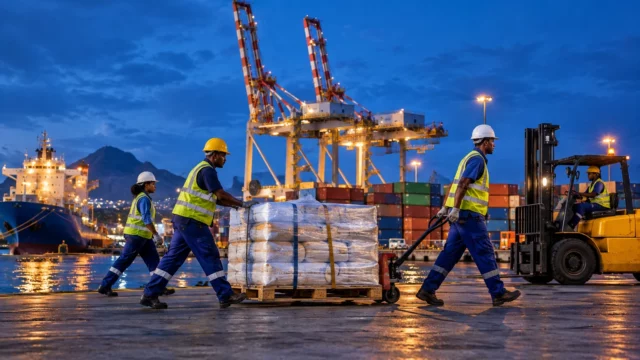
Trade with the US also includes Malagasy exports, particularly clothing and agricultural products. AGOA — a US law that, subject to conditions, grants duty-free access to certain products from eligible African countries — provides an important market. But this advantage does not offset changes in US trade policy. According to the Office of the US Trade Representative, imports of goods from Madagascar reached $695.1m in 2025, down 4.9% year on year. These figures are also published by the US Census Bureau. Trade data and Madagascar’s AGOA status thus show that a political partnership does not guarantee increased sales.
Health is another part of the relationship. An agreement signed in December 2025 provides for more than $134m in US commitments and more than $41m in Malagasy co-financing. It targets malaria, maternal and child health, and epidemic surveillance, among other areas. These amounts are multi-year commitments, not sums already paid in full. Their delivery will depend on budgets, timetables and monitoring mechanisms. Malagasy co-financing also reflects a shift towards a greater national contribution, at a time when health programmes must contend with limited public resources.
Political context will weigh on the credibility of commitments
These agreements come at a politically sensitive time. After the army seized power in October 2025, the African Union suspended Madagascar from its activities until constitutional order was restored. The Southern African Development Community (SADC), a regional organisation of which Madagascar is a member, called for an assessment mission and a co-ordinated response with the African Union and the Indian Ocean Commission. The SADC communiqué on the Malagasy crisis stresses the importance of a regional approach. Economic co-operation with Washington does not, in itself, mean political recognition of the change of power.
For Madagascar, the challenge now is to negotiate partnerships that bring in funding without abandoning its industrial, social and environmental priorities. For its partners, minerals and health also serve their own interests: securing raw materials and better containing epidemic risks. The next test will be tangible: outstanding permits, an investment decision at Toliara, actual funding for health programmes and the terms on which exporters can access the US market. The lasting significance of the rapprochement will be measured by these results, rather than by announcements.