Algeria
 Egypt
 Libya
 Morocco
 Sudan
 Tunisia
 Benin
 Burkina Faso
 Cabo Verde
 Côte d'Ivoire
 Ghana
 Guinea
 Guinea-Bissau
 Liberia
 Mali
 Mauritania
 Niger
 Nigeria
 Senegal
 Sierra Leone
 The Gambia
 Togo
 Cameroon
 Central African Republic
 Chad
 DR Congo
 Equatorial Guinea
 Gabon
 Republic of the Congo
 São Tomé and Príncipe
 Burundi
 Comoros
 Djibouti
 Eritrea
 Ethiopia
 Kenya
 Malawi
 Mauritius
 Mozambique
 Rwanda
 Seychelles
 Somalia
 South Sudan
 Tanzania
 Uganda
 Angola
 Botswana
 Eswatini
 Lesotho
 Namibia
 South Africa
 Zambia
 Zimbabwe
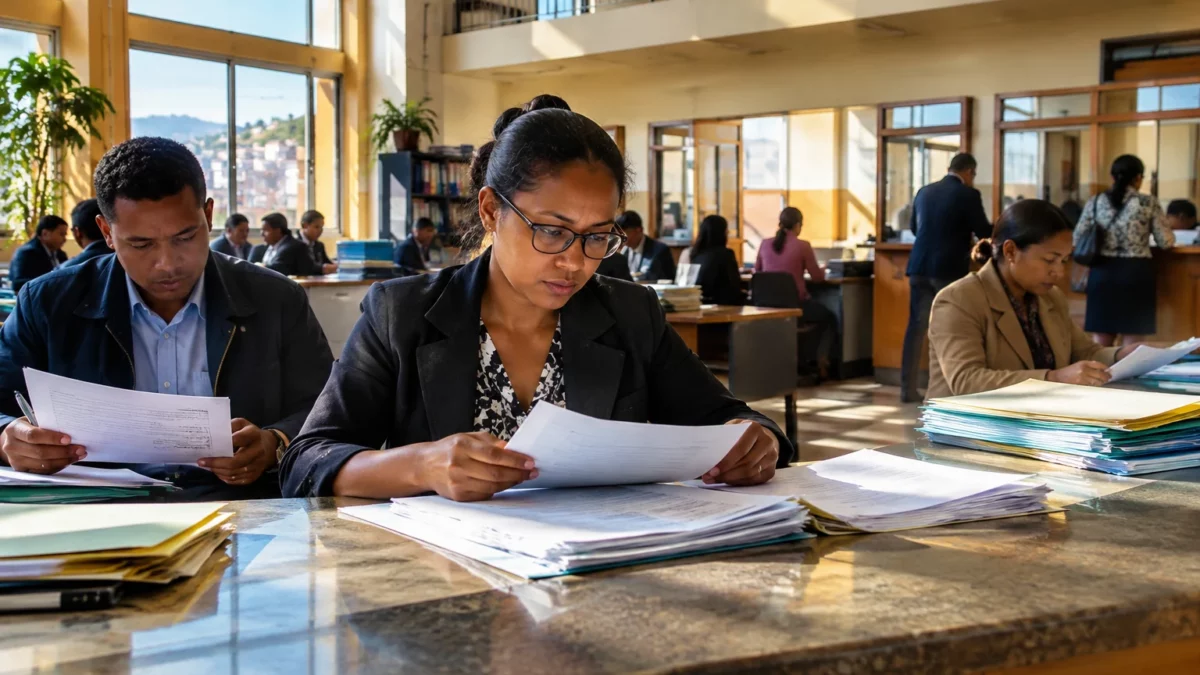
A budget can set ambitious revenue targets without the state being able to collect the money in practice. In Madagascar, this gap between forecasts and available resources affects public payments and investment, and ultimately the services expected by the population.
The assessment presented in Antananarivo on 26 November is part of a broader effort to modernise public finances. It examines progress made and persistent weaknesses as the authorities seek to strengthen trust in institutions and improve oversight of public money.
Digital tools are advancing, but government departments remain siloed
The PEFA++ 2025 assessment was conducted with support from the European Union and the French Development Agency. The PEFA framework is a tool for measuring the quality of public financial management, from budget preparation to expenditure oversight. Madagascar’s Ministry of Economy and Finance says the exercise was carried out from 23 to 27 November 2026.
Data presented at the event point to progress in digital services. According to figures reported on the occasion, 90% of customs duties are reportedly collected online. The number of taxpayers is said to have risen from 272,769 in 2017 to more than 1.59 million in 2026. These indicators point to wider use of formal tax services, but are not, on their own, enough to measure revenue actually collected or how it is distributed.
The picture remains mixed. The report notes that government departments do not share enough data and often work in “silos”. The state also lacks precise information on the value of all its assets. This shortcoming complicates planning, the protection of public assets and the assessment of investment choices.
Another challenge is that investment projects do not always undergo sufficiently robust economic analysis beforehand. Without an examination of costs, expected benefits and risks, it becomes harder to compare priorities and to check afterwards whether spending has delivered the promised results.
Overly optimistic forecasts can delay spending
The ministry’s secretary-general, Iouri Garisse Razafindrakoto, acknowledged that budget revenues were sometimes overestimated. He cited political and macroeconomic pressures that could limit technical staff’s ability to defend forecasts they consider realistic. His statement highlights a central challenge: a reliable budget also depends on the latitude officials have to present prudent estimates.
When forecast revenues do not materialise, budgetary balance requires trade-offs. Some spending may be cut or deferred to subsequent financial years. Payment delays then become a tangible risk for government suppliers and companies working with public administrations. Delays can also complicate the implementation of public projects, particularly when funding depends on specific deadlines.
A separate figure illustrates recent changes in budget execution: the Malagasy media outlet Midi Madagasikara reports that the execution rate rose from 77.5% in 2022 to 87.9% in 2024. This improvement indicates that more of the funds allocated in the budget were spent. It does not, however, show on its own that the spending was effective or that services reached their intended users.
The effects are not uniform. In Antananarivo, budget decisions are made at central level, but funding delays can affect government departments and projects in the regions. Small businesses, which often have less cash available than larger operators, may also be more exposed to late payments. The report therefore concerns not only accounting discipline, but also the state’s ability to meet its commitments day to day.
Oversight and public trust at stake
The assessment follows criticism of public financial management by the Court of Accounts. Madagascar’s Prime Minister’s Office says the Court presented its annual public report for the 2025 financial year on 19 March 2026. The existence of oversight and publication of findings are steps forward; translating them into corrective measures remains crucial to the credibility of institutions.
Transparency also matters to economic partners. Discussions about tackling corruption and money laundering make the quality of financial controls particularly important. The minister and the authorities will, however, need to distinguish verifiable reforms from reputational messaging: publishing an assessment does not in itself prove that risks have been addressed.
For this assessment, the PEFA++ framework also includes sections on gender and climate. The aim is to examine how these issues are integrated into the budget cycle, rather than just included in general commitments. This approach can inform spending choices, provided the indicators lead to decisions that are monitored and evaluated.
Reform under scrutiny beyond Madagascar’s borders
Madagascar is a member of the Southern African Development Community (SADC), a regional organisation for economic and political co-operation. Reliable public finances connect with wider concerns there: domestic resource mobilisation, institutional transparency and infrastructure financing. Member states’ trajectories differ, however, and the Malagasy assessment cannot automatically be applied to the region as a whole.
For the continent, the stakes are tangible: strengthening domestic revenue and making spending traceable can increase states’ ability to fund their priorities without relying solely on external financing. The African Development Bank estimates that Madagascar will need to mobilise about $7.3bn a year by 2030 to finance its development. This need makes the quality of budgetary choices all the more important, although administrative reform alone cannot close a funding gap of this scale.
The next step will be to turn the findings into a reform strategy, with clearly assigned responsibilities and measurable progress. For taxpayers and regional administrations alike, the test will not be limited to digitising revenue collection: it will also concern the accuracy of forecasts, the timeliness of payments and the ability to track public assets and investment.