Algeria
 Egypt
 Libya
 Morocco
 Sudan
 Tunisia
 Benin
 Burkina Faso
 Cabo Verde
 Côte d'Ivoire
 Ghana
 Guinea
 Guinea-Bissau
 Liberia
 Mali
 Mauritania
 Niger
 Nigeria
 Senegal
 Sierra Leone
 The Gambia
 Togo
 Cameroon
 Central African Republic
 Chad
 Equatorial Guinea
 Gabon
 Republic of the Congo
 São Tomé and Príncipe
 Burundi
 Comoros
 Djibouti
 Eritrea
 Ethiopia
 Kenya
 Madagascar
 Malawi
 Mauritius
 Mozambique
 Rwanda
 Seychelles
 Somalia
 South Sudan
 Tanzania
 Uganda
 Angola
 Botswana
 Eswatini
 Lesotho
 Namibia
 South Africa
 Zambia
 Zimbabwe
When public health advances where the state retreats
In the east of the Democratic Republic of the Congo, an epidemic is never just a medical issue. It runs up against blocked roads, busy markets, porous borders and areas where authority is contested. It is against this backdrop that AFC/M23 announced new travel restrictions around Ebola-affected areas, as the outbreak spreads faster than the response on the ground.
The issue extends beyond North Kivu province alone. Since May 2026, Kinshasa, the World Health Organization and Africa CDC have described an outbreak linked to the Bundibugyo virus, an Ebola strain distinct from the one behind other major outbreaks in DR Congo. As of 12 August, figures published by the WHO showed 4 665 confirmed cases in DR Congo, while the ECDC cited 2 184 deaths, illustrating the scale of a health crisis already historic for the country.
AFC/M23 restrictions on a strategic route
According to corroborated reports, the AFC/M23 movement has suspended shared taxi services for a month on the Goma-Kirumba route. Canoes carrying passengers on some routes on Lake Edward are also covered by the ban. Minibuses, however, remain permitted subject to health and security checks, and road freight continues to move.
The measures were taken after two imported cases were detected in travellers from Lubero, an area where local health authorities have confirmed several infections since the start of August. The first confirmations in Lubero were reported around 4 August, and local figures also point to deaths in that health zone.
AFC/M23’s choice is not insignificant. The group has controlled large parts of North Kivu and South Kivu since its 2025 offensive and the capture of Goma and then Bukavu, according to several consistent sources. In this area, it effectively administers services, conducts checks and imposes travel rules, while remaining an armed actor not recognised by Kinshasa.
A health response in a fragmented territory
The response to Ebola normally relies on rapid detection, contact tracing, isolation of cases and targeted vaccination. The WHO and Africa CDC called in early August for community-based response efforts to be strengthened, stressing contact tracing, access to care and surveillance at points of entry. The problem in eastern Congo lies in the overlap between the health emergency and a security crisis that complicates the movement of teams and the trust of residents.
Kinshasa, for its part, has tried to broaden the scope of the response. The health ministry issued 21-day health surveillance measures for some people returning from affected areas, while the presidency convened the national Ebola task force several times. These decisions show that the Congolese state is seeking to retain control of an epidemic that crosses front lines and does not respect administrative boundaries.
Field agencies are also reporting a worrying geographical spread. The WHO now reports cases in six provinces: North Kivu, South Kivu, Ituri, Haut-Uélé, Tshopo and Bas-Uélé. Africa CDC, for its part, noted that the spread had accelerated to the point of warranting intensified surveillance and care measures.
What these restrictions mean for the population
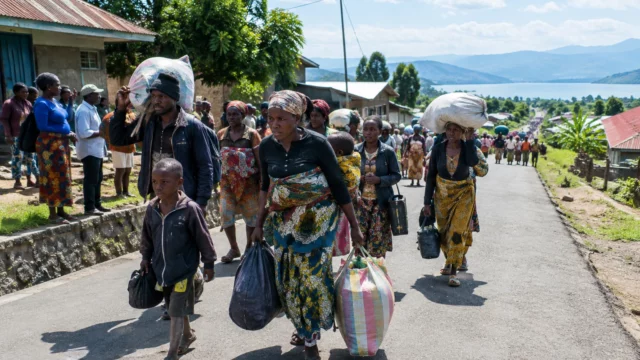
On paper, the temporary closure of some routes can slow the spread of the virus. In practice, it mainly affects households that depend on public transport to sell, buy, seek medical care or visit family. In Goma, Kirumba and around Lake Edward, a suspension of traffic can drive up the cost of food, slow trade and lengthen journeys to healthcare, while the local economy relies heavily on the daily movements of small informal businesses.
Keeping goods transport moving meets the need for economic continuity. It avoids a complete halt to supplies, especially in an area where regional trade feeds urban and rural markets. But this compromise does not solve everything. On the contrary, it shows how difficult it is to protect public health without disrupting the networks that sustain thousands of families.
The M23’s decision also highlights a battle for influence. By taking health measures, the group is seeking to project an image of governing capacity and administrative control over the territories it occupies. This stance allows it to speak in the name of health security, but it also exposes the absence of a stable public space where the state, aid workers and local authorities could operate without armed constraints.
A Congolese crisis with regional repercussions
DR Congo is not the only country affected. The WHO says the outbreak is unfolding in an area of high cross-border mobility, with routes into Uganda, Rwanda and other countries in the sub-region. As of 12 August, the WHO had also recorded 20 cases in Uganda and one case in France linked to the outbreak, underscoring how quickly a crisis that began in eastern Congo can spread beyond its borders.
For Central Africa and the Great Lakes region, the challenge is twofold. On the one hand, the virus must be contained before it becomes further entrenched along trade and humanitarian corridors. On the other, a health response must not be instrumentalised in the political confrontation over eastern Congo. This is where a significant part of regional credibility is at stake: the ability to address a health emergency without separating care from security, or security from the protection of civilians.
The next indicators are clear. The evolution of cases in Lubero, the teams’ actual ability to reach areas under AFC/M23 control, and the effective enforcement of the announced restrictions on roads and the lake must all be monitored. In an epidemic this mobile, the speed of decisions matters as much as their scope.