Algeria
 Egypt
 Libya
 Morocco
 Sudan
 Tunisia
 Benin
 Burkina Faso
 Cabo Verde
 Côte d'Ivoire
 Ghana
 Guinea
 Guinea-Bissau
 Liberia
 Mali
 Mauritania
 Niger
 Nigeria
 Senegal
 Sierra Leone
 The Gambia
 Togo
 Cameroon
 Central African Republic
 Chad
 Equatorial Guinea
 Gabon
 Republic of the Congo
 São Tomé and Príncipe
 Burundi
 Comoros
 Djibouti
 Eritrea
 Ethiopia
 Kenya
 Madagascar
 Malawi
 Mauritius
 Mozambique
 Rwanda
 Seychelles
 Somalia
 South Sudan
 Tanzania
 Uganda
 Angola
 Botswana
 Eswatini
 Lesotho
 Namibia
 South Africa
 Zambia
 Zimbabwe

Fewer incidents, but no return to calm
In eastern Democratic Republic of the Congo, a statistical decline can give a misleading impression. Fewer incidents do not mean less danger. In June 2026, the violence changed shape: it was less widespread, but hit civilians harder.
The Kivu Security Barometer, run by Ebuteli, a Congolese research institute based in Kinshasa, documented at least 247 security incidents in June in Ituri, North Kivu and South Kivu, down from 305 in May. That represents a 19% decline. But the same report shows that this fall masks a reshaping of the violence, in an area where civilians remain caught between rebels, regular forces and local militias.
This finding forms part of a wider crisis, already described by the United Nations as marked by serious violations in areas controlled by AFC/M23, as well as violence by the ADF, CODECO, CRP and wazalendo groups. In Kinshasa, the government speaks of restoring state authority. On the ground, the reality remains fragmented.
M23 is the leading perpetrator of civilian deaths in June
The month’s key finding is clear: M23 has once again become the deadliest armed group targeting civilians. The report attributes at least 114 civilian deaths and 17 abductions to the group in June 2026. This is its highest monthly toll since December 2025, when the rebellion took control of Uvira, according to Ebuteli.
The most serious abuses took place mainly in Masisi territory, in North Kivu, as part of an offensive against localities suspected of harbouring FDLR fighters or wazalendo sympathisers. The report cites, in particular, the use of heavy artillery against several settlements, as well as reprisals against residents accused of collaborating. In Bibwe, local sources reported finding at least 48 bodies, including 17 women; in Ronga, Rutangazo and Mutaraki, at least 18 more bodies were recorded. These figures should be understood as documented by local sources and cross-checked by the research project.
M23’s return to the forefront of deadly violence confirms a reality already highlighted by other sources. In June, Human Rights Watch described a climate of arbitrary arrests, killings and forced recruitment attributed to M23 and the Rwandan force supporting the movement. The United Nations continues to report persistent violations in areas under AFC/M23 control.
Ituri, Nord-Ubangi, Haut-Uele: a geography of pressure
In Ituri, June was not dominated by the same dynamics. CRP scaled back its activity after announcing a unilateral ceasefire on 14 May, followed by reports of discussions with the Congolese government under Ugandan mediation. CODECO, for its part, announced that it was transforming itself into a politico-military movement at a meeting held in Kpandroma from 5 to 7 June. For residents of Djugu, this does not mean the threats have ended. It shows above all that several groups are now seeking a place in the political arena while retaining the capacity to cause harm through armed force.
The ADF remain another major source of concern. The number of civilians they killed fell in June compared with the May peak, but their attacks continued in Beni territory, with deadly incidents in Mbau, Matiba, Mayangose and Vemba. The report also highlights their expansion into Haut-Uele, particularly Watsa and Wamba territories, an important development because it extends the map of insecurity beyond their traditional strongholds in North Kivu and Ituri.
On the eastern border, the report also mentions abuses attributed to South Sudanese forces in Aru territory. This detail is a reminder of a frequently underestimated fact: insecurity in this area is not only Congolese. It is also fuelled by cross-border interactions, institutional vacuums and armed movements that cross administrative boundaries.
What this means for Congolese people, and what the region should watch
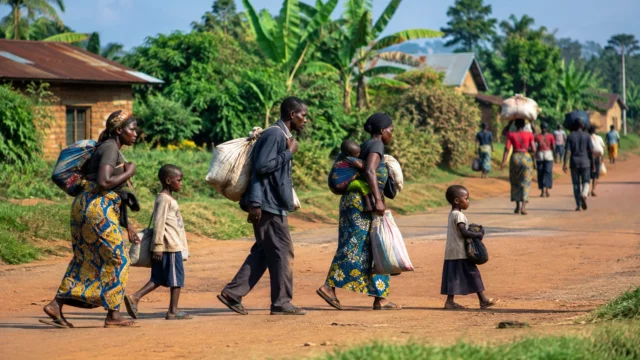
For residents of Masisi, Rutshuru, Beni and Djugu, the question is not which group tops a statistic. It is simpler and starker: who protects the villages, roads, markets and schools? When M23 concentrates its killings, the ADF expand into new areas, and some militias seek political legitimacy, daily life becomes more expensive, slower and riskier. The number of displaced people grows, agricultural activity contracts, and the informal economy bears part of the shock on its own.
South Kivu presents a different challenge: violence there is more diffuse, with a significant share of incidents unattributed. This complicates the public response. When the perpetrator is not clearly identified, protecting civilians becomes more difficult, investigations stall, and trust in the authorities erodes. At the same time, air strikes, drones and heavy artillery show that the conflict between AFC/M23, the FARDC and the wazalendo is becoming more militarily sophisticated.
At the regional level, June confirms that eastern DR Congo remains a major flashpoint for Central Africa and the Great Lakes region. Diplomatic efforts are ongoing, but their impact remains fragile as long as military commitments, verification mechanisms and the actual protection of civilians do not follow. Developments in the coming weeks will need to be closely watched in North Kivu, South Kivu and Ituri, where front lines can shift faster than agreements.