Algeria
 Egypt
 Libya
 Morocco
 Sudan
 Tunisia
 Benin
 Burkina Faso
 Cabo Verde
 Côte d'Ivoire
 Ghana
 Guinea
 Guinea-Bissau
 Liberia
 Mali
 Mauritania
 Niger
 Senegal
 Sierra Leone
 The Gambia
 Togo
 Cameroon
 Central African Republic
 Chad
 DR Congo
 Equatorial Guinea
 Gabon
 Republic of the Congo
 São Tomé and Príncipe
 Burundi
 Comoros
 Djibouti
 Eritrea
 Ethiopia
 Kenya
 Madagascar
 Malawi
 Mauritius
 Mozambique
 Rwanda
 Seychelles
 Somalia
 South Sudan
 Tanzania
 Uganda
 Angola
 Botswana
 Eswatini
 Lesotho
 Namibia
 South Africa
 Zambia
 Zimbabwe
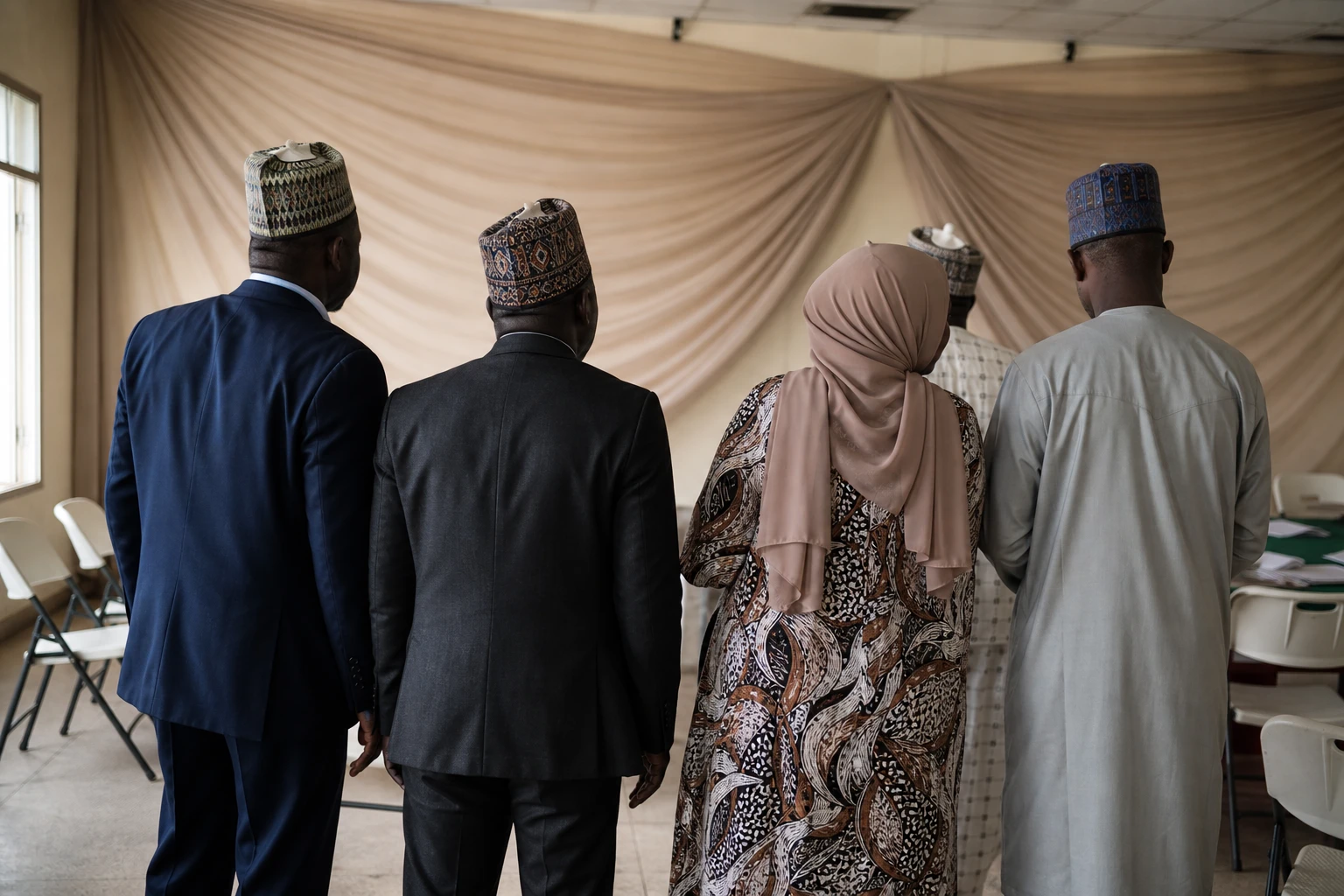
In Lagos, faith also takes up public space
In Lagos, the Mawlid celebration is more than a date on the Islamic calendar. It becomes a visible moment of movement through the city, of singing, gatherings and sharing. In a metropolis where the daily economy weighs heavily on households, this kind of gathering also says something else: social life does not stop because of the constraints of the moment. It asserts itself, organises itself and makes itself visible.
Nigeria, Africa’s most populous country, remains characterised by considerable religious diversity. According to some estimates by the Pew Research Center, the country has a Muslim majority, but also a huge Christian population, with affiliations varying by region. Lagos, on the Atlantic coast, concentrates this plurality in a densely populated, commercial and mobile urban space. The country is a member of ECOWAS, whose headquarters are in Abuja, the federal capital, a reminder of Nigeria’s political weight in West Africa.
A religious procession, but a civic message
On Tuesday 26 August 2026, thousands of Muslim worshippers celebrated Eid al-Mawlid in Lagos with a procession commemorating the birth of the Prophet Muhammad, on 12 Rabi-ul-Awwal according to the Islamic calendar. Other activities accompanied the day: Quran recitations, religious conferences and charitable acts organised by mosques and Islamic associations. In the accounts of participants, the festival also carried a call for unity between Muslims and Christians.
One worshipper interviewed at the scene stressed a simple idea: religions differ, but coexistence remains possible in the same country. This view echoes a familiar theme in Nigerian public life, where religious leaders are often called upon to remind communities of the need for balance. In Abuja, President Bola Ahmed Tinubu had called on Muslims to draw lessons in tolerance, humility and solidarity from the life of the Prophet, while praying for the country.
Nigeria’s context weighs on every celebration
The festival comes as the cost of living remains a major concern in Nigeria. The International Monetary Fund estimates that poverty reached 63% at the national poverty line in 2025, and that 27 million people faced food insecurity in autumn 2025. The World Bank, too, notes that more than 60% of Nigerians lived below the national poverty line in 2025 and that food inflation hits the poorest households, which spend up to 70% of their income on food.
Against this backdrop, religious celebrations often take on a broader social dimension. They provide networks of solidarity. They give some visibility to poorer neighbourhoods. They also create spaces for collective discipline, where religious organisations relay messages of peace, charity and restraint. This role is not merely symbolic. In a country where local tensions can quickly become entangled with religious divisions, the language of unity has practical significance.
Nigeria also faces a fragile security climate in several regions. The IMF has noted that the domestic situation remains a risk to people and economic activity. In this context, calls for prayers for peace are not just a formula. They are rooted in a reality in which violence, displacement and insecurity disrupt daily life, including far from areas of open conflict.
What the day says about Lagos and Nigeria
In Lagos, Mawlid illustrates how Nigeria’s major cities foster coexistence. The economic capital is not merely a financial centre. It is also a laboratory for religious neighbourliness, cultural exchange and urban sociability. Processions, recitations and charitable works show that Nigerian urban Islam is expressed in the streets, in mosques and through mutual aid, not only in the discourse of institutions.
This episode also reflects the political interpretation of Nigeria’s diversity. The presidential message seeks to remind people that religion can serve as a common language rather than a fault line. This is a sensitive issue in a federal country where local identities, religious affiliations and economic pressures overlap. The fact that the head of state called for sharing with the most vulnerable shows that religious festivals are also used as a framework for civic cohesion.
Across West Africa, the signal is clear. Nigeria remains a pivotal ECOWAS country, with the organisation’s headquarters in Abuja. When the authorities and religious leaders there prioritise messages of peace and balance, they resonate beyond Lagos. In a region beset by security tensions, political transitions and economic fragility, maintaining a public space in which Muslims and Christians share the same cities is an important political marker.
What happens next will depend less on the procession itself than on the ability of institutions, religious leaders and communities to sustain this common language. Nigeria is entering a period in which easing price pressures, reducing poverty and improving domestic security remain priorities. Against this backdrop, religious festivals are a reminder of an often underestimated truth: national cohesion cannot be decreed; it must be built every day, in neighbourhoods, mosques, churches and markets.