
 Algeria
 Egypt
 Libya
 Morocco
 Sudan
 Tunisia
 Benin
 Burkina Faso
 Cabo Verde
 Côte d'Ivoire
 Ghana
 Guinea
 Guinea-Bissau
 Liberia
 Mali
 Mauritania
 Niger
 Senegal
 Sierra Leone
 The Gambia
 Togo
 Cameroon
 Central African Republic
 Chad
 DR Congo
 Equatorial Guinea
 Gabon
 Republic of the Congo
 São Tomé and Príncipe
 Burundi
 Comoros
 Djibouti
 Eritrea
 Ethiopia
 Kenya
 Madagascar
 Malawi
 Mauritius
 Mozambique
 Rwanda
 Seychelles
 Somalia
 South Sudan
 Tanzania
 Uganda
 Angola
 Botswana
 Eswatini
 Lesotho
 Namibia
 South Africa
 Zambia
 Zimbabwe
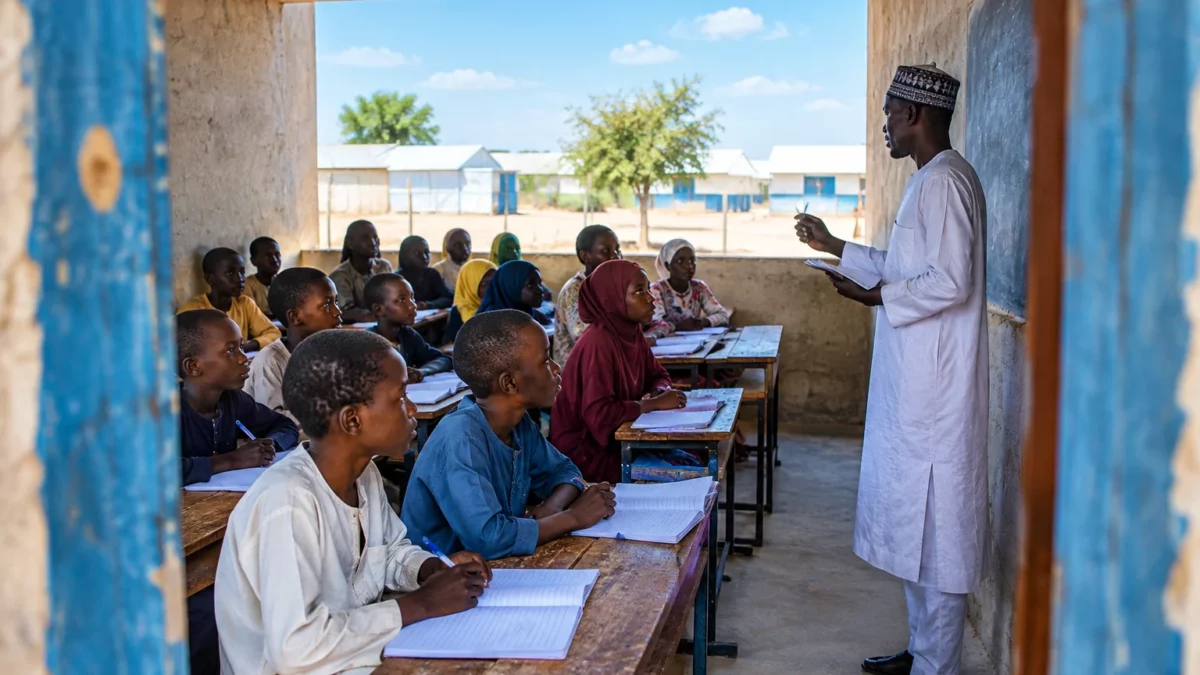
For Hadiza, learning is about more than returning to a classroom. At 15, displaced by an attack and married at 13, she recites the alphabet while pounding millet and practises writing on the ground. Her story shows how insecurity, household chores and social norms combine to keep Nigerian children away from school for good.
A national crisis with very different realities
In 2024, Unesco estimated that nearly 19 million children and young people were out of school in Nigeria. Unicef gave a similar figure, expressed differently: 10.2 million primary-school-age children and 8.1 million at lower-secondary level. These estimates do not measure exactly the same categories; nevertheless, they point to the scale of the challenge.
The national average masks stark disparities. In several northern states, girls are more likely to leave school, while conflict and abductions disrupt education. Elsewhere, distance, the cost of supplies or a lack of schools weigh more heavily. The problem is therefore not reducible to either security or income: these factors often reinforce one another.
In Goronyo, in Sokoto state, Hadiza lives in a camp after fleeing her village. She says she left school to marry at 13. Household chores now fill her days at her in-laws’ home. Nigeria prohibits marriage before the age of 18, but enforcement of the rule remains uneven, particularly where families and local authorities have limited means.
Displacement, family labour and fear of attacks
The situation of 12-year-old Rukayya reveals another vicious cycle. After her father was killed in an attack, she fled with her family. She collects and sells firewood and begs to help feed her brothers and sisters. For displaced children, attending school sometimes means choosing between lessons and an immediate income or meal.
In the north-west and north-central regions, armed criminal groups, often called “bandits” in Nigeria, commit robberies and abductions. They are distinct from the jihadist groups active in the north-east, although violence and displacement can overlap. The International Organization for Migration documents these displacements. In April 2024, it recorded nearly 3,000 people displaced after several attacks in Sokoto and Zamfara states.
In the Goronyo camp, the free school caters for only some of the children, and attendance is sometimes irregular. A teacher quoted in the account describes overcrowded classes, a shortage of classrooms and teachers, and uncertain funding. Fear also plays a role: he reports that an armed gang came to fire shots into the air near the school. After the incident, parents withdrew their children. Unicef has also recorded 19 incidents targeting schools in 2022 and 2023, as well as the closure of 113 schools in Borno, Adamawa and Yobe states.
A right enshrined in law, difficult to guarantee
Nigeria provides for nine years of basic education: six years of primary school and three years of lower secondary. Responsibility is shared between the federal government, state governments and local authorities. But formal rights are not enough when schools lack staff, families cannot afford transport and supplies, or displacement cuts a child off from their school.
Children from poor families are particularly vulnerable. They may contribute to household income, look after younger children or do domestic chores. For girls, early marriage adds a specific barrier. For displaced children, instability often means starting again elsewhere, sometimes without documents or an available place. Access to school therefore depends as much on the continuity of services as on the construction of classrooms.
The traditional Islamic Almajiri system also complicates the count. It provides pupils with religious instruction, but some do not have access to subjects in the general curriculum, such as mathematics and science. Whether they are counted as “out of school” depends on the statistical criteria used. The federal education ministry has published a policy to strengthen and integrate the system; the challenge is to broaden learning without erasing its educational tradition.
Responses to be measured on the ground
The federal government presents education as a priority and has launched Lumina, a programme intended to support one million girls through accelerated learning by 2030. For Hadiza and Rukayya, the effectiveness of such an initiative will be judged less by its stated target than by its ability to provide accessible classes, teachers who turn up and a safe environment. The federal authorities cannot act alone: states and local authorities administer an essential part of basic education.
Formats adapted to local languages and conditions can complement school, particularly when children live far from a school or have interrupted their education. They cannot, however, replace teachers or safe classrooms. Radio remains important in many households, while social media and television can widen the reach of lessons where connectivity and equipment allow.
For ECOWAS, the Economic Community of West African States, the challenge extends beyond Nigeria’s borders: displacement, armed groups and family ties link border areas. Hausa is spoken in Nigeria and several neighbouring countries; educational resources in the language can therefore reach a regional audience, provided they take account of national curricula and local realities.
Hadiza’s dream of becoming a doctor is a reminder of what statistics do not say: every departure from school interrupts a personal ambition, but does not erase the desire to learn. Her daily writing practice is no substitute for an education. It nevertheless shows that the demand for education endures, even when institutions and circumstances make it difficult to meet.



