Algeria
 Egypt
 Libya
 Morocco
 Sudan
 Tunisia
 Benin
 Burkina Faso
 Cabo Verde
 Ghana
 Guinea
 Guinea-Bissau
 Liberia
 Mali
 Mauritania
 Niger
 Nigeria
 Senegal
 Sierra Leone
 The Gambia
 Togo
 Cameroon
 Central African Republic
 Chad
 DR Congo
 Equatorial Guinea
 Gabon
 Republic of the Congo
 São Tomé and Príncipe
 Burundi
 Comoros
 Djibouti
 Eritrea
 Ethiopia
 Kenya
 Madagascar
 Malawi
 Mauritius
 Mozambique
 Rwanda
 Seychelles
 Somalia
 South Sudan
 Tanzania
 Uganda
 Angola
 Botswana
 Eswatini
 Lesotho
 Namibia
 South Africa
 Zambia
 Zimbabwe
When the school year meets the housing crisis
In Koumassi, in southern Abidjan, the return to class was about more than exercise books and uniforms. It also underscored a harsher reality: when a neighbourhood is demolished without a prompt rehousing solution, schools sometimes become temporary shelters. In a municipality where space is scarce and pressure on land is high, the line between social emergency and the school calendar can quickly become blurred.
The situation in Koumassi is part of a broader trend across Greater Abidjan. The autonomous district is home to a large share of the country’s urban population, while precarious neighbourhoods remain numerous and difficult to clear. Public data already released by the state refer to about 200 precarious neighbourhoods in the district, covering more than 8,000 hectares, or nearly 17% of the urbanised area. In this context, evictions raise the same question every time: how can redevelopment take place without shifting vulnerability from one place to another?
What happened in Koumassi
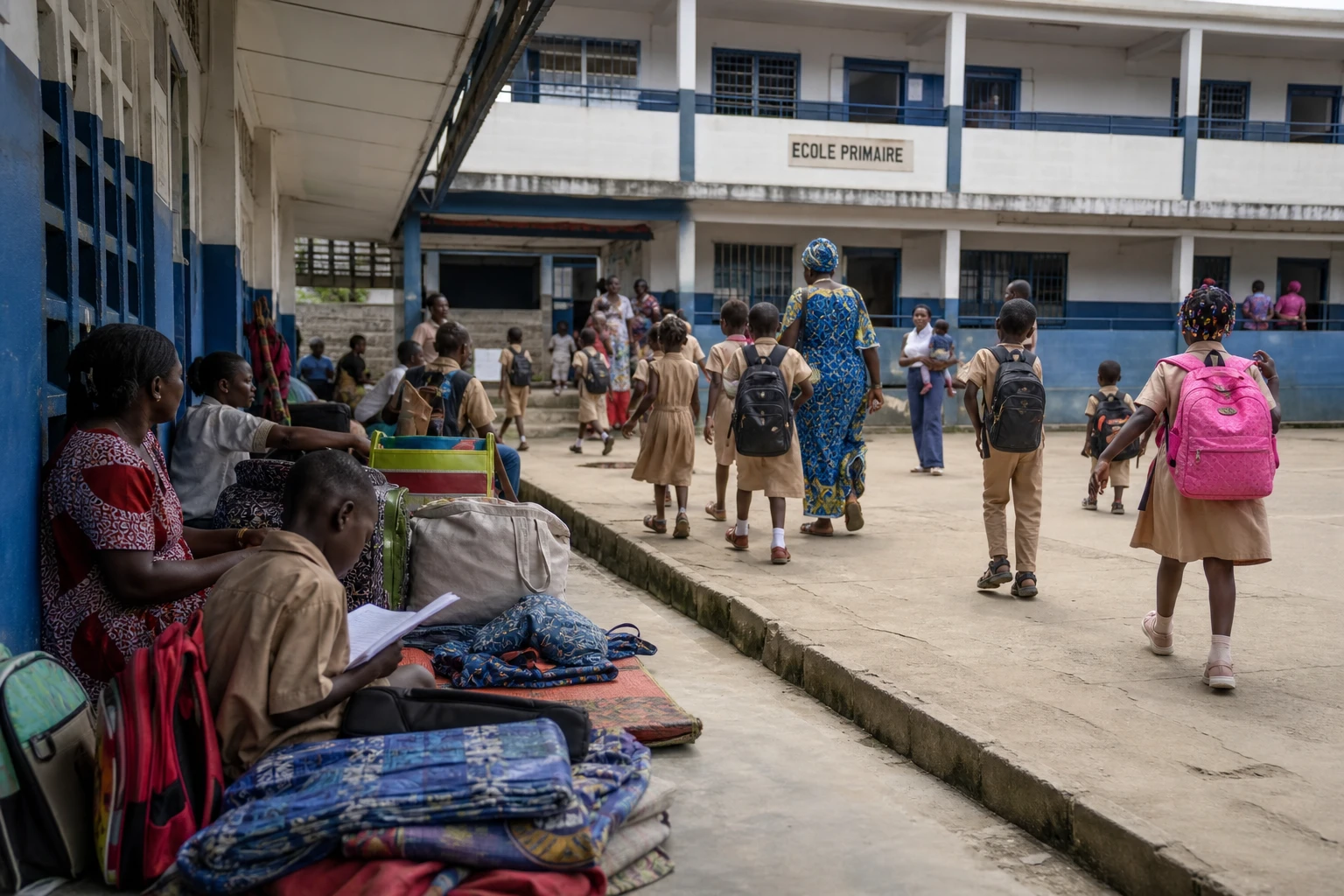
On 14 September 2026, the first day of the school year in Côte d’Ivoire, BAD school in Koumassi welcomed children returning to class, as well as families still living in its playground after the eviction of the Campement neighbourhood on 3 June 2026. According to the authorities, the operation affected a neighbourhood described as occupied without valid title. Since then, some of the households affected have found shelter in schools or temporary sites while they wait for a more lasting solution.
The government says it has already provided initial support to 400 evicted households. On 28 June 2026, the minister responsible for solidarity announced at Koumassi Municipal High School financial assistance of 250,000 CFA francs per household, supplemented by food and essential-needs kits with support from UNICEF. Koumassi town hall, for its part, has set up a crisis unit and stepped up discussions with families still without a lasting solution.
Those staying at the school say they cannot leave without money to pay for new accommodation. Their request is simple: a relocation grant to cover a deposit, the first rent payment and moving costs. In Abidjan’s rental market, upfront demands are often high, sometimes equivalent to ten or eleven months’ rent, according to accounts gathered on the ground. This helps explain why families remain stuck, even after being registered and receiving initial assistance.
A social issue, but also an urban and educational one
At its core, the Koumassi case goes far beyond the issue of evictions. It highlights the gap between Abidjan’s growth and the ability of formal housing to keep pace. World Bank analyses of the city show that rapid urbanisation without sufficient planning fuels informal settlements and puts pressure on urban services. UN-Habitat, meanwhile, notes that Abidjan district comprises 13 municipalities and remains a testing ground for Côte d’Ivoire’s urban policies.
The timing is also sensitive for schools. The 2026-2027 school year was confirmed by the Ministry of National Education as beginning on Monday 14 September across the country. The authorities therefore had to manage a practical paradox: reopen classrooms while asking families housed in a school to leave. For pupils, the risks are twofold: disruption to lessons and exposure to an unstable environment that affects concentration, health and dignity.
This kind of situation hits women and children hardest, as they make up a large share of the households displaced from Campement. Accounts gathered show precarious living conditions, including the use of school toilets and luggage stored in areas intended for pupils. Here too, the issue is not merely humanitarian. It raises questions about urban planning, the preparation of eviction operations and the availability of temporary solutions before any demolition takes place.
What the situation reveals about Côte d’Ivoire and the region
In Côte d’Ivoire, this case illustrates a political balancing act. On the one hand, the state says it wants to restore order to land use and secure land tenure. On the other, evictions that come before rehousing solutions shift the problem to places that are already vulnerable. In a country where Abidjan concentrates economic activity, social housing, urban planning and the protection of low-income households have become matters of stability as well as social justice.
The implications are regional too. In several West African capitals, urban growth is outpacing infrastructure development. ECOWAS, which brings together the countries of the sub-region, has no control over national land policies, but its member states face the same equation: internal migration, rising rents, the expansion of informal neighbourhoods and pressure on schools, roads and sanitation. Abidjan is therefore no exception; rather, it reflects the experience of other West African cities facing the same urban transition.
What happens next will depend on how quickly rehousing proceeds, whether the authorities can prevent other families from once again taking shelter in schools, and on the decisions that follow regarding the land issue in Koumassi Campement. In the short term, the matter will remain tied to two imperatives: keeping schools places of learning and treating affordable housing as a fully fledged public policy, rather than an intermittent emergency.