Algeria
 Egypt
 Libya
 Morocco
 Sudan
 Tunisia
 Benin
 Burkina Faso
 Cabo Verde
 Côte d'Ivoire
 Ghana
 Guinea
 Guinea-Bissau
 Liberia
 Mali
 Mauritania
 Niger
 Nigeria
 Senegal
 Sierra Leone
 The Gambia
 Togo
 Cameroon
 Central African Republic
 Chad
 DR Congo
 Equatorial Guinea
 Gabon
 Republic of the Congo
 São Tomé and Príncipe
 Burundi
 Comoros
 Djibouti
 Eritrea
 Ethiopia
 Kenya
 Madagascar
 Malawi
 Mauritius
 Mozambique
 Rwanda
 Seychelles
 Somalia
 South Sudan
 Tanzania
 Uganda
 Angola
 Botswana
 Eswatini
 Lesotho
 Namibia
 Zambia
 Zimbabwe
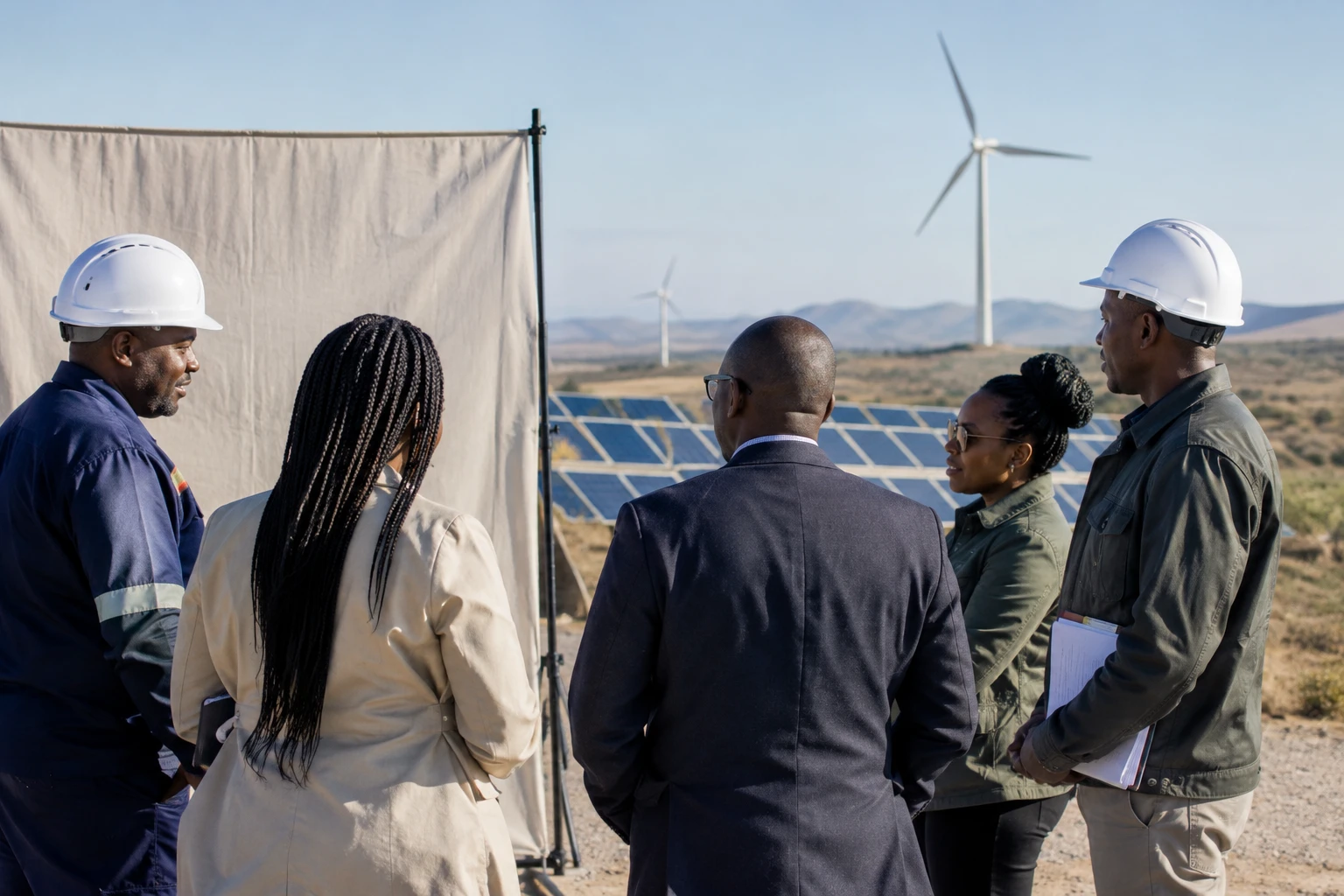
For a mine, generating some of its own electricity rather than relying solely on grid purchases can reduce exposure to costs and outages. In South Africa, a complex of three wind and solar power plants illustrates the growing reach of these private contracts, while highlighting a central question: who can access this new electricity supply?
A changing South African electricity market
South Africa has been seeking for several years to strengthen and diversify its electricity system. Reforms have gradually opened power generation to private operators, while companies can enter into power purchase agreements with producers. The country nevertheless remains dependent on a national grid in which the long-standing operator, Eskom, plays a major role in transmitting electricity.
Wheeling, or the transmission of electricity, allows a producer to sell its power to a customer elsewhere using the public grid. The producer and buyer are bound by a contract; grid-use charges apply. This mechanism does not therefore mean that a dedicated line directly connects a power plant to a mine.
This shift is taking place within a changing institutional framework. South Africa’s Electricity Regulation Amendment Act, signed in August 2024, provides for a transformation of the market and greater scope for competition. At regional level, South Africa is a member of the Southern African Development Community (SADC), which brings together countries committed to energy co-operation. But the Koruson 2 project primarily serves contracts and needs within South Africa.
Three facilities, one sales arrangement
The Koruson 2 complex has a total installed capacity of 520 megawatts. It comprises the 240 MW Mooi Plaats solar power plant and two wind farms, Umsobomvu and Hartebeesthoek, each with a capacity of 140 MW. The facilities are located in the Eastern Cape and Northern Cape provinces.
The three projects reached commercial operation in June 2026, according to information published by EDF power solutions. The complex represents an announced investment of about 15 billion rand. Its electricity is pooled and marketed by Envusa Energy, a joint venture between EDF power solutions and mining group Anglo American.
Long-term supply contracts cover the South African operations of Valterra Platinum, Kumba Iron Ore and De Beers. The electricity passes through the national grid before being allocated to the buyers under the commercial agreements in place. For details of the arrangement and capacity, EDF power solutions’ overview of the Koruson 2 complex describes the three facilities and their grid connection.
The project also relies on infrastructure shared by Koruson 1 and Koruson 2: a 400-kilovolt substation designed to accommodate up to 1.5 gigawatts of generation. Koruson 1, a 420 MW wind complex, entered service in February 2026 under South Africa’s public procurement programme for electricity from independent power producers. It sells its output to Eskom, unlike Koruson 2, which serves private industrial customers.
A boost for industry, not a single solution
For mining companies, these contracts can diversify supply and help reduce emissions associated with their electricity consumption. For developers, they provide identified buyers over the long term, which can help finance costly facilities. Koruson 2 shows how private operators and lenders can contribute to large renewable energy projects in the country.
The model does not, however, remove constraints in the electricity system. Power plants still depend on connection capacity, the transmission grid and sufficiently predictable billing rules. Contract revenues primarily benefit producers, industrial buyers and those financing or operating the infrastructure. Households and small businesses do not automatically become customers for this electricity, even if additional generation can help expand available supply.
Local impacts will also depend on how the projects are integrated into the provinces concerned: sustained employment, contracts awarded to local businesses and benefits for communities need to be assessed separately from commercial gains. The public information reviewed establishes the complex’s capacity, customers and grid connection, but is not sufficient on its own to measure how those benefits are distributed.
A signal for southern Africa
Koruson 1 and Koruson 2 bring together 940 MW of wind and solar capacity around a single connection point. This infrastructure leaves technical headroom for future projects, but available capacity does not guarantee that they will go ahead: financing, power purchase agreements, permits and a grid able to transmit the output will all be needed.
South Africa’s trajectory is of interest to other SADC countries, where access to reliable electricity and diversification of supply are shared concerns. Koruson 2 is not a model that can simply be replicated everywhere: it relies on the size of the South African market, its infrastructure and the presence of large industrial buyers. The issue to watch is instead whether reforms can enable private producers, the public grid and new customers to coexist without reserving the gains of the transition for large consumers alone.
For an overview of national reforms, the South African government sets out the Electricity Regulation Amendment Act. Koruson 2’s entry into service marks a concrete milestone; its broader impact will now depend on how the grid and market can integrate new projects and buyers.