
 Algeria
 Egypt
 Libya
 Morocco
 Sudan
 Tunisia
 Benin
 Burkina Faso
 Cabo Verde
 Côte d'Ivoire
 Ghana
 Guinea
 Guinea-Bissau
 Liberia
 Mali
 Mauritania
 Niger
 Nigeria
 Senegal
 Sierra Leone
 The Gambia
 Togo
 Cameroon
 Central African Republic
 Chad
 Equatorial Guinea
 Gabon
 Republic of the Congo
 São Tomé and Príncipe
 Burundi
 Comoros
 Djibouti
 Eritrea
 Ethiopia
 Kenya
 Madagascar
 Malawi
 Mauritius
 Mozambique
 Rwanda
 Seychelles
 Somalia
 South Sudan
 Tanzania
 Uganda
 Angola
 Botswana
 Eswatini
 Lesotho
 Namibia
 South Africa
 Zambia
 Zimbabwe
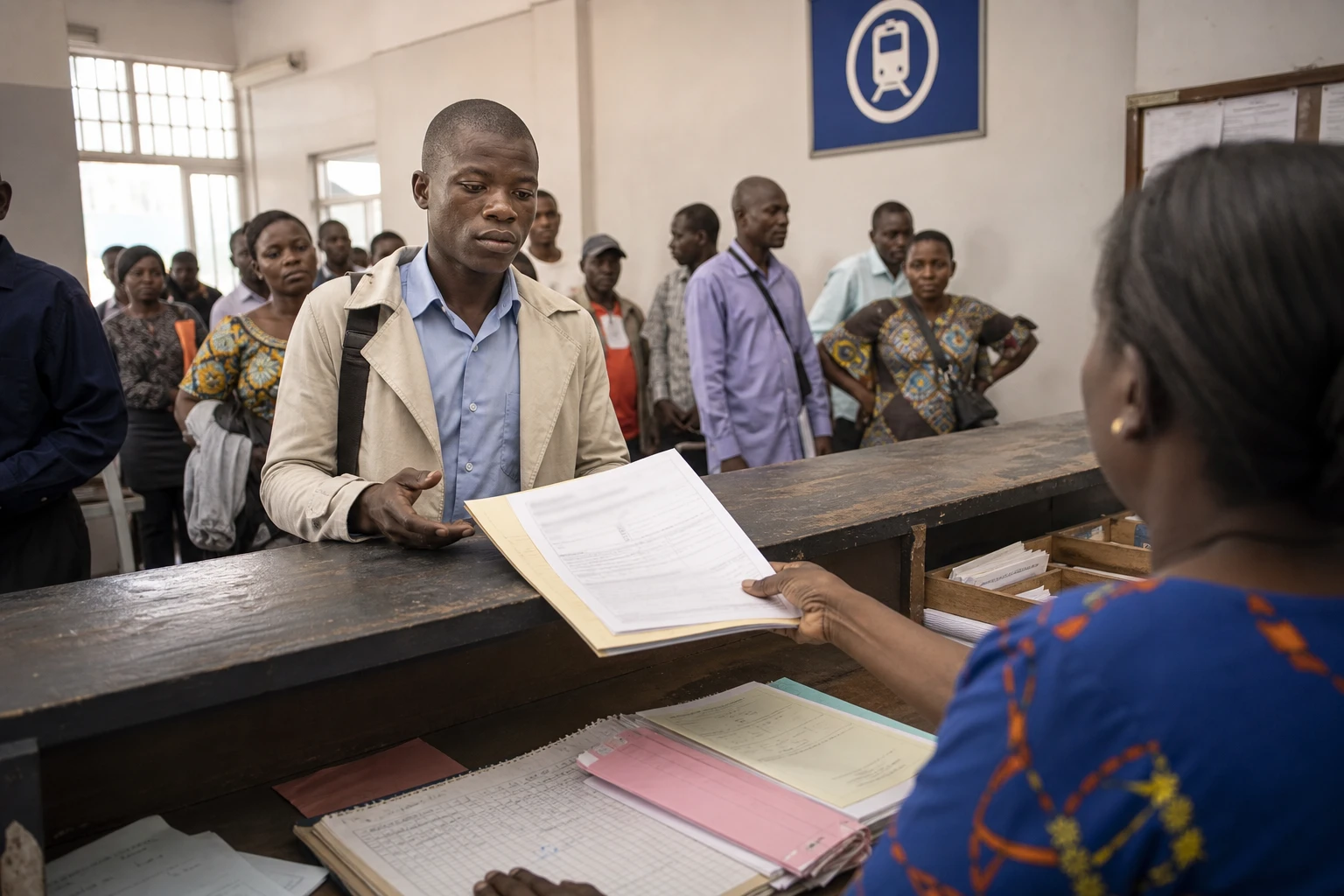
In Kinshasa, rail is once again a practical answer to congestion
In the capital of the Democratic Republic of the Congo, daily travel remains a trial for thousands of passengers. When a city sprawls and grows rapidly while relying too heavily on roads, every return of the urban train goes beyond mere technical curiosity: it affects journey times, transport costs and access to work.
The issue is all the more sensitive because Kinshasa, one of Africa’s largest metropolitan areas, has been seeking more reliable mobility solutions for several years. The urban train is part of that effort, alongside a major railway modernisation project presented under the name MetroKin, backed by African and international public- and private-sector partners.
A long-awaited revival, quickly put to the test
Urban train services linking the Central Station to N’djili international airport have resumed in Kinshasa after a long interruption, initially on a basis announced in August 2026, then with services confirmed to be running again in early September after a minor derailment and repair work. Railway authorities said the service had restarted on 4 September 2026 on the Central Station–airport route, following track cleaning and repair work.
Before that, the resumption had already been presented as effective on 19 August 2026, with an initial journey observed between Masina and the Central Station, followed by a gradual increase in service. Early reports pointed to strong enthusiasm among residents of Tshangu, a district in eastern Kinshasa particularly exposed to traffic jams on Boulevard Lumumba.
The National Transport Office, which oversees operations, has also highlighted the need to protect the railway and prevent rubbish or encroachment from weakening the rail corridor. This matters: in Kinshasa, the railway suffers not only from a lack of maintenance, but also from rapid urbanisation and encroachment on transport corridors.
What the train means for Kinshasa’s residents
The value of this resumption is measured not only by the symbolism of the train’s return after years of silence. Above all, it is measured in minutes saved, more predictable journeys and a slightly clearer transport budget for households. In Kinshasa, where traffic can bring a route to a standstill for hours, a reliable railway line is an economic tool as much as a public service.
The service is aimed chiefly at residents of the eastern communes travelling to Gombe, the administrative and commercial centre, as well as passengers heading to N’djili airport. For them, the train could ease congestion on the most saturated roads and provide an alternative to informal road transport, which is often slower, more expensive at peak times and difficult for users to navigate.
But the stakes go beyond urban mobility alone. The return of the urban train is also a test of the Congolese state’s ability to restore ageing infrastructure, secure public land and sustain a collective transport service over time. The MetroKin project, presented as a much wider network, still has financial and technical milestones to meet, with financial close and the start of construction scheduled for October 2026.
National and regional significance for urban mobility
The revival of Kinshasa’s urban train has significance beyond the Congolese capital. It says something about a continent where megacities are growing faster than roads, buses and mobility policies. In Central Africa, the DRC is seeking to show that urban rail can be put back at the heart of planning, rather than feature only in infrastructure rhetoric.
It also serves as a reminder that a transport network is judged not on its inauguration day, but on its ability to withstand incidents, keep to schedules and absorb demand. The first days of service have already shown genuine passenger interest and, at the same time, capacity constraints. This means the train’s return will not solve everything; rather, it opens a period in which maintenance, safety and the frequency of services will be decisive.
For the Congolese authorities, the project will therefore be watched well beyond Kinshasa. A functioning urban train in such a densely populated capital could become a political, economic and technical signal. At regional level, it feeds into debates already under way in other major African cities about the role of rail, the cost of congestion and the need to invest in mass transport that is genuinely accessible.



