Algeria
 Egypt
 Libya
 Morocco
 Sudan
 Tunisia
 Benin
 Burkina Faso
 Cabo Verde
 Côte d'Ivoire
 Ghana
 Guinea
 Guinea-Bissau
 Liberia
 Mali
 Mauritania
 Niger
 Nigeria
 Senegal
 Sierra Leone
 The Gambia
 Togo
 Cameroon
 Central African Republic
 Chad
 Equatorial Guinea
 Gabon
 Republic of the Congo
 São Tomé and Príncipe
 Burundi
 Comoros
 Djibouti
 Eritrea
 Ethiopia
 Kenya
 Madagascar
 Malawi
 Mauritius
 Mozambique
 Rwanda
 Seychelles
 Somalia
 South Sudan
 Tanzania
 Uganda
 Angola
 Botswana
 Eswatini
 Lesotho
 Namibia
 South Africa
 Zambia
 Zimbabwe
In Kinshasa, armed groups can no longer be dealt with by force alone
In the east of the Democratic Republic of the Congo, every move involving the FDLR carries implications far beyond the military arena. It affects relations with Rwanda, the credibility of peace commitments and the daily lives of people who have endured the cumulative effects of insecurity, displacement and mistrust between neighbours for years. In Kinshasa, this diplomatic phase comes as the government seeks to show it is pursuing de-escalation without relinquishing Congolese sovereignty.
The issue is part of a broader framework: regional security mechanisms established around the Kivu crisis, with the support of the United States, Qatar, the African Union and the United Nations. The « CONOPS », or concept of operations, provided the technical basis for the harmonised plan to neutralise the FDLR and disengage forces, before being incorporated into the Washington Agreement signed on 27 June 2025.
What Kinshasa says it has signed, and why the issue remains sensitive
Congolese authorities have announced the signing of a protocol linked to the FDLR’s surrender, presented as a commitment by fighters to lay down their arms, assemble at cantonment sites, and then return to Rwanda or be sent to a third country willing to receive them. The announcement was made publicly by Floribert Anzuluni, the Congolese minister for regional integration, who said an operational plan was expected in the coming days, including a timetable, a budget and a precise division of responsibilities.
The move is not neutral. For years, Kigali has justified part of its security posture in the east of the DRC by pointing to the presence of the FDLR, an armed movement initially formed by former Rwandan Hutu officials and fighters linked to the 1994 genocide. In recent texts, neutralising this threat is one of the key steps expected of Kinshasa. The UN Security Council, in its 2025 resolution 2773, also reiterated the requirement for the DRC to sever all ties with the FDLR and neutralise it.
But the issue is politically explosive. In recent months, Kigali has rejected any interpretation that treats the FDLR question as a purely technical matter. The Rwandan authorities believe neutralisation must be concrete and verifiable, and linked to the withdrawal of Rwandan forces from Congolese territory. This divergence explains why every announcement from Kinshasa is immediately scrutinised, debated and then challenged across the region.
A diplomatic gamble for Kinshasa, a test of credibility for the region
Choosing surrender as a way out serves more than a military purpose. It also advances a diplomatic goal: to show that the DRC is acting on the part assigned to it in the peace framework, in order to ease pressure over Rwanda and the M23. With this in mind, Floribert Anzuluni has made several regional trips in recent weeks, speaking with African capitals and European partners to explain the Congolese approach.
This strategy could have a political impact, but its practical effectiveness depends on three things. First, the ability to distinguish an announcement of principle from actual disarmament on the ground. Second, coordination between the Ministry of Regional Integration, the P-DDRCS — the Congolese programme for disarmament, demobilisation, community recovery and stabilisation — and the FARDC. Finally, the question of what happens to the fighters: repatriation, cantonment, reintegration or transfer to a third country. Without a clear mechanism, the protocol remains fragile.
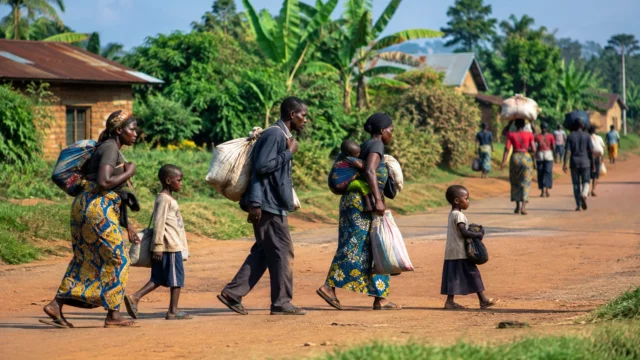
For people in the east, the stakes are tangible. A surrender agreement alone does not ease the constraints on roads, markets, schools or farmland. In the territories of North Kivu and South Kivu, security also depends on the effective presence of the state, support for displaced communities and the ability to prevent armed groups from regrouping under other names. Here, peace is measured less by declarations than by freedom of movement, the return of public services and a decline in violence.
What this phase says about Africa’s Great Lakes region
The implications extend beyond the DRC. The Great Lakes remain an area where internal conflicts, cross-border alliances and diplomatic rivalries quickly feed into one another. That is why the African Union, the United Nations, SADC and the EAC are closely monitoring the implementation of the agreements, while Washington and Doha provide support for the process. Any delay or ambiguity could reignite suspicion between Kinshasa and Kigali.
The Congolese institutional dimension also deserves attention. By signing a protocol on surrender, the government wants to position itself as part of the solution, not merely as an administration under pressure. But this stance will be credible only if the announced operational plan is published, the steps can be verified and responsibilities are clearly shared. In a context where disinformation spreads quickly, transparency is as much a component of security as it is a diplomatic tool.
The next phase will therefore depend on the timetable. The Washington Agreement has already established a monitoring framework, with a joint security coordination mechanism. It remains to be seen whether the announced protocol on the FDLR is genuinely integrated into this framework, or whether it opens another chapter of dispute over the same question: who must do what, and in what order, to bring a lasting end to the security crisis in the east of the DRC.