Algeria
 Egypt
 Libya
 Morocco
 Sudan
 Tunisia
 Benin
 Burkina Faso
 Cabo Verde
 Côte d'Ivoire
 Ghana
 Guinea
 Guinea-Bissau
 Liberia
 Mali
 Mauritania
 Niger
 Nigeria
 Senegal
 Sierra Leone
 The Gambia
 Togo
 Cameroon
 Central African Republic
 Chad
 DR Congo
 Equatorial Guinea
 Gabon
 Republic of the Congo
 São Tomé and Príncipe
 Burundi
 Comoros
 Djibouti
 Eritrea
 Kenya
 Madagascar
 Malawi
 Mauritius
 Mozambique
 Rwanda
 Seychelles
 Somalia
 South Sudan
 Tanzania
 Uganda
 Angola
 Botswana
 Eswatini
 Lesotho
 Namibia
 South Africa
 Zambia
 Zimbabwe
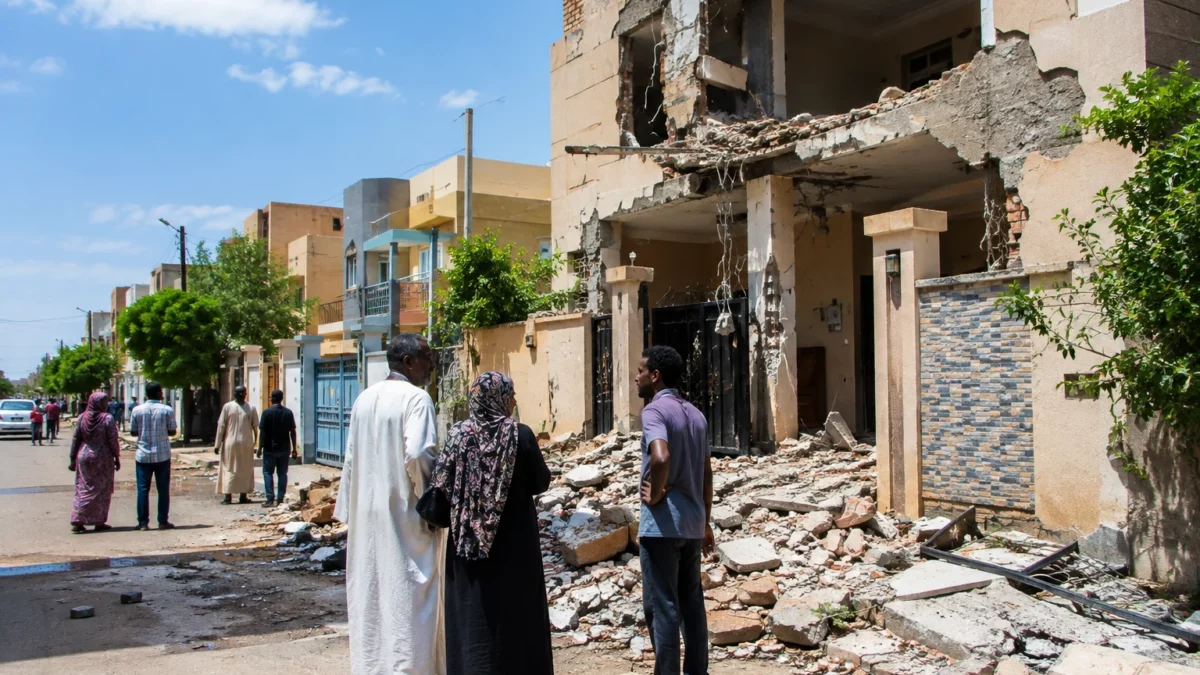
In Khartoum, the army’s recapture of neighbourhoods has not removed war from daily life. During the night of Saturday 21 to Sunday 22 November 2026, drones struck residential areas and damaged a United Nations building. The origin of the attack remains uncertain, but accusations against Ethiopia have raised fears that Sudan’s conflict could spill further over its borders.
A recaptured capital, but still exposed
The war between the Sudanese army and the Rapid Support Forces (RSF), a paramilitary group, broke out in April 2023. It pits two forces once linked to the state apparatus against each other, particularly over control of power and the integration of the RSF into the army. Since March 2025, the army has recaptured Khartoum from the paramilitaries. The recapture has not, however, shielded the capital from long-range strikes.
Sudan is also caught up in regional rivalries. It shares a border with Ethiopia, where Addis Ababa and Khartoum are at odds over several issues, including the border region of Al-Fashaga and the waters of the Nile. The Intergovernmental Authority on Development (IGAD), a regional organisation in the Horn of Africa, provides one forum for dialogue between neighbouring states. But current bilateral tensions are compounded by internal conflicts in both countries.
For months, Sudanese authorities have accused Ethiopia of allowing the RSF to use its territory to prepare or launch attacks. Addis Ababa rejects these accusations and, in turn, says Khartoum is supporting fighters opposed to the Ethiopian government in the Tigray region. Neither government has provided publicly verified evidence establishing its responsibility for Sunday’s strikes.
Damage confirmed, death toll still unknown
Explosions were heard between about 2am and 4.30am local time, according to witnesses cited by the press. Homes were hit in several areas of Khartoum and its outskirts. In Jebel Aulia, about 45 kilometres south of the city centre, a drone reportedly struck the home of a mosque’s muezzin, the person who calls the faithful to prayer. The authorities had not immediately released a casualty figure.
The UN confirmed that one of its buildings, where members of its staff were present, was damaged in a civilian neighbourhood. Denise Brown, the United Nations humanitarian co-ordinator in Sudan, stressed that civilians are not legitimate targets and described the risk imposed on humanitarian teams as unacceptable. The material damage has therefore been confirmed by the organisation. The available information, however, does not establish who carried out the attack.
A source close to the Sudanese army said the drones had allegedly taken off from Bahir Dar airport in Ethiopia. The accusation echoes complaints Khartoum says it lodged in early November with the UN Security Council and the African Union’s Peace and Security Council. The Ethiopian government has previously denied any involvement in attacks attributed to the RSF. The allegation concerning the 22 November strikes has not been independently confirmed.
Drones increase risks for civilians
The strike on Khartoum forms part of a trend documented across the country. According to the United Nations High Commissioner for Human Rights, more than 2,230 civilians were killed between January and October 2026. More than 1,630 of these confirmed deaths are attributed to drone strikes. The UN says the actual toll could be higher. These nationwide figures are not, on their own, enough to attribute a specific attack to one of the belligerents.
The consequences extend beyond combat zones. Strikes recorded by the UN have hit markets, civilian vehicles, hospitals, schools, fuel depots and electricity facilities. Shortages of electricity or fuel also affect healthcare, access to water and people’s ability to travel. City residents may be struck directly, while rural populations often rely on services and roads already disrupted by the war.
Drones can reach places far from the front without directly exposing combatants. This range makes it harder to distinguish between military and civilian areas and puts greater pressure on infrastructure. For the period from 20 October to 4 November, the UN documented attacks attributed to the RSF against electricity facilities and petrol stations in several states. These incidents do not prove who carried out the strikes in Khartoum, but they show why the growing use of drones is alarming civilians far beyond the front lines.
The risk of a wider regional conflict
The dispute between Khartoum and Addis Ababa now has a diplomatic dimension. By taking its accusations to the African Union and the Security Council, Sudan is seeking to have them examined in forums where both countries may be called upon to account for their positions. Complaints and official statements do not, however, in themselves amount to independent verification of the facts.
Tensions are rising as each government accuses the other of supporting armed groups. Analysts cited by the Associated Press say this dynamic could open up a new indirect front as internal crises on either side of the border increasingly intersect. An escalation between states would threaten people in border regions and complicate mediation efforts and the delivery of aid.
In the short term, the questions to be clarified are concrete: the toll from the 22 November strikes, the extent of the damage and whether there is any independent evidence of their origin. The stakes go beyond the security of Sudan’s capital. If unverified accusations become a pretext for escalation, the war could shift its front lines again, to the detriment of civilians and stability in the Horn of Africa.
The UN statement on the strikes in Khartoum and UN data on drone strikes and civilian casualties provide separate details on local damage and the nationwide toll. Accusations between the two countries and their regional context have also been reported by the Associated Press and the Anadolu Agency.