Algeria
 Egypt
 Libya
 Morocco
 Sudan
 Tunisia
 Benin
 Burkina Faso
 Cabo Verde
 Côte d'Ivoire
 Ghana
 Guinea
 Guinea-Bissau
 Liberia
 Mali
 Mauritania
 Niger
 Nigeria
 Senegal
 Sierra Leone
 The Gambia
 Togo
 Cameroon
 Central African Republic
 Chad
 DR Congo
 Equatorial Guinea
 Gabon
 Republic of the Congo
 São Tomé and Príncipe
 Burundi
 Comoros
 Djibouti
 Eritrea
 Kenya
 Madagascar
 Malawi
 Mauritius
 Mozambique
 Rwanda
 Seychelles
 Somalia
 South Sudan
 Tanzania
 Uganda
 Angola
 Botswana
 Eswatini
 Lesotho
 Namibia
 South Africa
 Zambia
 Zimbabwe
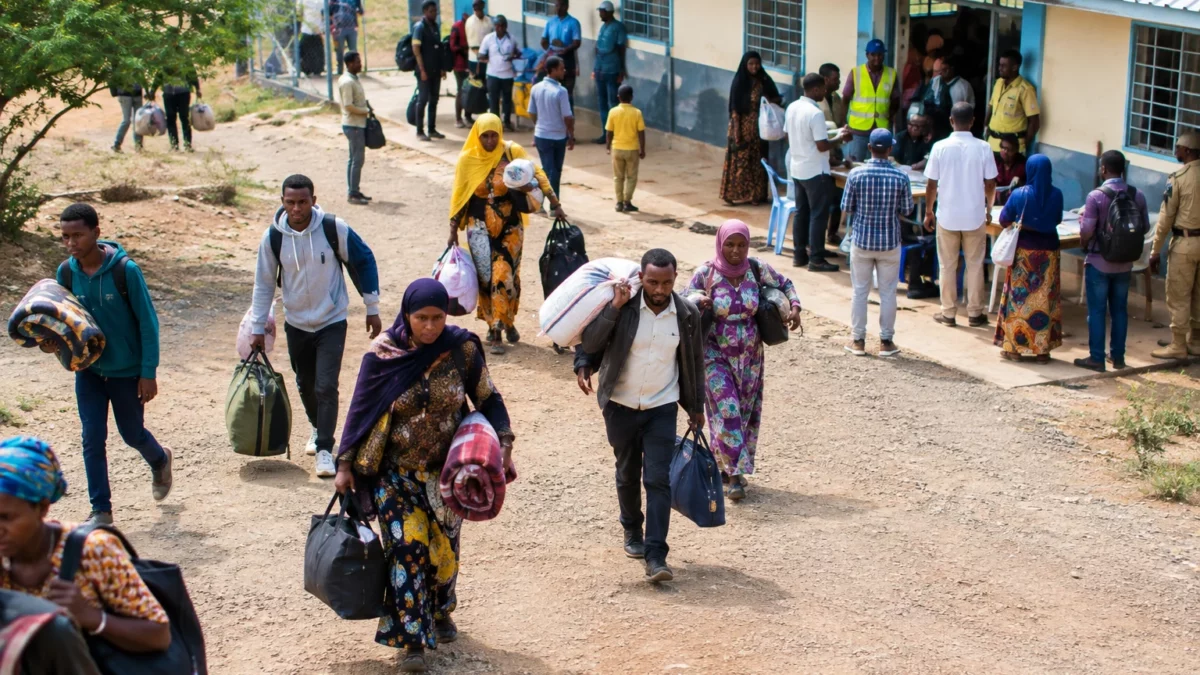
In Moyale, an Ethiopian town shared between two regional administrations, a territorial dispute has once again taken on a cross-border dimension. Tens of thousands of people are reported to have fled to Kenya. In Ethiopia, humanitarian actors are also warning of mass displacement within the country, but its scale has yet to be independently confirmed.
An administrative boundary at the heart of tensions
Moyale lies in southern Ethiopia, on the border with Kenya. The town is administered by the Oromia and Somali regions, two federated entities whose boundaries and jurisdictions are recurrently contested. These regional borders are part of Ethiopia’s federal system, which recognises, among other things, the identities and languages of the country’s communities.
The issue is not simply a line on a map. Control of a territory can determine which administration provides public services, who exercises local authority and how resources are managed. In Moyale, Oromo and Somali communities live on either side of a boundary that cuts across areas of movement, trade and social ties.
The dispute is also unfolding amid national tensions. Ethiopia is experiencing several separate conflicts, notably in the Oromia, Amhara and Tigray regions. These situations should not be conflated with the clashes in Moyale, but they are placing demands on state capacity and complicating humanitarian access in several areas.
Mass displacement, but figures should be treated with caution
The current clashes reportedly began in late October 2026, according to information published on 19 November. Humanitarian organisation Islamic Relief estimates that nearly 700,000 people have left their homes in southern Ethiopia. It puts the number of displaced people at 329,000 in the Dawa zone of the Somali region and 359,798 in southern Oromia. These estimates could not be corroborated by a second independent source consulted, and should therefore remain attributed to the organisation.
The figure for people who have crossed the border is supported by a separate source. The United Nations High Commissioner for Refugees (UNHCR) says about 50,000 people have arrived in Moyale, Kenya. The agency says many are staying with families or in temporary sites, and that pressure on local services is mounting. The Associated Press also reports that Kenyan authorities and organisations on the ground are continuing to register arrivals, meaning the exact number may change.
This distinction matters. People displaced within Ethiopia are not automatically registered as refugees in the neighbouring country. Counting methods, collection dates and areas covered may also vary. Islamic Relief’s total should therefore not be added to the UNHCR figure, which covers arrivals in Kenya.
Available reports describe homes destroyed and health services disrupted. Islamic Relief says clashes have reportedly spread as far as 300 kilometres from Moyale. The AP traces the immediate source of the tensions to a dispute over a regional administration and its flag in a contested area. These details do not, on their own, establish responsibility for the violence. No precise death toll has been confirmed by the information cross-checked here.
The effects extend beyond the front lines
For displaced families, fleeing often means losing their homes, incomes and access to healthcare. Children may have to stop attending school. Those who remain in affected areas must contend with insecurity and weakened services. Across the border, Kenyan communities are hosting arrivals while their own water and food resources are under pressure, according to local authorities cited by the AP.
Local economic life may also be affected. Moyale is a crossing point between Ethiopia and Kenya. The AP reported that trucks were stranded on both sides of the border as tensions continued. If displacement and movement restrictions persist, traders, transport operators and informal workers could lose income, while supplies become harder to secure.
The emergency response cannot therefore be limited to helping people crossing the border. It also requires identifying displaced people in the affected Ethiopian regions, maintaining healthcare and supporting host communities. UNHCR says it is coordinating with the International Organization for Migration and the Kenya Red Cross in Kenya. However, the available information does not establish the scale or coverage of assistance inside Ethiopia.
An issue for Ethiopia and the Horn of Africa
The crisis is testing relations between regional administrations and the federal government. It is a reminder that a local dispute can quickly affect people on both sides of an international border. The management of Moyale is therefore also a concern for Kenya, where public services and host communities must absorb significant arrivals.
The Intergovernmental Authority on Development (IGAD), a regional organisation in the Horn of Africa, provides a framework for cooperation between neighbouring states on peace and displacement issues. The sources consulted, however, report no mediation or decision by IGAD linked to these clashes. It would be premature to attribute a role in the current response to the organisation.
In the short term, three issues remain to be monitored: verification of displacement figures in Ethiopia, developments in arrivals in Kenya, and the authorities’ ability to restore services and security around Moyale. Pending more robust data, the figure of nearly 700,000 displaced people describes Islamic Relief’s estimate, not a consolidated tally by United Nations humanitarian agencies.