Algeria
 Egypt
 Libya
 Morocco
 Sudan
 Tunisia
 Benin
 Burkina Faso
 Cabo Verde
 Côte d'Ivoire
 Ghana
 Guinea
 Guinea-Bissau
 Liberia
 Mali
 Mauritania
 Niger
 Nigeria
 Senegal
 Sierra Leone
 The Gambia
 Togo
 Cameroon
 Central African Republic
 Chad
 DR Congo
 Equatorial Guinea
 Gabon
 Republic of the Congo
 São Tomé and Príncipe
 Burundi
 Comoros
 Djibouti
 Eritrea
 Kenya
 Madagascar
 Malawi
 Mauritius
 Mozambique
 Rwanda
 Seychelles
 Somalia
 South Sudan
 Tanzania
 Uganda
 Angola
 Botswana
 Eswatini
 Lesotho
 Namibia
 South Africa
 Zambia
 Zimbabwe
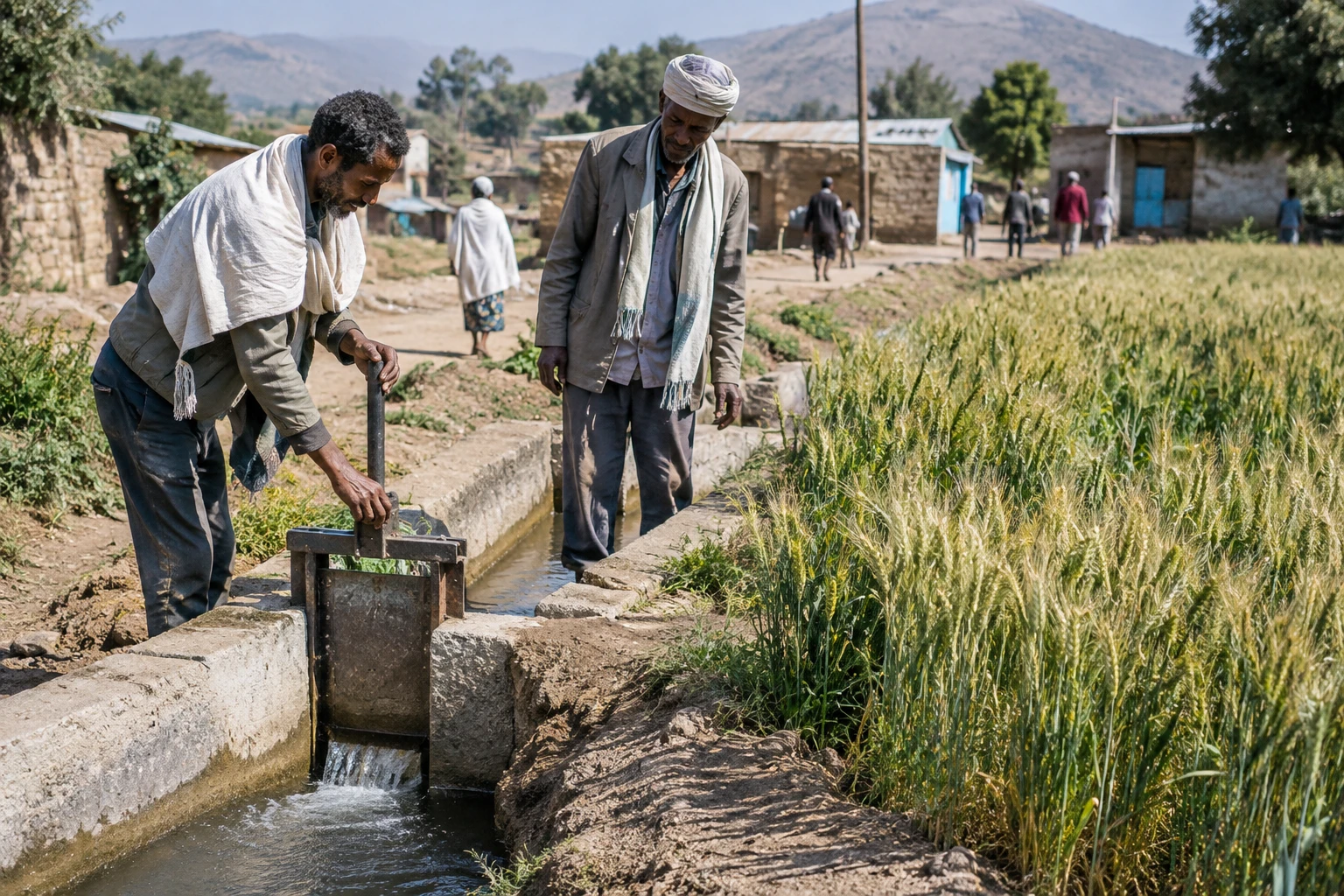
Can an irrigated plot make up for a failed rainy season? In eastern Tigray, one farmer’s experience shows what access to water can change at farm level. It also highlights the limits of a response that remains costly and dependent on local resources.
In Tigray, a harvest dependent on access to water
In Semha, in eastern Ethiopia, Haregot farms two hectares near a river. During the season described, his wheat fields withstood the lack of rain thanks to an irrigation system installed in 2012 with support from an American organisation. He expected to harvest 15 to 16 quintals of grain and sell them for 13,000 birr per quintal, according to figures he gave at the time.
These figures describe a specific situation whose date is not fully clear: they should not be read as current prices. They nevertheless show the possible difference between a plot supplied with water and neighbouring fields where seeds did not germinate. For Haregot, irrigation also means being able to rely more on his own produce, without having to seek outside assistance after every bad season.
The contrast is significant in a country where most crops depend on rainfall. The FAO notes that droughts and floods cause crop losses in Ethiopia. A study of rain-fed agriculture in the country estimates that this form of farming accounts for a major share of cultivated land. Percentages vary according to definitions and time periods; the figure of “more than 90%” cited in the account therefore cannot be generalised without specifying its statistical basis.
Irrigation, a useful but demanding response
For Zeweld Woldegebrial, an environmental researcher at Mekele University, water management is essential in an agricultural sector heavily reliant on rainfall. Reservoirs, retention basins and irrigation systems can help secure crops and even make it possible to grow several crops a year when water and agronomic conditions allow.
But this option comes at a cost. Pumps, pipes and equipment maintenance are difficult for many smallholders to finance. And drawing more water from a river can jeopardise downstream uses, especially when reserves are already low. Poorly planned irrigation therefore risks shifting the shortage rather than solving it.
Research conducted in irrigation schemes in Tigray likewise stresses the importance of efficient water management. The challenge is not simply to install infrastructure. It is necessary to choose suitable crops, monitor water resources, maintain equipment and distribute water among farming households. Soil and moisture conservation measures complement this work: they can reduce runoff and help land retain water more effectively.
A region facing overlapping shocks
Drought does not affect an agricultural economy isolated from its other difficulties. In northern Ethiopia, the consequences of the 2020–2022 conflict weighed on livelihoods, harvests and the functioning of markets. An analysis by FEWS NET notes that the erosion of agricultural production and trade routes in Tigray contributed to persistent food needs after the war.
The effects differ from one household to another. A farm near a river or equipped with a pump can protect part of its harvest. A family without access to these resources depends more heavily on rainfall, market prices and, at times, food aid. Differences also emerge between rural areas and urban centres: lower production can reduce farm incomes, while higher grain prices weigh on consumers who buy their food.
The available information does not make it possible to establish a current, quantified picture of losses across Tigray based solely on the season described. The FAO and FEWS NET have, however, documented the persistence of climate shocks and food difficulties in Ethiopia in recent periods. These national or regional assessments should not be confused with the outcome for an individual farm.
From Tigray to the Horn of Africa
The issue extends beyond the region. Ethiopia is a member of IGAD, the regional organisation for the Horn of Africa, where drought, water availability and food security affect several countries. Better water management can strengthen the resilience of farms, but rivers and agricultural needs also require coordination between territories.
For the Ethiopian authorities, the challenge is to develop irrigation without depleting resources or reserving its benefits for the best-equipped farmers. For farmers, the immediate priority remains protecting harvests and incomes. And for regional partners, the question is how to support practices suited to local conditions rather than relying on a single infrastructure project.
The case of Semha does not prove that irrigation can replace rainfall. It shows that regular access to water can make a difference for a farm, provided it is sustainable and affordable. In Tigray, what happens next will depend as much on the seasons as on the ability to repair the effects of conflict, manage shared resources and better protect farmland.
For further context, see the FAO’s analysis of agricultural emergencies in Ethiopia, the FAO-GIEWS monitoring of harvests and agricultural conditions, and FEWS NET’s analysis of food security in Ethiopia.