Algeria
 Egypt
 Libya
 Morocco
 Sudan
 Tunisia
 Benin
 Burkina Faso
 Cabo Verde
 Ghana
 Guinea
 Guinea-Bissau
 Liberia
 Mali
 Mauritania
 Niger
 Nigeria
 Senegal
 Sierra Leone
 The Gambia
 Togo
 Cameroon
 Central African Republic
 Chad
 DR Congo
 Equatorial Guinea
 Gabon
 Republic of the Congo
 São Tomé and Príncipe
 Burundi
 Comoros
 Djibouti
 Eritrea
 Ethiopia
 Kenya
 Madagascar
 Malawi
 Mauritius
 Mozambique
 Rwanda
 Seychelles
 Somalia
 South Sudan
 Tanzania
 Uganda
 Angola
 Botswana
 Eswatini
 Lesotho
 Namibia
 South Africa
 Zambia
 Zimbabwe
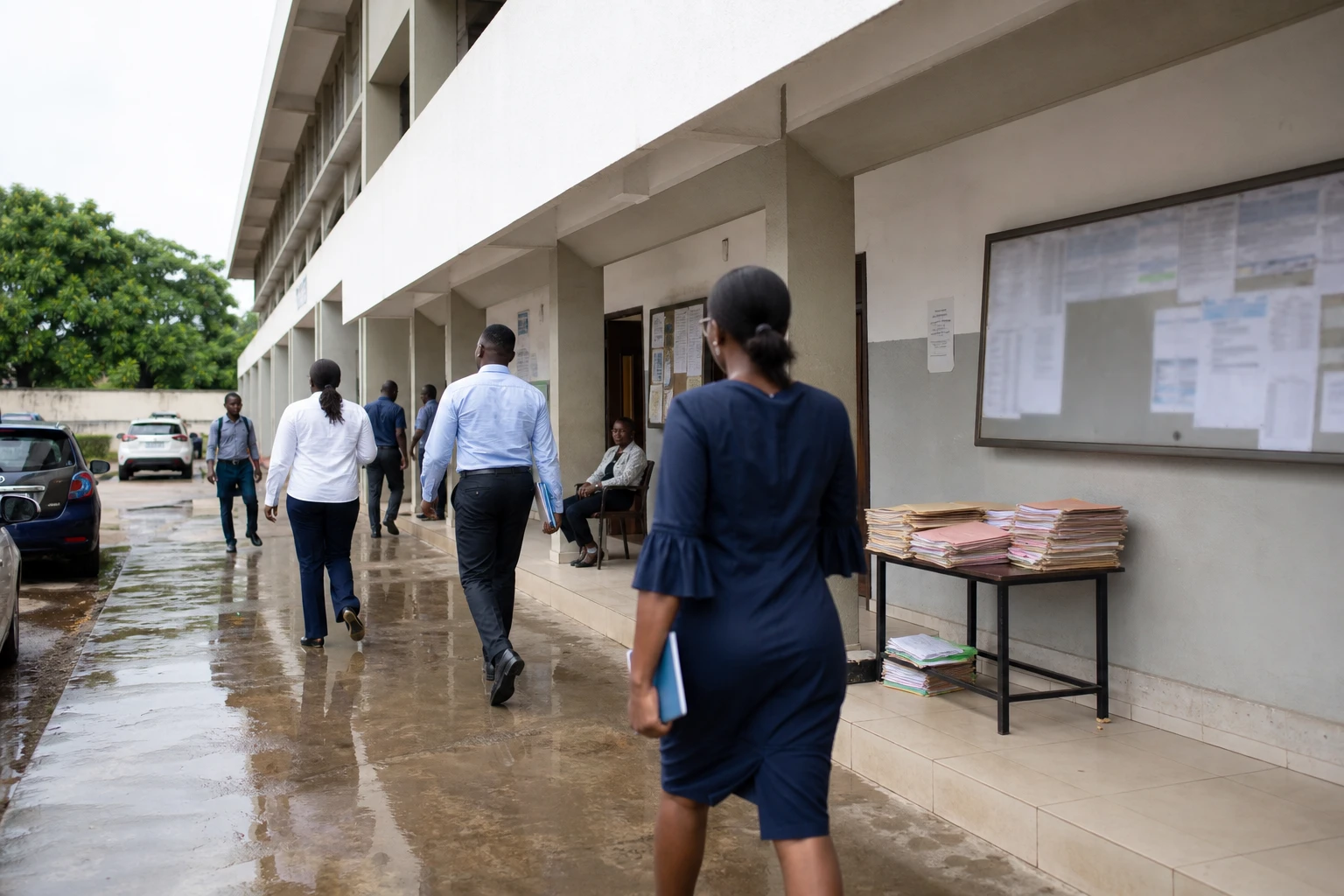
When public investment finally targets forgotten villages
In western Côte d’Ivoire, the question is no longer simply how to grow the national figures. It is whether that growth can be seen in practical terms: in a refurbished school, an equipped health centre or a rural road that is passable all year round. That is where part of the credibility of development in Côte d’Ivoire is now at stake, in a country whose capital is Yamoussoukro and whose economy remains highly concentrated around major urban centres.
The Ivorian government ratified a €87.3m loan agreement at the Council of Ministers meeting on 22 July 2026. The agreement was concluded on 10 June 2026 with the International Development Association, the World Bank Group’s concessional lending arm. The funding is intended to support a community and local development project in the west of the country. The same dossier states that the goal is to improve access to basic social services and economic opportunities.
The announcement does not come out of the blue. On 19 May 2026, the World Bank had already announced its approval of a $100m project for western Côte d’Ivoire, aimed at helping about 1.8 million people in the Montagnes district gain access to basic services and new economic activities. The institution also describes a region where rural poverty and gaps in access to water remain well above the national average.
Closing territorial gaps at the heart of Côte d’Ivoire’s strategy
Western Côte d’Ivoire is not peripheral in the weak sense of the term. It is an area of movement, agricultural production and cross-border trade, close to Liberia and Guinea, but also marked by longstanding vulnerabilities: pressure on land, the isolation of some communities, infrastructure shortfalls and fragile public services beyond the main routes. By targeting sub-prefectures, schools, literacy centres, health centres and water infrastructure, the project aims less to build a “major structure” than to connect the territory.
This choice is part of a rationale that Abidjan is now more openly embracing: correcting territorial disparities without disrupting macroeconomic momentum. The UN Development Programme’s 2026-2030 country programme document, published on 1 April 2026, clearly states that its partnership with Côte d’Ivoire aims to accelerate inclusive growth, strengthen governance and promote climate resilience. The text also refers to the country’s structural transformation. In other words, the question is no longer simply how to produce more, but how to distribute the benefits better.
In this context, community projects carry political weight. They are expected by municipalities, traditional chiefs, women active in small-scale trade, young people seeking work and agricultural producers who depend on better access to inputs and markets. They also matter to the central government, which sees them as a way to show that decentralisation and local development are not slogans, but tools for reducing social tensions.
The figures show progress, but also its limits
The contrast between national progress and pockets of vulnerability remains clear. According to the UNDP and data from the Human Development Report, Côte d’Ivoire’s Human Development Index rose by 0.017 between 2022 and 2023. The country ranks 157th out of 193, with an HDI of 0.582, and this increase was presented as the largest in sub-Saharan Africa over the period. But the same indicator shows that the country remains in the medium human development category.
This is precisely where the western project takes on significance. In a region where basic services do not always keep pace with national growth, community investment acts as a corrective. Renovating a school does not solve everything. A borehole cannot end poverty on its own. But combining drinking water, local healthcare, rural mobility and income-generating activities can change daily life far more quickly than announcements of major economic policies.
The programme’s economic component is therefore central. The announced funding is also expected to support agriculture, connectivity between production areas and economic hubs, and activities aimed at young people and women. This structure is not incidental. In the west, as elsewhere in the sub-region, informal incomes often dominate everyday economic life. When roads, water points and health facilities work, the entire local productive fabric becomes more stable.
The message is also political in the African sense of the term. Côte d’Ivoire remains one of West Africa’s economic powerhouses, within a community space where expectations are high around jobs, mobility and market integration. A project that reduces disparities between Abidjan and the country’s interior therefore goes beyond the national framework alone. It also strengthens the country’s ability to exert influence within ECOWAS, where economic resilience, territorial cohesion and social stability remain shared priorities.
What to watch now
The real question now is one of implementation. Concessional funding is useful when it leads to visible construction work, deadlines being met and lasting services. It is less useful when it gets lost in the administrative chain or local needs are not prioritised well enough. The western project will therefore be judged on its ability to reach the communities concerned, avoid duplication and genuinely involve beneficiaries in setting priorities.
At the continental level, this sequence confirms a broader trend: international donors are no longer funding only national infrastructure, but increasingly mechanisms to close territorial gaps, build climate resilience and create local jobs. The UNDP’s 2026-2030 CPD and the World Bank’s support make the same point in different words: West Africa does not simply lack growth; it needs growth that reaches the margins of the real country.
For Côte d’Ivoire, the challenge is clear. It is not to prove that the country is making progress. It is to show that this progress can be seen in the west, in rural areas, in local services and in jobs for young people. Only then will macroeconomic progress cease to be an abstraction and become a shared reality.