
 Algeria
 Egypt
 Libya
 Morocco
 Sudan
 Tunisia
 Benin
 Burkina Faso
 Cabo Verde
 Ghana
 Guinea
 Guinea-Bissau
 Liberia
 Mali
 Mauritania
 Niger
 Nigeria
 Senegal
 Sierra Leone
 The Gambia
 Togo
 Cameroon
 Central African Republic
 Chad
 DR Congo
 Equatorial Guinea
 Gabon
 Republic of the Congo
 São Tomé and Príncipe
 Burundi
 Comoros
 Djibouti
 Eritrea
 Ethiopia
 Kenya
 Madagascar
 Malawi
 Mauritius
 Mozambique
 Rwanda
 Seychelles
 Somalia
 South Sudan
 Tanzania
 Uganda
 Angola
 Botswana
 Eswatini
 Lesotho
 Namibia
 South Africa
 Zambia
 Zimbabwe
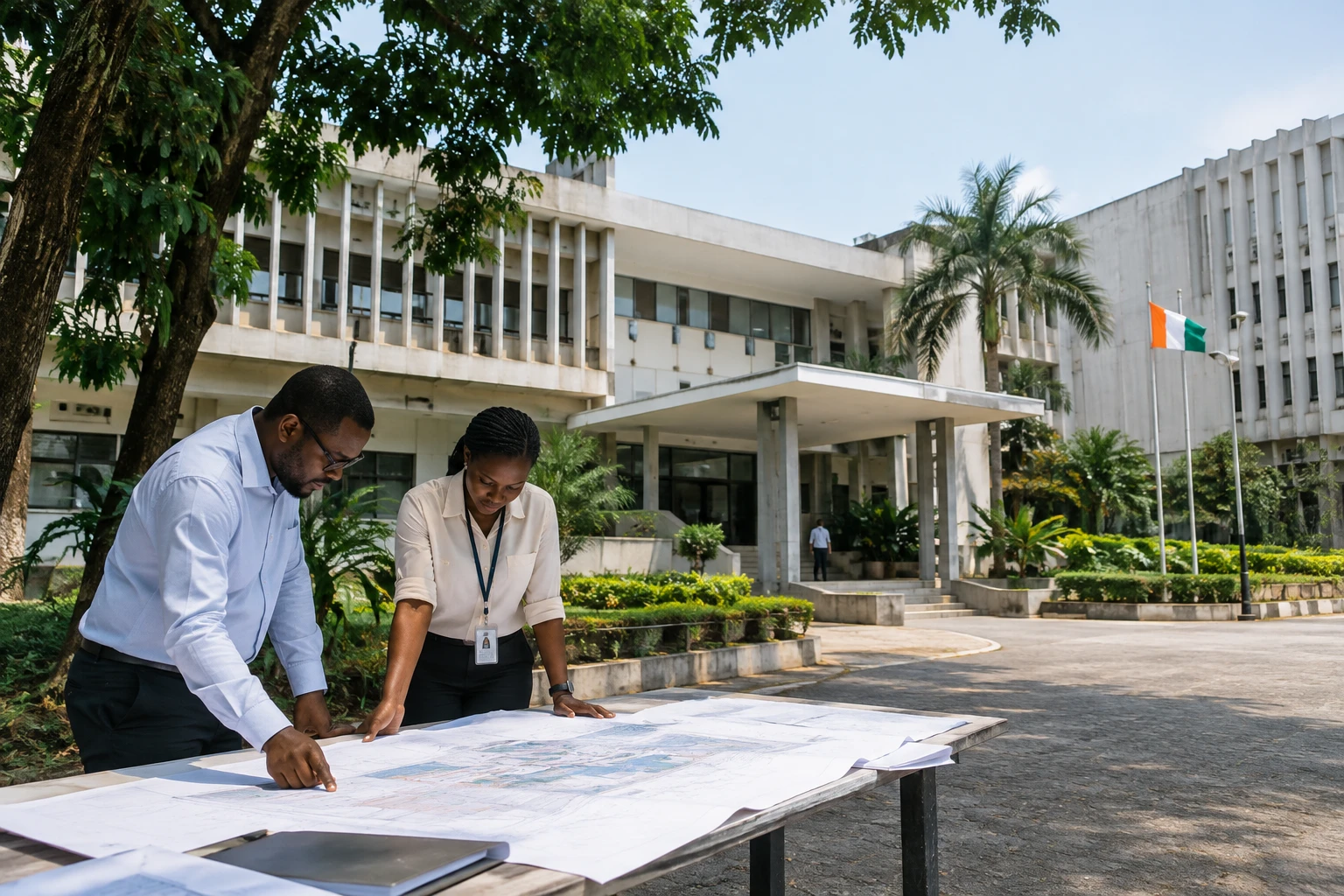
Minerals, oil and electricity could play a greater role in Côte d’Ivoire’s economy. But the decisive question is not only how much the country extracts or exports: it is also how much of the employment, procurement and processing remains in Ivorian hands.
This question arises in an economy where agriculture retains a major role, while extractive resources are gaining ground. Côte d’Ivoire is a member of ECOWAS, the Economic Community of West African States, and WAEMU, which brings together eight countries sharing the CFA franc. Its energy and mining choices therefore reach beyond its borders: they affect trade, electricity supply and value chains across the sub-region.
Turning resources into local activity
On 9 November 2026, in Abidjan, Minister of Mines, Petroleum and Energy Mamadou Sangafowa-Coulibaly presented the Integrated Mineral Resources and Energy Policy (PIRME). Adopted by the Council of Ministers on 3 December 2025, the strategy brings together the priorities of the mining, oil and energy sectors in a 15-year programme. The presentation and announced targets were reported by the ministry and the Ivorian government portal.
The plan envisages investment of 38 trillion CFA francs, or around €58 billion at the WAEMU CFA franc’s fixed exchange rate. According to the government, 88% of the expected funding would come from the private sector and 12% from the public sector. The aim is to increase the contribution of mining, hydrocarbons and energy to gross domestic product from about 7% in 2025 to 14% in 2040.
PIRME also sets local-content targets. By 2035, the government aims for Ivorian production to meet at least 95% of the goods and services required by the extractive industry. It also intends to raise the share of nationals employed in industrial mines and on oil platforms to 95%. These targets, announced by the authorities, are not results already achieved.
To meet them, the state plans to establish independent regulatory authorities in the mining and hydrocarbons sectors. It also wants to transform PETROCI, the national oil operations company, and SODEMI, responsible for mining development, into holding companies capable of supporting the emergence of Ivorian businesses. Success will depend in particular on their governance, resources and the role actually given to local suppliers in contracts.
High ambitions, results to be measured
By 2035, Côte d’Ivoire wants to rank among Africa’s five largest oil producers and become the continent’s leading gold producer. It also aims to become the sub-region’s leading energy exporter by 2040. These are government targets, not certain forecasts: their achievement will depend on discoveries, investment, infrastructure and demand.
Recent production growth offers a glimpse of the acceleration under way. The National Statistics Agency’s (ANStat) socio-economic dashboard reports that in 2025 crude oil production rose by 42.5% and natural gas production by 17.1% compared with 2024. Manganese production reached about 1.117 million tonnes, an increase of 8%. These figures, published by Côte d’Ivoire’s statistics institute, show changes in extraction but do not, on their own, indicate how much value added is retained in the country.
Exports already illustrate the weight of these activities. In 2024, raw or semi-processed gold accounted for 15.4% of goods exports by value. Crude oil represented 3.9% and other petroleum products 10.5%, according to Ivorian customs data cited by the national economic information portal. A high share of external sales can nevertheless coexist with imports of equipment, specialised services and refined products.
For workers and businesses, the challenge is therefore to move from extraction towards more subcontracting, training and processing at home. The benefits may vary between regions: industrial activity and infrastructure are concentrated around certain sites and routes, while revenues, jobs and environmental impacts also affect neighbouring communities. The policy provides for an intersectoral monitoring committee; regular publication of indicators will be essential to compare targets with results.
A regional challenge of electricity and processing
The strategy highlights projects involving several countries. These include critical-mineral processing corridors backed by the African Development Bank, a phosphate hub in the WAEMU region and the strengthening of the electricity interconnection between Côte d’Ivoire, Liberia, Sierra Leone and Guinea. The AfDB already documents the CLSG interconnection project, which links the four countries’ grids. The strengthening announced in PIRME should be distinguished from this existing infrastructure.
This regional dimension matters both to neighbouring countries and to Ivorian producers. Power lines can facilitate trade and reliable supply, while local mineral processing could retain more activity in the region. But these benefits will depend on coordination between states, funding and transparent rules on contracts and revenues.
At the continental level, PIRME is part of the debate over how to turn natural resources into productive capacity and skilled jobs. For Côte d’Ivoire, an African Union member, the next test will be less about rankings than implementation: investment actually mobilised, the share of Ivorian businesses, national employment, available energy production and verifiable benefits in local communities. The announced monitoring committee will need to make this progress clear as the 2035 and 2040 deadlines approach.
Government presentation of PIRME on 9 November 2026 · Local-content targets and production ambitions · ANStat 2025 socio-economic dashboard · Ivorian foreign trade data · CLSG regional electricity interconnection project · Independent report on the presentation of PIRME



