Algeria
 Egypt
 Libya
 Morocco
 Sudan
 Tunisia
 Benin
 Burkina Faso
 Cabo Verde
 Ghana
 Guinea
 Guinea-Bissau
 Liberia
 Mali
 Mauritania
 Niger
 Nigeria
 Senegal
 Sierra Leone
 The Gambia
 Togo
 Cameroon
 Central African Republic
 Chad
 DR Congo
 Equatorial Guinea
 Gabon
 Republic of the Congo
 São Tomé and Príncipe
 Burundi
 Comoros
 Djibouti
 Eritrea
 Ethiopia
 Kenya
 Madagascar
 Malawi
 Mauritius
 Mozambique
 Rwanda
 Seychelles
 Somalia
 South Sudan
 Tanzania
 Uganda
 Angola
 Botswana
 Eswatini
 Lesotho
 Namibia
 South Africa
 Zambia
 Zimbabwe
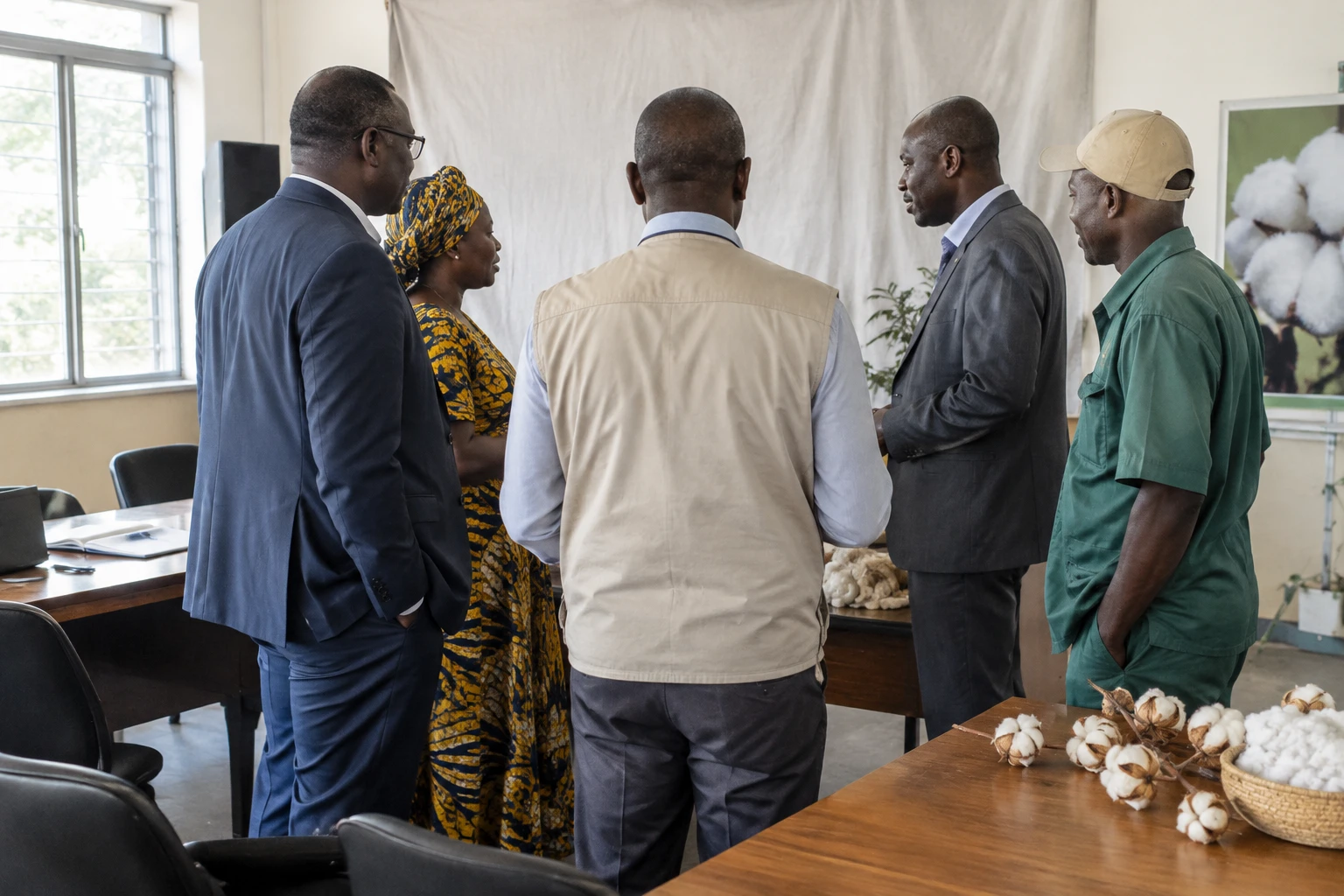
A guaranteed price is not always enough to keep producers in the sector. In Côte d’Ivoire, cotton is still paid at 310 CFA francs per kilogram for top-grade cotton, but growers leaving the sector raise a broader question: how can this crop be made viable when costs are rising and other products are attracting farmers?
A protected price in a sector under pressure
Côte d’Ivoire’s cotton sector is part of an agricultural economy in which producers weigh up several cash and food crops. In the north of the country, cotton shares land and labour in particular with maize and cashew. For farming households, the choice depends on expected income, but also on the cost of inputs, the work required and the risks to the harvest.
Côte d’Ivoire is a member of ECOWAS, the Economic Community of West African States. Across the region, its producers operate in markets where neighbouring countries also grow cotton, while international prices influence the revenues of cotton companies and margins across the sector.
The price announced to producers acts as a buffer against these fluctuations. However, it does not resolve the physical demands of the work or questions of yield and profitability at the level of individual farms.
CFAF 310 per kilo, with public support announced
On 3 November 2026 in Abidjan, the Minister of Agriculture, Rural Development and Food Crops, Bruno Nabagné Koné, announced that the price would be maintained for the 2026-2027 season: 310 CFA francs per kilogram of first-grade seed cotton and 285 francs for second-grade cotton. The figures were reported by two Ivorian media outlets, L’Avenir and Journal d’Abidjan.
According to the press conference report, the government plans to provide CFAF 29.3bn in public support to the sector. The funding is intended to support producers and reduce the impact of high costs. The exact breakdown between price support and input subsidies is not detailed in the information cross-checked; the separate amounts cited should therefore not be presented as confirmed budget lines.
The minister also cited expected production of more than 352,000 tonnes in the new season. This is a forecast target, not a harvest result. Its achievement will depend in particular on the area sown, growing conditions and yields.
Falling producer numbers are a warning sign
The stable price comes as the producer base is shrinking. Figures published by the Federation of Cotton Producers and reported in the region show a fall from about 130,000 producers to around 80,000 over four seasons. The trend echoes the minister’s comments about discouragement in the sector. However, the reference periods and counting methods are not specified consistently in the publications consulted.
This decline affects more than just cotton volumes. Fewer producers may mean less land under cultivation, but also reduced activity for co-operatives, transporters, input suppliers and ginning plants. In cotton-growing areas, seasonal income contributes to household spending and commercial activity.
For a farm, the price per kilogram is only part of the calculation. The cost of seeds, fertilisers and crop protection products must also be taken into account, along with family or paid labour and the quantity harvested per hectare. If these expenses rise or the harvest disappoints, a guaranteed price may not be enough to protect the margin.
The shift to maize or cashew is therefore an economic trade-off, not simply a change in preference. Maize can meet local food and commercial needs; cashew offers another cash-crop outlet. Choices vary according to the land, access to inputs, market access and families’ cash-flow needs.
Yields and appeal: the next tests
Sector stakeholders are counting on improved seeds and higher yields. An increase in production per hectare can raise the volume sold without a corresponding increase in land under cultivation. But this requires suitable seeds, regular technical support and inputs that are accessible at the right time.
In April 2026, the producers’ federation reported a campaign to bring farmers back to the sector, carried out with representatives of the Cotton-Cashew-Shea Council, the interprofessional body and research organisations. This mobilisation shows that the recovery effort does not rest solely on a price announcement: it also depends on dialogue with producers and the ability of support services to reach growing areas.
The next decisive indicator will be the gap between targeted production and the harvest actually marketed. It will also be necessary to track the number of registered producers, the area sown and yields, distinguishing forecasts from recorded results. For the authorities, the challenge is to support the sector without concealing its difficulties; for producers, it is to know whether cotton pays enough for the work and investment involved.
The situation in Côte d’Ivoire resonates across West Africa, where cotton sectors are also grappling with input costs and market fluctuations. ECOWAS provides a framework for regional co-operation, but pricing policies and production conditions remain largely national. In Côte d’Ivoire, the stable price sets a benchmark for the 2026-2027 season. Whether it can stem the exodus will show if that benchmark, combined with support and yield gains, is enough to make the crop attractive again.