Algeria
 Egypt
 Libya
 Morocco
 Sudan
 Tunisia
 Benin
 Burkina Faso
 Cabo Verde
 Ghana
 Guinea
 Guinea-Bissau
 Liberia
 Mali
 Mauritania
 Niger
 Nigeria
 Senegal
 Sierra Leone
 The Gambia
 Togo
 Cameroon
 Central African Republic
 Chad
 DR Congo
 Equatorial Guinea
 Gabon
 Republic of the Congo
 São Tomé and Príncipe
 Burundi
 Comoros
 Djibouti
 Eritrea
 Ethiopia
 Kenya
 Madagascar
 Malawi
 Mauritius
 Mozambique
 Rwanda
 Seychelles
 Somalia
 South Sudan
 Tanzania
 Uganda
 Angola
 Botswana
 Eswatini
 Lesotho
 Namibia
 South Africa
 Zambia
 Zimbabwe
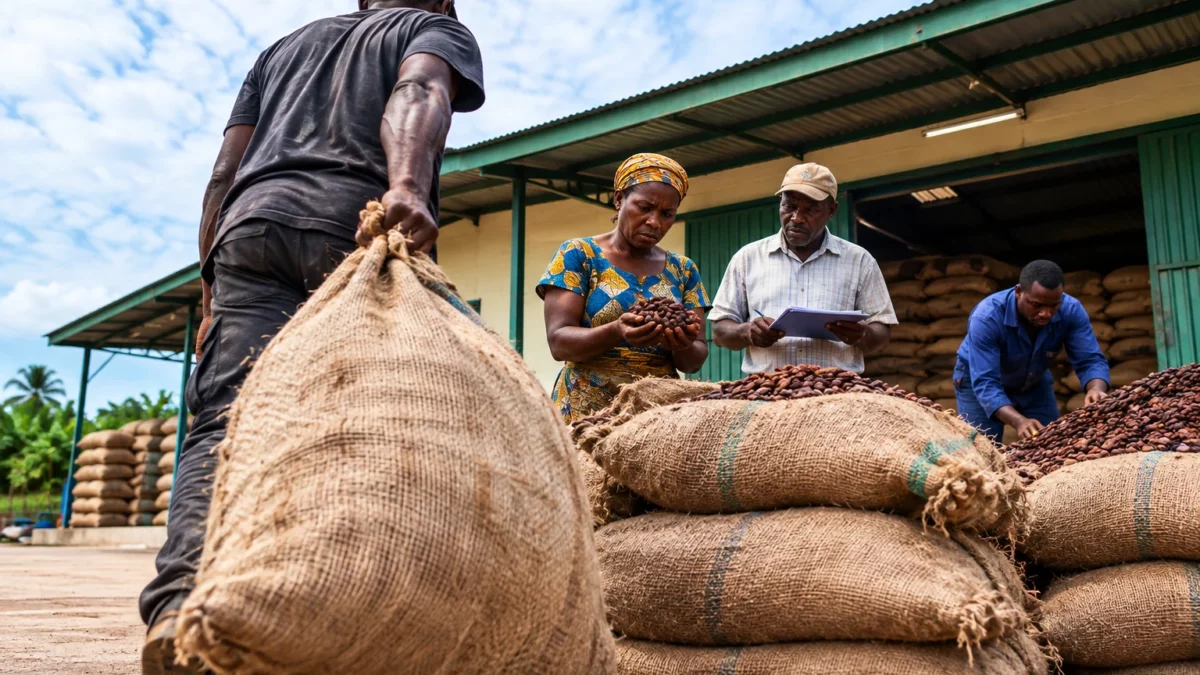
Cocoa left in a warehouse can mean delayed payment for a cooperative and its farmers. In Côte d’Ivoire, the figures behind a public operation intended to clear these beans are now being challenged in detail.
Intervention to ease the campaign
The crisis took shape during the 2025-2026 main crop season. After domestic marketing slowed in December 2025, an inventory conducted from 14 to 18 January 2026 put cooperative stocks at 123,000 tonnes, according to the report by the Coffee and Cocoa Council (CCC), the public body overseeing the sector.
The government subsequently authorised the clearance of 100,000 tonnes, with a budget of 280 billion CFA francs announced. The aim was to free up warehouse space and enable the sale of beans marketed at the guaranteed price for the main crop season. The measure did not, therefore, cover the entire recorded stock.
The intervention comes in a sector exposed to shocks in the global market. In January, the Associated Press reported that falling international prices had contributed to the accumulation of unsold cocoa in Côte d’Ivoire. For farmers, the issue is immediate: until the beans are taken in and paid for, a recorded sale does not necessarily mean the income has reached them.
Regulator’s figures, then a challenge
In a statement published on 23 November 2026, the CCC said that 96,235 tonnes had been unloaded out of the planned 100,000. It said that 269.45 billion CFA francs had been spent from the available budget. Of the volumes submitted by the Agricultural Interprofessional Organisation for the coffee and cocoa sector, 61,224 tonnes were said to have been unloaded. The Council said that 3,765 tonnes were rejected over “bean count fraud”, an irregularity relating to the number of beans in a sample.
The operation was declared complete on 5 August 2026. The figures were reported by the Ivorian News Agency, based on the Council’s report. The agency also said the published tables set out the beneficiary cooperatives, volumes and payments. The release therefore provides more verifiable data, but does not in itself settle whether the figures are accurate.
The National Agricultural Union for Progress in Côte d’Ivoire (SYNAP-CI) challenged the figures on 25 November. Its president, Koné Moussa, questioned the volumes attributed to cooperatives and the payment amounts. According to the Ivorian agency, the union said it had recorded 8,954.382 tonnes of cocoa held by cooperatives that had not been bought. This figure reflects the organisation’s position; it has not been independently established in the public information consulted.
The disagreement also concerns how volumes were allocated. The CCC report attributes 955 tonnes to SYNAP-CI, while the union disputes how the data were handled. Three elements must therefore be distinguished: figures published by the regulator, discrepancies flagged by the union, and facts that remain to be verified at each cooperative. The information available so far is not sufficient to resolve these differences.
Figures that affect incomes and trust
For farmers, the issue goes beyond accounting. Cooperatives organise storage and collective sales; a discrepancy between declared stocks, beans actually received and reported payments can strain their cash flow. In production areas, farmers are directly affected by delays in marketing. In Abidjan and San Pedro, meanwhile, export and processing operations depend on volumes moving regularly.
The CCC gives a specific reason for rejecting the 3,765 tonnes: an irregularity in the bean count. Assessing this justification would require information on the inspection procedures used, the results of checks and the avenues of appeal available to cooperatives. Likewise, publishing a list of beneficiaries does not automatically confirm that each sum was paid to the right recipient.
An independent audit could clarify these points, including by comparing the initial inventories, weighing slips, unloading reports and proof of payment. The union is calling for greater transparency. The government spokesman had previously said that state oversight bodies could intervene if there were a problem. However, the information consulted makes no mention of a completed independent audit or a judicial finding on these disputes.
An Ivorian issue with regional implications
Côte d’Ivoire, whose political capital is Yamoussoukro, plays a major role in global cocoa supplies. Difficulties in its sector also resonate across West Africa, particularly in Ghana, another major producer. But marketing rules and support schemes remain national: the two countries have no common regional mechanism that would automatically resolve unsold stocks or producer prices.
For ECOWAS, the Economic Community of West African States, this case highlights the importance of agricultural co-ordination and cross-border value chains. It also underscores the role of national decisions in rural incomes and the region’s exports. Its continental significance will depend less on the announcement of a volume than on whether marketing mechanisms can be scrutinised.
The next step is therefore concrete: the authorities will need to clarify whether an independent audit will be conducted and how cooperatives can challenge the data or unloading refusals. Until inventories and payments are publicly reconciled, the figure of 96,235 tonnes will remain a contested official figure rather than one accepted by all stakeholders.