Algeria
 Egypt
 Libya
 Morocco
 Sudan
 Tunisia
 Benin
 Burkina Faso
 Cabo Verde
 Ghana
 Guinea
 Guinea-Bissau
 Liberia
 Mali
 Mauritania
 Niger
 Nigeria
 Senegal
 Sierra Leone
 The Gambia
 Togo
 Cameroon
 Central African Republic
 Chad
 DR Congo
 Equatorial Guinea
 Gabon
 Republic of the Congo
 São Tomé and Príncipe
 Burundi
 Comoros
 Djibouti
 Eritrea
 Ethiopia
 Kenya
 Madagascar
 Malawi
 Mauritius
 Mozambique
 Rwanda
 Seychelles
 Somalia
 South Sudan
 Tanzania
 Uganda
 Angola
 Botswana
 Eswatini
 Lesotho
 Namibia
 South Africa
 Zambia
 Zimbabwe
A bank’s sustainability commitments are measured less by its statements than by its financing, recruitment and purchasing decisions. In Côte d’Ivoire, where the next National Development Plan is expected to give private capital a major role, the issue also concerns businesses seeking funds to modernise their operations.
Sustainability enters financing decisions
On 24 November, at a round table organised by the Côte d’Ivoire Network of the United Nations Global Compact, business leaders and UN representatives discussed the private sector’s contribution to the country’s development. The date and details of the meeting are reported by participants and in available accounts.
NSIA Banque Côte d’Ivoire presented the development of its corporate social responsibility (CSR) approach, which means taking account of the social and environmental effects of an organisation’s activities in its strategy and practices. Léonce Yacé, chief executive of NSIA Holding Financière, described a shift from one-off initiatives, particularly humanitarian ones, to an approach integrated into the bank’s activities.
This shift has been supported by staff training and assistance from the International Finance Corporation to develop the CSR policy. The bank also says it incorporates sustainability criteria into its financing assessments. Its “Altitude” strategic plan, adopted in 2022, strengthened this approach by placing people at the centre of its priorities.
According to the presentation at the meeting, the approach now covers several internal functions: purchasing, recruitment, dispute management and management practices. The challenge is to avoid confining social responsibility to a specialised department. For a bank, this means examining the risks and potential effects of the projects it finances, as well as their profitability.
Green capital, but also conditions for access
The bank said it had mobilised nearly €100 million for green finance and the energy transition. This is the figure presented at the meeting; the public information consulted does not make it possible to provide a full breakdown by project or period. It should therefore be understood as a figure reported by the bank, not as a detailed account of the environmental results achieved.
Green finance is intended for investments that contribute, for example, to reducing energy consumption or supporting lower-carbon energy solutions. But the existence of a fund does not in itself guarantee that the businesses concerned will be able to use it. The cost of credit, the guarantees required, the ability to prepare robust applications and the size of projects also determine access to funds.
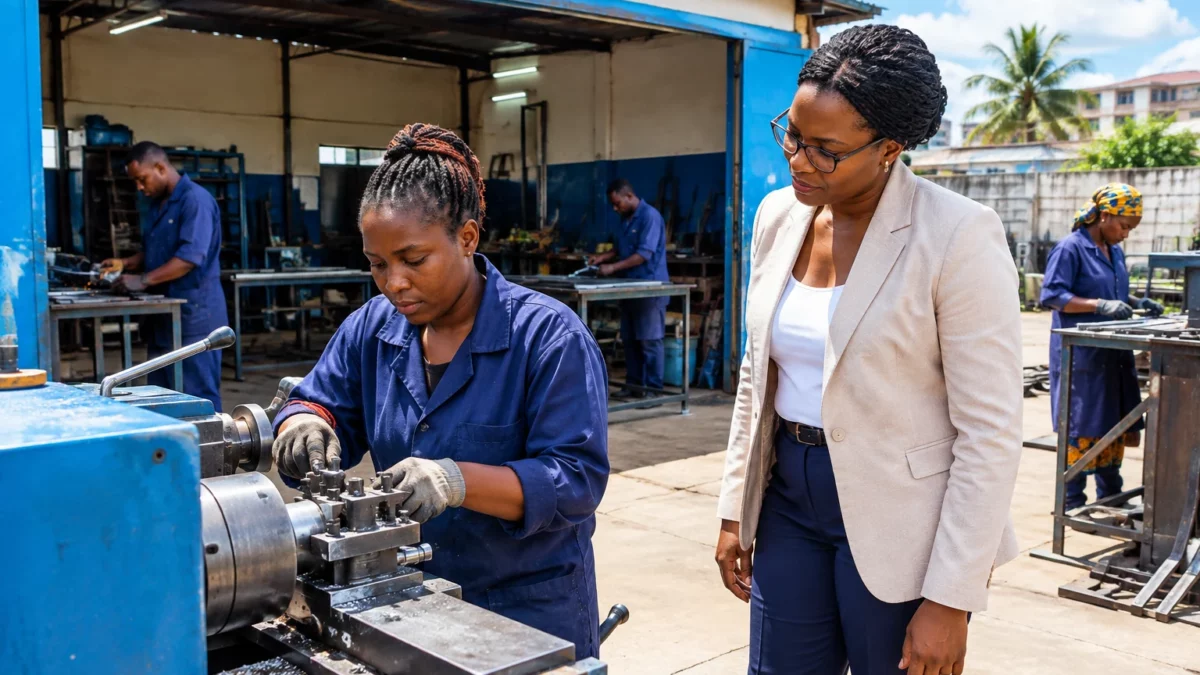
This issue is particularly important for small and medium-sized Ivorian businesses. A large company can often draw on more expertise to document its expenditure and meet the criteria for specialised finance. SMEs, including those outside Abidjan, may face greater difficulties in financing preliminary studies or providing the required guarantees. Available information on the round table does not specify how the funds are divided between business categories or regions.
Léonce Yacé also proposed adding an energy-transition component to the tax-reduction mechanism for investment. The idea is to strengthen tax incentives for businesses that invest in sustainable practices. It nevertheless raises questions about implementation: which investments would qualify, under what criteria and with what monitoring of their effects?
A national and West African issue
The meeting took place as the Ivorian government expects the private sector to make a significant contribution to development investment. The 2026-2030 National Development Plan, adopted by the National Assembly in April 2026, provides for a total budget of CFAF 114,838.5 billion. According to figures from the Ministry of Planning, 70.2% of this investment is expected to come from the private sector. This framework postdates the round table and now gives a measure of the issue raised by participants.
Mobilising private finance is not simply a matter of attracting capital. It also requires deciding which sectors benefit and on what terms. Energy, infrastructure and industrialisation are among the areas where investment can support economic transformation. For the public, the effects will depend in particular on access to more reliable services, job creation and the ability of local businesses to take part in projects.
The regional dimension also matters. Côte d’Ivoire is a member of ECOWAS, the Economic Community of West African States, and WAEMU, the economic and monetary union of eight countries that share the West African CFA franc. Banks and businesses there finance activities that sometimes extend beyond national borders. Clear, comparable criteria for sustainable investment could therefore facilitate regional financing; conversely, complex rules risk favouring the best-equipped players.
NSIA Banque’s presentation thus illustrates a change in approach: integrating social responsibility into the routine decisions of a financial institution. The next point to watch will be how these commitments translate into the financing provided, its beneficiaries and its results. The 2026-2030 National Development Plan puts the private sector in the leading role; the credibility of this ambition will also depend on how transparently investment is monitored.
Information about the meeting and the bank’s presentation is reported in the account of the Global Compact round table in Côte d’Ivoire. The current investment framework is set out in the Ivorian Ministry of Planning’s data on the 2026-2030 National Development Plan. The “Altitude” strategic plan is described in NSIA Banque’s corporate brochure.