Algeria
 Egypt
 Libya
 Morocco
 Sudan
 Tunisia
 Benin
 Burkina Faso
 Cabo Verde
 Ghana
 Guinea
 Guinea-Bissau
 Liberia
 Mali
 Mauritania
 Niger
 Nigeria
 Senegal
 Sierra Leone
 The Gambia
 Togo
 Cameroon
 Central African Republic
 Chad
 DR Congo
 Equatorial Guinea
 Gabon
 Republic of the Congo
 São Tomé and Príncipe
 Burundi
 Comoros
 Djibouti
 Eritrea
 Ethiopia
 Kenya
 Madagascar
 Malawi
 Mauritius
 Mozambique
 Rwanda
 Seychelles
 Somalia
 South Sudan
 Tanzania
 Uganda
 Angola
 Botswana
 Eswatini
 Lesotho
 Namibia
 South Africa
 Zambia
 Zimbabwe
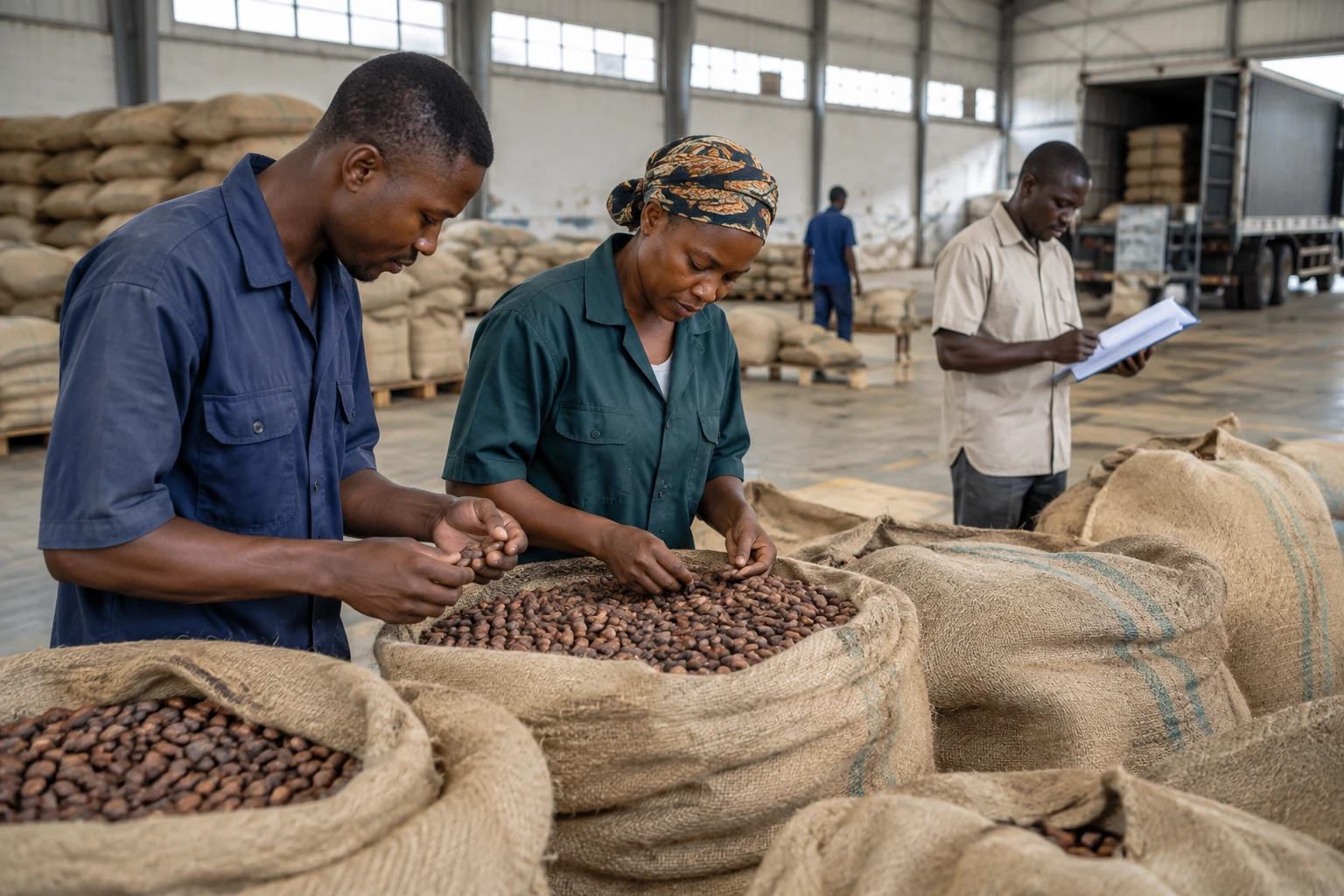
Does a guaranteed price protect producers when buyers can no longer finance their purchases? Côte d’Ivoire’s 2016-2017 cocoa crisis made the question concrete: within months, beans piled up, contracts unravelled and the regulator had to intervene.
A system designed to cushion shocks
In Côte d’Ivoire, cocoa directly links the incomes of many farmers to export earnings and public finances. The country also shares the sector with Ghana, the region’s second-largest producer. Decisions taken in Abidjan therefore have effects beyond Côte d’Ivoire’s borders.
After the sector was liberalised in the 1990s, the state reorganised the industry. The Coffee and Cocoa Council (CCC), operational since 2012, oversees marketing and sets a minimum farmgate price: the amount buyers must pay producers at the farm.
The system relies in particular on forward sales. The CCC sells a large share of the expected harvest before it reaches the market. The method is intended to give exporters visibility and enable a guaranteed price for farmers to be set, despite fluctuations in international prices.
This protection reflects a difficult experience. Before the reform, producers were more exposed to price changes. But stabilisation has its limits: it also depends on buyers’ ability to finance the volumes they purchase and honour their contracts.
The 1,100 CFA franc price, then a reversal
On 28 September 2016, at the opening of the 2016-2017 main season, the authorities announced a guaranteed price of 1,100 CFA francs per kilogram. This was an increase on the previous season. Yet international prices began to fall amid abundant stocks and expectations of a large harvest.
The timing made the situation more difficult. Exporters had to buy beans at the announced price, often using bank financing, and then sell them under contracts agreed on the global market. When prices fell, the gap between their commitments and expected revenues widened. The higher farmgate price also increased the working capital needed to collect the beans.
In February 2017, the Ivorian government reported that about 350,000 tonnes were affected by contract defaults and an underestimation of production. This volume represented a significant share of the expected harvest. Buyers slowed their purchases, while stocks accumulated in collection channels and near the ports of Abidjan and San Pedro. The figures and explanation given are set out in a 22 February 2017 statement by the Ivorian government.
For farmers, the deadlock threatened access to the guaranteed price itself: an official price cannot fully protect a producer if their crop has no buyer. Prolonged storage also raised concerns about bean quality. Producer organisations called for measures to unblock purchases.
The shock was also reflected in the mid-crop season. On 30 March 2017, the government set its guaranteed price at 700 CFA francs per kilogram, against 1,100 CFA francs for the main season. It cited the fall in world prices and the mechanism linking producer prices to a share of the international price. The decision, announced on the Ivorian government’s official portal, illustrates the dilemma: supporting incomes while taking account of the revenue available to the sector.
The regulator absorbs part of the shock
The CCC then suspended forward sales for the following season, while existing contracts still had to be dealt with. In response to defaults, the regulator took over volumes and resold them on less favourable terms. This emergency response was intended to prevent the deadlock from spreading further among farmers and exporters.
The exact cost depends on the period and scope considered. A CCC audit puts the net cost of the crisis to the council at 185bn CFA francs, in the form of repayments and support. This figure may not cover all potential losses related to contracts that had yet to be settled, the audit report published in 2018 notes. It is therefore better to use this documented figure than present a rounded estimate as a definitive assessment.
The crisis also led to a change at the head of the institution. The reserve fund, created to cushion difficulties in the sector, was used to finance support. Its use shows the value of a stabilisation mechanism, but also the risk of depleting its resources quickly when a shock hits prices, contracts and cash flow at the same time.
A lesson that remains relevant for the current season
Ten years later, the 2026-2027 season has just opened. The minimum price announced for cocoa is 1,200 CFA francs per kilogram, according to the authorities and information reported by the Ivorian Press Agency. The price alone is not enough to measure the system’s strength: actual purchases, payments to farmers and the sale of volumes must also be monitored. The AIP report on the current season also highlights traceability and quality.
The sector must now contend with other pressures: climate risks, crop diseases, traceability requirements and rules against deforestation in some export markets. These do not replace the financing challenge. They add to it, bringing costs and responsibilities that do not fall equally on smallholders, co-operatives, exporters and the state.
The lesson of 2016-2017 is not that guaranteed prices are useless. It is that they must be backed by credible harvest forecasts, buyers able to finance their contracts and sufficient reserves to absorb a downturn. For Côte d’Ivoire and its West African partners, the challenge remains to protect rural incomes without leaving marketing vulnerable to the next market shock.