Algeria
 Egypt
 Libya
 Morocco
 Sudan
 Tunisia
 Benin
 Burkina Faso
 Cabo Verde
 Ghana
 Guinea
 Guinea-Bissau
 Liberia
 Mali
 Mauritania
 Niger
 Nigeria
 Senegal
 Sierra Leone
 The Gambia
 Togo
 Cameroon
 Central African Republic
 Chad
 DR Congo
 Equatorial Guinea
 Gabon
 Republic of the Congo
 São Tomé and Príncipe
 Burundi
 Comoros
 Djibouti
 Eritrea
 Ethiopia
 Kenya
 Madagascar
 Malawi
 Mauritius
 Mozambique
 Rwanda
 Seychelles
 Somalia
 South Sudan
 Tanzania
 Uganda
 Angola
 Botswana
 Eswatini
 Lesotho
 Namibia
 South Africa
 Zambia
 Zimbabwe
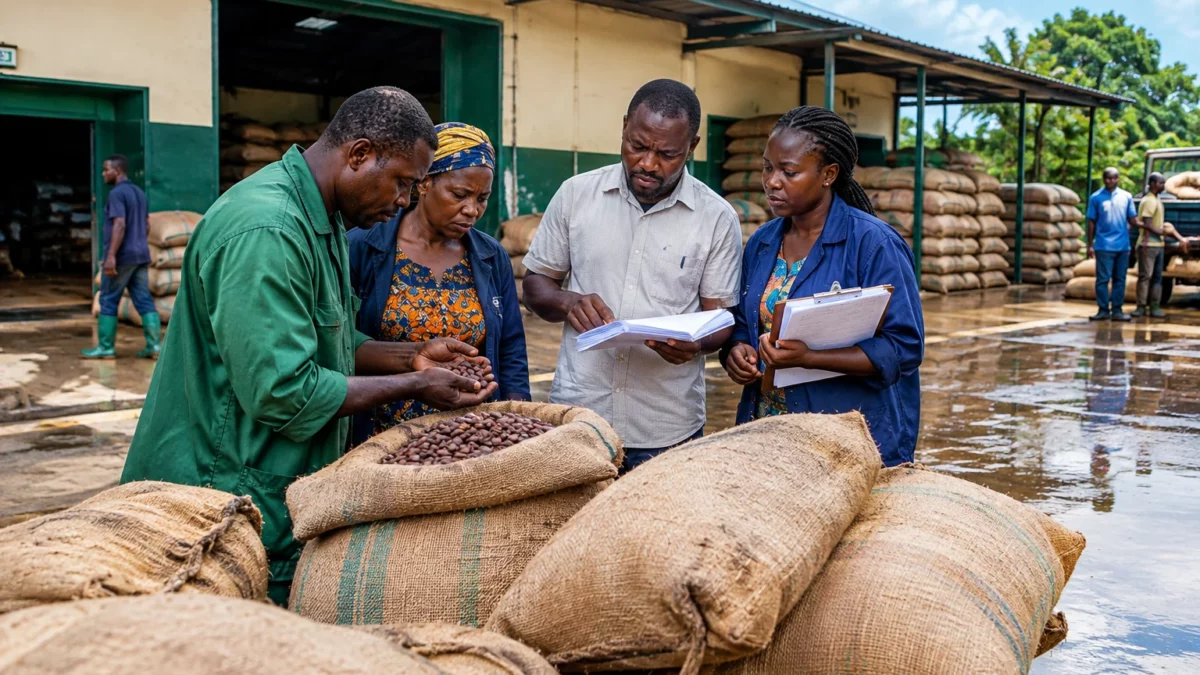
A public stock announced as almost entirely cleared does not necessarily mean that the beans have left cooperative warehouses. In Côte d’Ivoire, the gap between the administrative account and stocks still reported by supply-chain actors now raises a practical question: what quantities were bought, from whom and with what proof of payment?
Emergency intervention after purchases stalled
Tensions emerged during the main 2025-2026 season, when buyers slowed their purchases and beans piled up in production areas. The Coffee and Cocoa Council (CCC), the public regulator of the sector, recorded 123,000 tonnes held by cooperatives in an inventory carried out from 14 to 18 January 2026. The government then mobilised CFAF 280 billion to organise the removal of 100,000 tonnes at the guaranteed price of CFAF 2,800 per kilogram.
The scheme was intended to inject liquidity into the supply chain and clear the stocks that had built up. The CCC handled the initial volumes, then the Coffee and Cocoa Agricultural Interprofessional Organisation (OIA-CC), which represents the sector’s organised stakeholders, proposed lots and cooperatives for the next phase of the operation. Côte d’Ivoire, whose agricultural economy depends heavily on cocoa, was seeking to cushion the effects of a market downturn and declining commercial purchases.
Official figures disputed by farming organisations
In a note dated 20 November 2026, the CCC says 96,235 tonnes were cleared: 35,011 tonnes directly by the regulator and 61,224 tonnes proposed by the OIA-CC. It also says 3,765 tonnes proposed by the interprofessional body were rejected for “fraud on bean count”, meaning a discrepancy between bean size and the declared quality. The amount spent is said to total CFAF 269.46 billion, out of the CFAF 280 billion planned.
The National Agricultural Union for Progress in Côte d’Ivoire (SYNAPCI) has cast doubt on these figures. Its president, Moussa Koné, has called for proof of payment to be published and disputed the allocation of 955 tonnes to the union, which says it does not buy cocoa. The allocation nevertheless appears in the CCC’s account. The union is calling for documents that would make it possible to verify the volumes concerned and the beneficiaries.
The disagreement is not limited to SYNAPCI. The Collective of Cooperative Companies and Buyers of Côte d’Ivoire (CSCA-CI) has also called for stocks to be checked “operator by operator, stock by stock and volume by volume”. Its president, Stéphane Takry Goupi, says the collective’s members still hold 10,287.718 tonnes from the season, worth an estimated CFAF 28.805 billion according to the collective. These figures come from the group and do not, at this stage, constitute an independent inventory published by the authorities.
Figures that do not answer every question
The CCC’s data establish the volume it says it cleared and the expenditure incurred. On their own, they do not resolve questions about the fate of lots that were not selected, stocks that may remain with cooperatives or whether the records match the beans physically present in warehouses. The collective is calling in particular for access to purchase declarations, removal slips, proof of payment and administrative tracking data.
The bean-count check illustrates what is at stake. This criterion measures the number of beans in a given weight and affects the commercial assessment of cocoa. The CCC describes the 3,765 rejected tonnes as non-compliant lots; for those calling for an audit, it remains essential to be able to examine the rejection decisions and their traceability. The two questions — the quality of the lots and whether they were actually removed — are not the same.
For farmers and cooperatives, the gap between physical stocks, recorded volumes and payments can prolong the tying up of income and complicate the repayment of advances. Exporters and the authorities, meanwhile, have to manage the effects of the market downturn and the slowdown in trade. Documentary transparency is therefore a matter of trust as well as accounting.
A governance test for the sector and the region
The government had defended the operation as a way to restore liquidity and ensure that beans were moved to factories and the ports of Abidjan and San Pedro. The public intervention committed considerable resources; its credibility now depends on the possibility of reconciling financial figures, lists of beneficiaries and stocks actually cleared. An independent audit, if commissioned, could clarify the discrepancies without presuming wrongdoing.
The issue extends beyond Côte d’Ivoire’s borders. Côte d’Ivoire and Ghana account for a large share of Africa’s global cocoa supply in West Africa; disruptions to sales in either country can affect farmers, traders and the region’s processing chains. The immediate task for Ivorian institutions is to respond to requests for supporting documents and clarify how residual stocks will be handled. In Yamoussoukro, the country’s political capital, as in production areas, the question is whether an emergency programme can also leave behind verifiable accounts and restored trust.