Algeria
 Egypt
 Libya
 Morocco
 Sudan
 Tunisia
 Benin
 Burkina Faso
 Cabo Verde
 Ghana
 Guinea
 Guinea-Bissau
 Liberia
 Mali
 Mauritania
 Niger
 Nigeria
 Senegal
 Sierra Leone
 The Gambia
 Togo
 Cameroon
 Central African Republic
 Chad
 DR Congo
 Equatorial Guinea
 Gabon
 Republic of the Congo
 São Tomé and Príncipe
 Burundi
 Comoros
 Djibouti
 Eritrea
 Ethiopia
 Kenya
 Madagascar
 Malawi
 Mauritius
 Mozambique
 Rwanda
 Seychelles
 Somalia
 South Sudan
 Tanzania
 Uganda
 Angola
 Botswana
 Eswatini
 Lesotho
 Namibia
 South Africa
 Zambia
 Zimbabwe
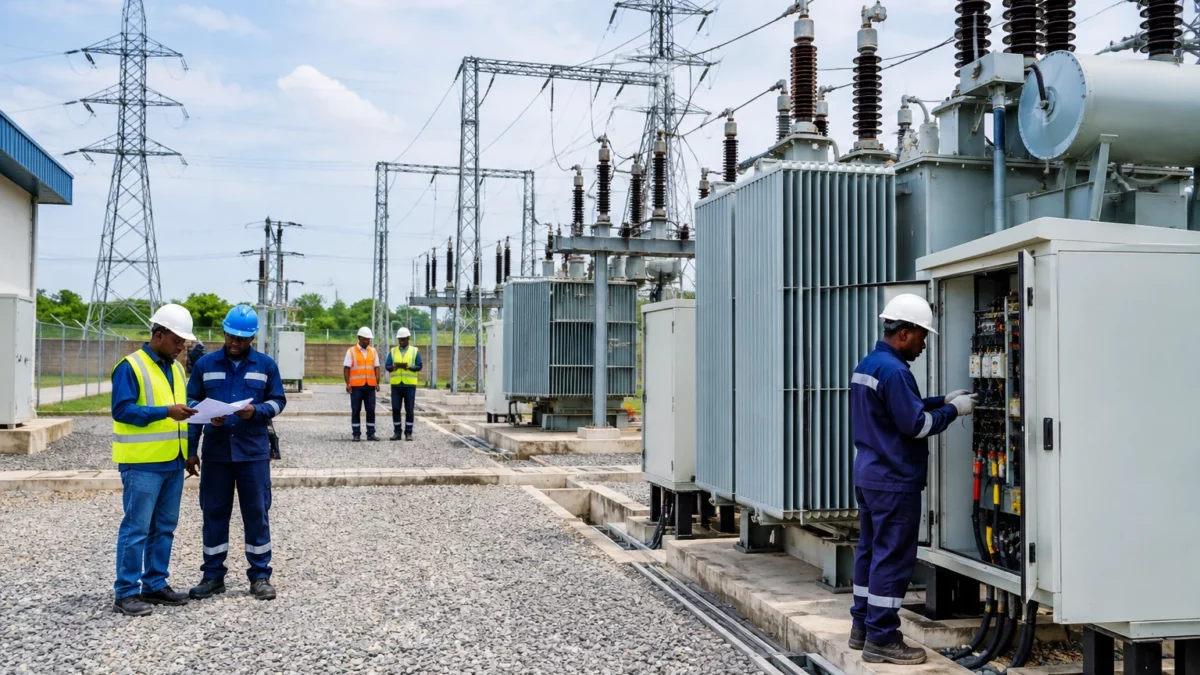
Storing electricity does not produce new kilowatt-hours. But it can help prevent available energy from going to waste when demand and production do not match. That is the purpose of the financing ratified by Ivory Coast to install batteries as part of a regional programme.
A national grid at the heart of West African power trade
Ivory Coast plays an important role in electricity trade in West Africa. Its grid is connected to those of neighbouring countries and contributes to the operation of the West African Power Pool, which facilitates cross-border electricity trade. The Economic Community of West African States (ECOWAS), the regional economic community, coordinates projects aimed at strengthening these interconnections.
The programme in question brings together several countries in the region and the ECOWAS Commission. Its BEST component — short for “Battery Energy Storage Technology” — is intended to support access to electricity and grid stability. Batteries can store energy and then release it when the system needs it. They also help regulate frequency, an essential parameter for keeping the grid operating stably.
This regional infrastructure matters to households and businesses, as well as to countries that import or export electricity. A disruption to an interconnected grid can have effects beyond national borders. Conversely, better-coordinated equipment can facilitate exchanges between national systems.
Additional loan to finance storage
On 25 November 2026, the Ivorian Council of Ministers ratified a €5.2 million loan agreement, equivalent to about CFA francs 3.41 billion. Signed on 18 July 2026 with the International Development Association (IDA), the World Bank Group institution that provides financing to low-income countries, the loan is additional funding for the regional electricity access project.
The government statement specifies that the programme provides for a storage system with a total capacity of 205 megawatt-hours (MWh). The equipment is intended to help control frequency and will be connected to the 225-kilovolt (kV) busbars at the substations concerned. A megawatt-hour measures a quantity of stored energy; on its own, it does not indicate the instantaneous power the batteries can deliver.
In Korhogo, Boundiali and Odienné, in the north of the country, the project provides for 105 MWh of equipment, as well as protection against flooding and fires. The 205 MWh figure refers to the system described under the regional programme; 105 MWh is the share specified for these three Ivorian towns. ECOWAS also describes the installation of 205 MWh as a goal of the regional programme.
Batteries are useful, but do not replace generation
Storage can help absorb fluctuations in solar or wind power generation and supply electricity when these sources produce less. It can therefore make the grid more flexible and facilitate the integration of new renewable capacity. However, batteries do not create energy: their usefulness depends on the electricity available to charge them, how long they can store it, and the quality of the lines and substations connecting them to the grid.
Ivory Coast had installed generation capacity of 3,019 MW in 2024, according to ministry data cited by the Ivorian economic portal. That same year, gross production came from thermal power plants (75.13%), hydropower (24.5%) and solar power (0.37%), according to government figures. The country aims for renewables to account for 45% of its electricity mix by 2030.
This gap between the current generation mix and the stated target gives storage a role, without making it a sufficient solution. The effective connection of installations, their maintenance and availability, and the growth of renewable capacity will also affect the results. The protections planned in Korhogo, Boundiali and Odienné are a reminder that continuity of service also depends on equipment being resilient to local risks.
For consumers, the expected effect is indirect: greater stability may help limit grid imbalances, but the loan does not in itself mean lower tariffs or an immediate improvement in service in every locality. The benefits will depend on implementation and coordination between generation, storage and transmission. Potential gains concern connected customers, economic activity and regional trade, while remote areas will also continue to depend on the expansion of distribution networks.
An issue that extends beyond Ivory Coast’s borders
The project is part of a trend in which national grids are increasingly interconnected. In June 2026, ECOWAS brought together representatives of the five beneficiary countries — Ivory Coast, Mali, Mauritania, Niger and Senegal — to review progress on the BEST programme. This coordination matters: storage installed in one country can help stabilise an interconnected grid, but its effect also depends on trading rules and the capacity of cross-border lines.
The next step, then, is less about announcing capacity than delivering it: the construction schedule, connection of the batteries, commissioning and monitoring of their contribution to the grid. For Ivory Coast, the project combines a national goal of diversifying electricity supply with a regional ambition to share energy. The loan ratified on 25 November provides targeted financing; its tangible impact will be measured once the equipment is operational and electricity trade can rely on a more stable grid.