
 Algeria
 Egypt
 Libya
 Morocco
 Sudan
 Tunisia
 Benin
 Burkina Faso
 Cabo Verde
 Ghana
 Guinea
 Guinea-Bissau
 Liberia
 Mali
 Mauritania
 Niger
 Nigeria
 Senegal
 Sierra Leone
 The Gambia
 Togo
 Cameroon
 Central African Republic
 Chad
 DR Congo
 Equatorial Guinea
 Gabon
 Republic of the Congo
 São Tomé and Príncipe
 Burundi
 Comoros
 Djibouti
 Eritrea
 Ethiopia
 Kenya
 Madagascar
 Malawi
 Mauritius
 Mozambique
 Rwanda
 Seychelles
 Somalia
 South Sudan
 Tanzania
 Uganda
 Angola
 Botswana
 Eswatini
 Lesotho
 Namibia
 South Africa
 Zambia
 Zimbabwe
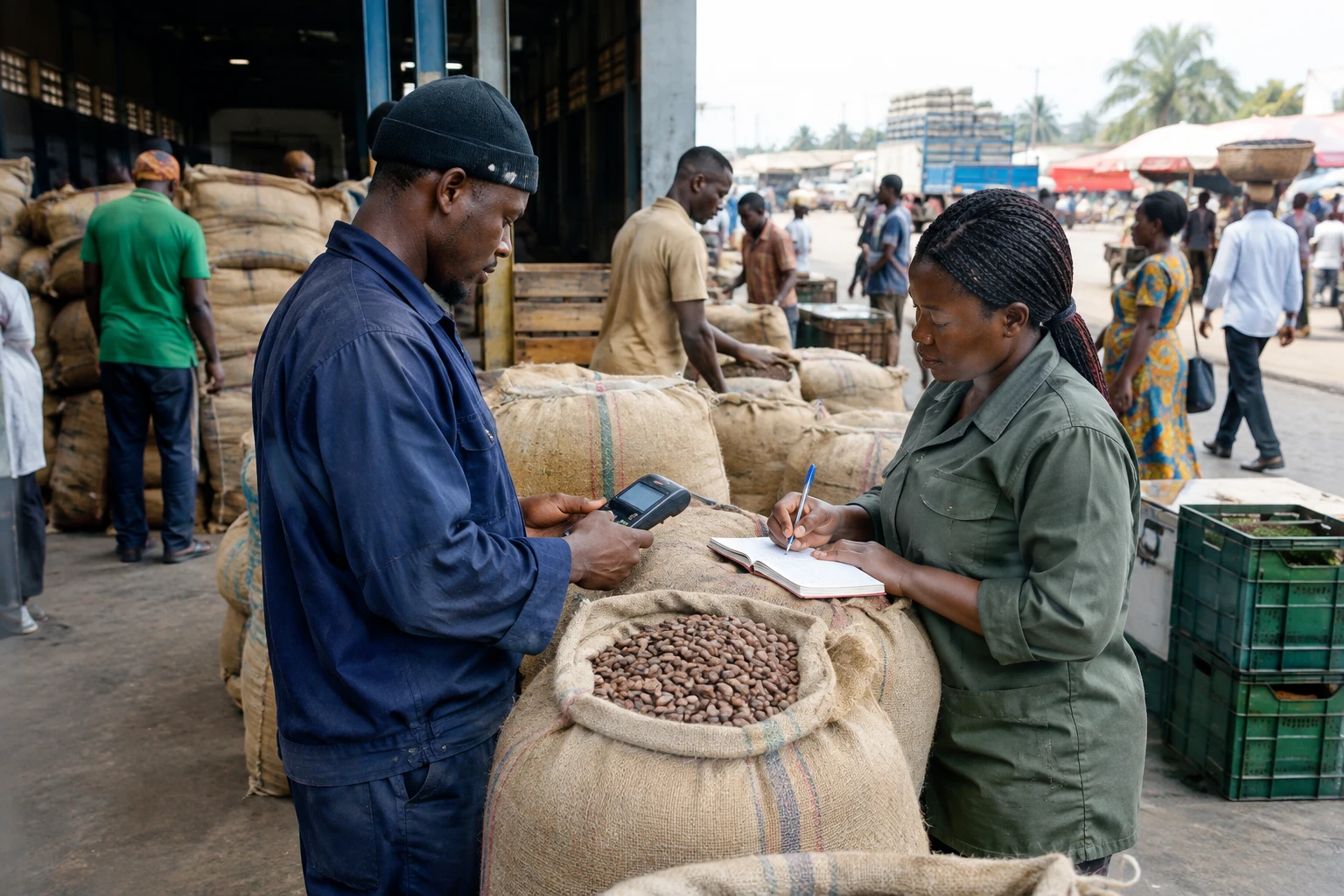
Between the price paid to the producer and the bean sold for export, coffee and cocoa pass through a chain of players who often have to finance their operations before receiving revenue. In Côte d’Ivoire, a bank has announced that it will step up its support for this chain during the 2026-2027 season. One practical question remains: how can financing support collection, agricultural incomes and local processing at the same time?
A season already governed by guaranteed prices
The 2026-2027 main season was officially opened in Abidjan on 1 September. The government announced a guaranteed minimum price of CFAF 1,200 per kilogram for cocoa and CFAF 1,300 for coffee. These farm-gate prices set the minimum amounts due to producers for their harvest. The Ivorian Press Agency reported the announcement, which was also relayed by the Coffee and Cocoa Council, the public body responsible for regulating the sector.
This framework is important for growers, but it does not in itself address the sector’s cash-flow needs. Costs mount up before the final sale, from buying the beans to transporting, drying and storing them, and moving them to ports or processing plants. Cooperatives, traders and exporters need to be able to mobilise funds at the right time.
The issue extends beyond national borders. Côte d’Ivoire is a member of WAEMU, the West African Economic and Monetary Union, and ECOWAS, the regional economic community of West Africa. Cocoa trade links producers, transporters, businesses and financial services across the region, while Ivorian decisions carry weight in regional and global markets.
Bank financing announced for several links in the chain
On 29 September 2026 in Abidjan, Banque Atlantique Côte d’Ivoire launched its banking programme for the season, in the presence of Naziha Belkeziz, chief executive of the Banque Centrale Populaire (BCP) group, which owns the bank. The institution says it aims to support the entire chain, from production to export, including collection, trading, storage and processing.
The announced offer covers seasonal and collection financing, pre-financing of operations, storage, exporters’ activities, and investments and local processing projects. The bank is drawing in particular on its “Agri Desk”, a specialised service presented as tailored to the sector’s cycles and needs. However, the available information does not specify the detailed terms — committed volumes, beneficiaries, credit conditions or expected results.
This distinction matters. Announcing a programme or a financing facility is not, in itself, enough to measure cooperatives’ and producers’ actual access to credit. Smaller organisations do not necessarily have the same collateral, administrative capacity or banking relationships as large traders and exporters. The programme’s impact will therefore also depend on how the financing is distributed.
Financing: a lever, but also an area to watch
For a cooperative, seasonal credit can make it easier to buy beans and transport them without having to wait for payment from a buyer. For an exporter, pre-financing can cover operations through to shipment. Storage, meanwhile, can provide greater flexibility in organising sales. These mechanisms can make the chain run more smoothly, provided repayment deadlines take account of the agricultural and commercial calendar.
Producers are at the heart of the issues, but they are not always the direct first beneficiaries of bank financing. Better cash flow for intermediaries does not automatically guarantee prompt payment to growers or compliance with the minimum price. Transparent purchasing, traceable payments and strong cooperatives will therefore remain crucial.
Local processing is another issue. Financing equipment or industrial projects can increase the value created in Côte d’Ivoire, beyond the sale of beans. But such investments require capital, markets and the capacity to cope with fluctuations in prices and costs. Their contribution will be judged by the capacity actually brought into operation and the value retained in the Ivorian economy.
A test for the sector and regional finance
Banque Atlantique places its initiative within the strategy of the BCP group, which is present in several African countries and active in the WAEMU region. This regional presence could help support operators working across several markets. It does not, however, replace Ivorian public regulation or the professional organisations representing the different links in the sector.
For the current season, the indicators to watch will be concrete: cooperatives’ access to financing, payment speed, collection and storage capacity, and the delivery of announced processing investments. The results will show whether the stronger banking presence amounts to a change that businesses and producers can actually feel.
Côte d’Ivoire’s sector is part of an interconnected West African economy, but its benefits remain primarily national and local. In Yamoussoukro, the country’s political capital, as well as in production areas and Abidjan, where some commercial activities are concentrated, the challenge is to forge stronger links between financing, production and value creation. The next season review will show whether the new bank financing has met this need.



