Algeria
 Egypt
 Libya
 Morocco
 Sudan
 Tunisia
 Benin
 Burkina Faso
 Cabo Verde
 Ghana
 Guinea
 Guinea-Bissau
 Liberia
 Mali
 Mauritania
 Niger
 Nigeria
 Senegal
 Sierra Leone
 The Gambia
 Togo
 Cameroon
 Central African Republic
 Chad
 DR Congo
 Equatorial Guinea
 Gabon
 Republic of the Congo
 São Tomé and Príncipe
 Burundi
 Comoros
 Djibouti
 Eritrea
 Ethiopia
 Kenya
 Madagascar
 Malawi
 Mauritius
 Mozambique
 Rwanda
 Seychelles
 Somalia
 South Sudan
 Tanzania
 Uganda
 Angola
 Botswana
 Eswatini
 Lesotho
 Namibia
 South Africa
 Zambia
 Zimbabwe
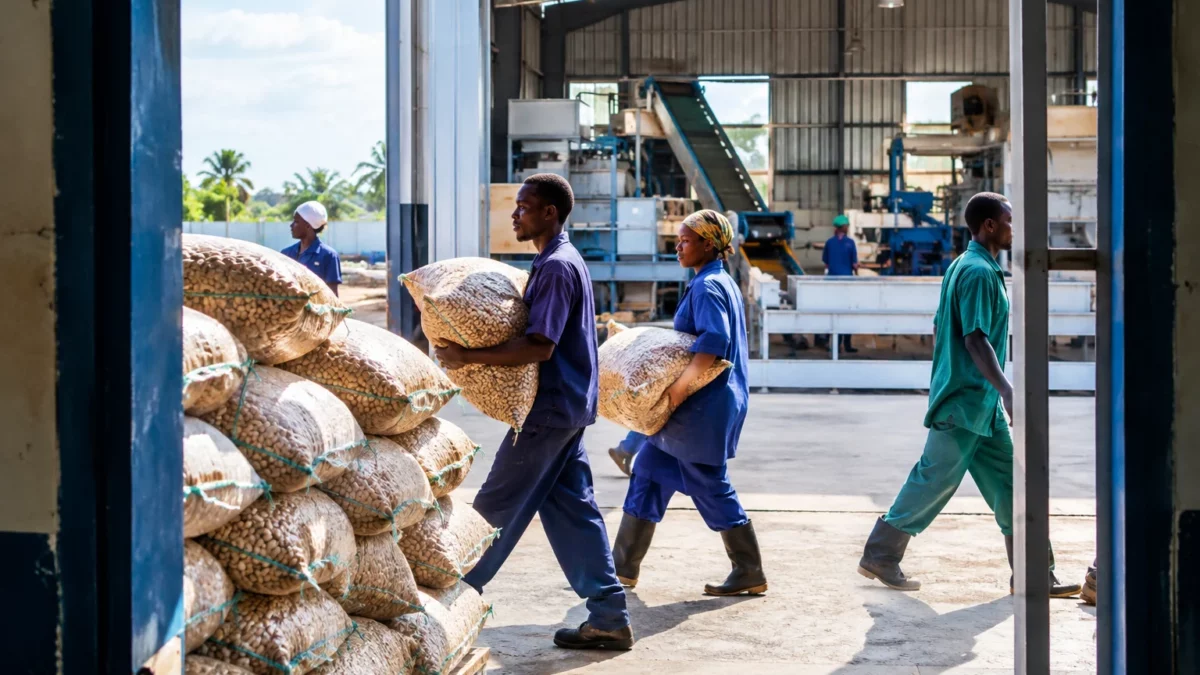
A processing plant does not start production when its machinery arrives. It also needs spaces designed to receive raw materials, store them and organise their movement. In Odienné, in the north-west of Côte d’Ivoire, this infrastructure supports a broader ambition: to process more cashew nuts close to where they are produced.
From harvest to factory, a decisive logistical link
Odienné lies at the heart of a region where cashew is an important agricultural activity. In June 2024, the EcoCajou factory was inaugurated there, with a nominal capacity to process 15,000 tonnes of raw nuts a year. The Ivorian Press Agency and the company confirmed this capacity and the opening date. The facility belongs to the ECOOKIM union of co-operatives. The Ivorian Press Agency reports on the opening of the Odienné factory.
The project includes 12,000 sq m of steel buildings supplied by Steel Shed, according to information provided about the construction project. An Ivorian partner carried out the assembly. These spaces are more than simple shelters: they connect the receipt and storage of nuts with the shelling lines and the packaging of kernels.
Storage is particularly important in a seasonal industry. Without sufficient capacity, producers and co-operatives may have to sell quickly, even when market conditions are unfavourable. A warehouse alone does not resolve questions of price or financing. It does, however, provide more scope to store the harvest and supply the factory in line with its production schedule.
Processing is increasing, but remains incomplete
Côte d’Ivoire is seeking to retain a greater share of the value created by its agricultural products. For cashew, official figures point to a marked increase: the share processed locally is said to have risen from 2% in 2011 to more than 42% in 2025, equivalent to more than 660,000 tonnes processed. The Prime Minister’s Office published these figures in 2026; they remain government figures and should be read as such. The Prime Minister’s Office presents Ivorian cashew-processing figures.
This progress is also supported by agro-industrial zones in producing regions. The government cites Korhogo, Bondoukou and Séguéla in particular. In February 2025, it announced that three zones would begin operating, with the aim of adding at least 150,000 tonnes of processing capacity from the 2026 season. The gap between this announced capacity and the volume actually processed will depend on operators setting up, supplies and the availability of equipment. The Ivorian government sets out the role of agro-industrial zones.
The question of buildings therefore goes beyond cashew alone. A poorly sized structure can slow the movement of materials, complicate maintenance or limit the expansion of a production line. By contrast, a building suited to the machinery, harvest volumes and constraints of the site can reduce delays between products arriving and being processed.
Local assembly, a first step towards greater value
At the Odienné construction site, assembly by an Ivorian partner illustrates a tangible opportunity for local participation. Teams can also adapt certain components to measurements taken on site and carry out maintenance. These tasks require technical skills, even when the main components are made elsewhere.
Local manufacture of components, meanwhile, remains subject to specific industrial constraints. Vincent Lyonnet, a partner at Steel Shed, cites hot-dip galvanising in particular, a process that protects steel from corrosion with a zinc coating. According to him, equipment available locally cannot always accommodate the large components used by the group. This observation relates to his business and is not enough to provide a full picture of Côte d’Ivoire’s metalworking capacity.
Other components appear more accessible in the short term, such as insulation, joinery and certain aluminium elements. Partnerships with Ivorian suppliers could incorporate these products into projects assembled locally. Training in digital tools, installation and maintenance then becomes as important as investment in equipment: it determines local companies’ ability to participate sustainably in the industrial supply chain.
Investing outside Abidjan also means securing land
Industrial development depends on more than workshops. Investors need to find serviced plots, verify land rights and assess the cost of access to utilities and roads. These processes can weigh more heavily on a project based in a secondary city than on a site already connected to major logistics corridors.
Abidjan, the economic capital and the country’s main port, facilitates the transport of some imported equipment. But processing in producing regions is also intended to bring factories closer to harvests. The challenge is therefore to connect the two scales: ports and international suppliers on the one hand; producers, co-operatives and industrial sites inland on the other. The political capital remains Yamoussoukro, while the logistical decisions and port flows discussed here mainly concern Abidjan.
The benefits are not automatically shared equally. Industrial companies may gain capacity and a more regular supply. Producers may benefit from closer markets and greater scope for storage, without any guarantee of a better price. Processing and maintenance jobs may grow in regional cities, provided plants continue operating after their inauguration and have sufficient orders, energy and raw materials.
A West African value-chain challenge
For Côte d’Ivoire, a member of ECOWAS — the West African economic integration organisation — the issue feeds into a regional question: where are jobs and added value linked to agricultural production created? Industrial buildings are only one link in the chain, alongside financing, skills, access to energy and market organisation.
The next step will be to establish whether the new agro-industrial zones actually attract processors and reach their announced capacities. It will also be important to observe the role reserved for Ivorian companies in supplying components, construction and maintenance. This is the scale at which industrialisation will be measured: not only by the number of square metres built, but by the continuity of production and the share of activity that remains in local communities.