Algeria
 Egypt
 Libya
 Morocco
 Sudan
 Tunisia
 Benin
 Burkina Faso
 Cabo Verde
 Côte d'Ivoire
 Ghana
 Guinea
 Guinea-Bissau
 Liberia
 Mali
 Mauritania
 Niger
 Nigeria
 Senegal
 Sierra Leone
 The Gambia
 Togo
 Central African Republic
 Chad
 DR Congo
 Equatorial Guinea
 Gabon
 Republic of the Congo
 São Tomé and Príncipe
 Burundi
 Comoros
 Djibouti
 Eritrea
 Ethiopia
 Kenya
 Madagascar
 Malawi
 Mauritius
 Mozambique
 Rwanda
 Seychelles
 Somalia
 South Sudan
 Tanzania
 Uganda
 Angola
 Botswana
 Eswatini
 Lesotho
 Namibia
 South Africa
 Zambia
 Zimbabwe
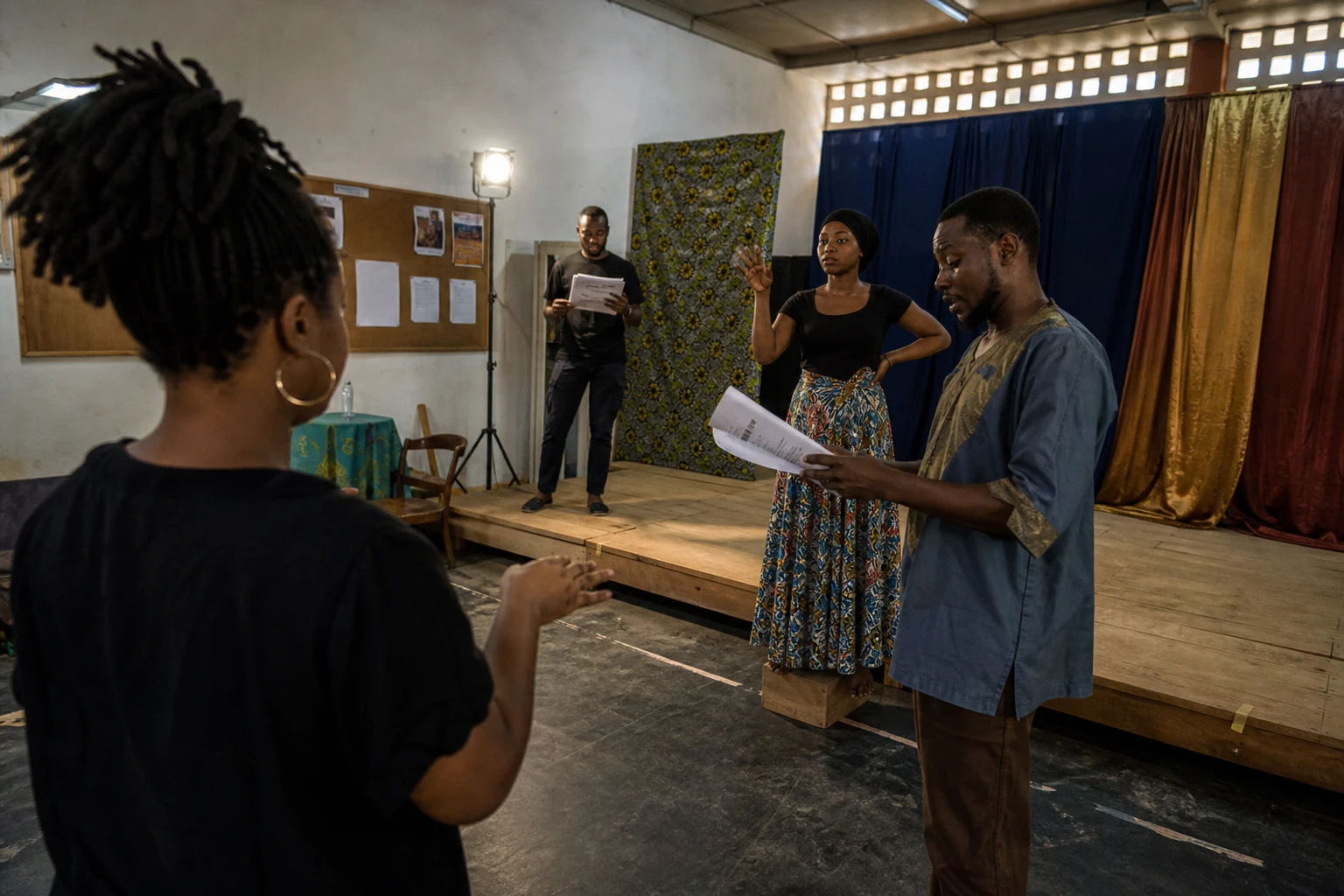
In Cameroon, where theatre careers are often forged far from specialist schools, Hermine Yollo has chosen a different path: making words a space of freedom. On 27 September 2026, the Cameroonian playwright won the RFI Theatre Prize for Ima Maryam : le jugement de Marie, a play that questions faith, dogma and the place accorded to women in religious narratives.
An award that builds on a career spanning Douala and Yaoundé
The prize will be presented to her in Limoges, as part of Les Zébrures d’automne, a festival dedicated to French-language writing and theatre. The jury, chaired by Guinean playwright Hakim Bah, selected her text from among the submissions for the 2026 edition. The award is supported by a network of cultural partners, including the Society of Dramatic Authors and Composers, the Institut français, Théâtre Ouvert and the Normandy-Rouen National Drama Centre.
This recognition is not an isolated milestone in her career. Hermine Yollo was born in 1981 in Douala, into a family already involved in theatre. Her parents, themselves actors and directors, introduced her from an early age to the stage, literature, music and visual arts. She grew up in an environment where creativity was part of everyday life.
Her path also reflects the realities of arts education in Cameroon. In the absence at the time of a national school devoted entirely to theatre, she combined literary studies, a master’s degree in translation and several professional experiences. She later trained with Cameroonian and African artists, as well as at international organisations, including in Tunis, Cannes, Marseille and Ouagadougou.
Based in Yaoundé, she now leads Compagnie NGOTI. Her work is rooted in theatre that moves between languages, memories and forms. Her presence in the Cameroonian capital matters. It is a reminder that the country’s contemporary writing is not confined to foreign stages, where it is sometimes first introduced to French-speaking audiences.
Maryam speaks out against narratives that have fixed her in place
In Ima Maryam : le jugement de Marie, Hermine Yollo imagines Maryam, the woman associated with the figure of the Virgin Mary, taking the floor. After centuries of prayers, interpretations and portrayals, the character demands the right to tell her story and find a measure of rest.
The play does not seek to pit belief against creativity. Instead, it opens up a space for questioning. Who speaks on behalf of women turned into religious or symbolic figures? What remains of their human experience when institutions, traditions and collective narratives transform them into idealised images?
To convey this tension, the playwright brings several figures linked to Mary into view. Maryam, an entity presented as all-powerful and another reduced to an image of purity answer one another. The names are similar, but the identities shift. The text thus forces readers or audiences to lose their bearings before forming their own perspective anew.
Language is central. The sentences are fragmented. Silences, breaths and pauses become elements of the dramaturgy, or the art of structuring a theatrical work. The layout also contributes to the meaning. Alignment, spaces and repetitions give the text a rhythm close to prayer, while introducing critical distance.
A theatre linking religious narratives to contemporary violence
The play also addresses violence against women. Hermine Yollo links portrayals of women in monotheistic traditions to the norms that continue to bear down on women’s bodies. She highlights the persistence of a binary view: women are seen as either pure and respectable or guilty and unworthy.
This reading is not limited to a critique of religion. More broadly, it targets the mechanisms that silence women. Theatre thus becomes a place where narratives considered untouchable can be examined. The stage does not necessarily provide an answer. It makes visible questions that social conventions or authorities have sometimes sought to close off.
The choice of Mary gives the project a particular dimension. In many African societies, including Cameroon, Christian references play an important role in family, social and cultural life. They coexist with other legacies, local practices and diverse spiritual paths. By taking up a familiar figure, Hermine Yollo therefore engages a widely shared imaginary while shifting its perspective.
The approach can also be viewed in the context of Central Africa. In the countries of the Central African Economic and Monetary Community, a regional organisation that includes Cameroon, Gabon, Congo, the Central African Republic, Equatorial Guinea and Chad, theatre stages remain important spaces for debate. They make it possible to discuss family, faith, power, gender and historical legacies without reducing creative work to denunciation.
Recognition for African playwriting
The RFI Theatre Prize is part of a history of circulation for French-language plays. Since 2014, it has supported texts from Africa, the Caribbean, the Indian Ocean, the Near East and the Middle East. Award-winning works generally receive staged readings, dramaturgical support and exposure to programmers and actors.
For Hermine Yollo, this recognition builds on a career that already included a first selection for the same prize in 2019, with M-119 Autopsie. It also confirms the continuing strength of a Cameroonian theatre scene shaped by several generations of artists. They include writers, directors, actors and collectives working in Yaoundé, Douala and other cities across the country, despite often unreliable resources.
The award is also a reminder that African writing is not merely a source of testimony about the continent’s crises. It also creates demanding forms, symbolic narratives and universal questions. With Ima Maryam, Hermine Yollo starts from an ancient religious figure to explore power, memory and freedom. The next chapter will unfold on stage, wherever the text can be read, discussed and brought to life.