Algeria
 Egypt
 Libya
 Morocco
 Sudan
 Tunisia
 Benin
 Burkina Faso
 Cabo Verde
 Côte d'Ivoire
 Ghana
 Guinea-Bissau
 Liberia
 Mali
 Mauritania
 Niger
 Nigeria
 Senegal
 Sierra Leone
 The Gambia
 Togo
 Cameroon
 Central African Republic
 Chad
 DR Congo
 Equatorial Guinea
 Gabon
 Republic of the Congo
 São Tomé and Príncipe
 Burundi
 Comoros
 Djibouti
 Eritrea
 Ethiopia
 Kenya
 Madagascar
 Malawi
 Mauritius
 Mozambique
 Rwanda
 Seychelles
 Somalia
 South Sudan
 Tanzania
 Uganda
 Angola
 Botswana
 Eswatini
 Lesotho
 Namibia
 South Africa
 Zambia
 Zimbabwe
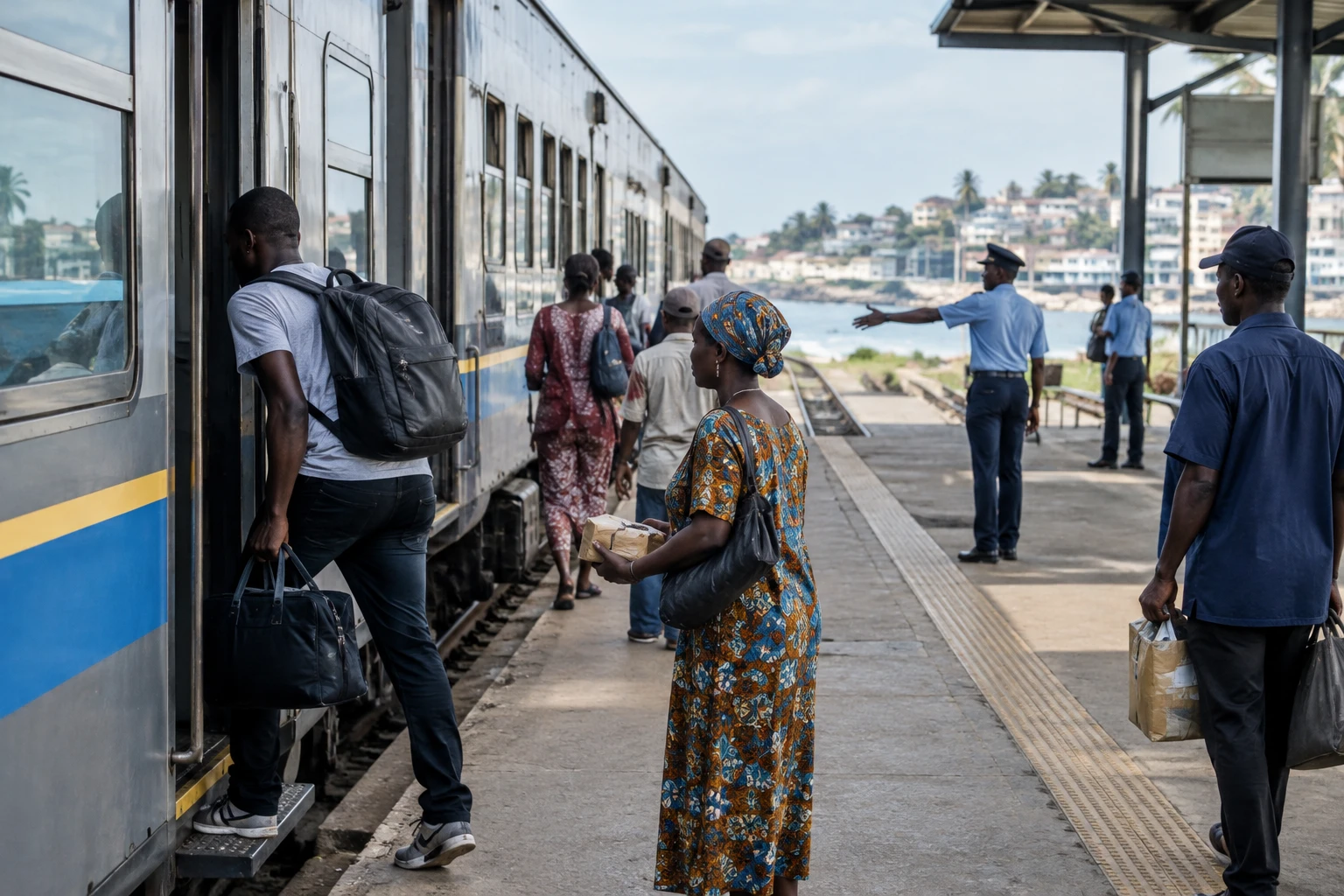
A train can carry ore to a port. It can also bring cities closer, open up markets for producers and make travel easier. In Guinea, this second promise of the TransGuinean has yet to be delivered: the inaugural passenger journey marks a milestone, not the launch of a commercial service.
A mining corridor that is also meant to serve Guineans
The TransGuinean is primarily part of the Simandou project, a vast iron ore operation in the south-east of the country. It connects the mining areas to the port of Morébaya, in Forécariah prefecture. More than 650 kilometres long, according to Guinean authorities, the double-track railway is designed to carry ore, as well as goods and passengers.
This shared purpose is set out in the project agreements. It matters in a country where rail infrastructure remains limited and travel between regions relies mainly on roads. In time, the line could serve areas far from Conakry and connect several economic hubs. But a railway built for a major mining project does not automatically become a practical and accessible public network.
The regional framework adds another dimension. Guinea is a member of ECOWAS, the Economic Community of West African States, which aims, among other things, to facilitate trade and movement in the region. At this stage, the TransGuinean is not a cross-border line. However, its capacity to carry goods other than iron ore could affect transport costs and market opportunities for Guinean businesses.
An inaugural journey, not yet a train timetable
On 12 October 2026, President Mamadi Doumbouya took part in an inaugural journey aboard a passenger train, departing from the port of Morébaya. The route reached Ouré Kaba, in Mamou prefecture, according to Guinean accounts of the event. The journey shows that a passenger train was able to travel along part of the corridor. On its own, it does not confirm that all sections are ready for regular services.
The TransGuinean Company (CTG), responsible for operating infrastructure co-developed by the state and the project partners, said in April that passenger transport and commercial freight services would open gradually between late 2026 and 2027. The timetable depends in particular on completion of the tracks and facilities. Ten stations are planned along the route, but they are not all ready, according to information provided by the company.
The details of the service also remain to be settled: frequency, fares, train capacity, stops and access conditions. These details will determine whether the train meets the everyday needs of residents, traders and businesses, beyond its symbolic significance. For communities along the route, a useful station also requires connections, access roads and services able to serve nearby villages.
Training staff and organising shared use of the tracks
Launching the service depends as much on skills as on tracks. On 6 October, 60 Guinean workers left for China for specialised training in railway occupations, including train driving. The Guinean public news agency and local media reported their departure. The announced duration of a training course for trainees is four months, but the size of the teams required and their start dates have not been made public in detail.
This training could help transfer skills, provided the workers who complete it go on to secure lasting jobs and operational responsibilities. The issue also concerns maintenance, safety, station management and co-ordination between operators. The network will need to accommodate mining trains, freight convoys and passengers without making one service unpredictable or inaccessible because of another.
The question is particularly important for the areas along the route. Businesses near the corridor could benefit from new market opportunities, while farmers will need practical ways to get their produce to market. For passengers, the impact will depend on ticket prices, schedules and reliability. A service limited to major centres or periods of mining activity would not deliver the same benefits as one designed around local needs.
The economic promise remains to be tested over time
The official launch of Simandou operations took place in November 2025, according to Guinea’s Budget Ministry. The railway is therefore at the heart of a project bringing together mines, a port and transport. The authorities present this infrastructure as a driver of national development. To assess its impact, however, revenues and flows linked to ore will have to be distinguished from benefits genuinely available to other sectors and the population.
Governance of the corridor will be decisive: who can reserve capacity, under what rules and at what cost? The co-development agreements provide for a multi-user access regime. But the existence of a framework does not, on its own, guarantee that small businesses or producers will actually be able to use the network. Transparency around access conditions and publication of the steps towards commissioning will provide tangible indications.
For Guinea, then, the key milestone is not the inaugural journey but the transformation of a route built around Simandou into a reliable and open service. Across West Africa, the project highlights a broader question: how can infrastructure linked to natural resources be turned into tools for mobility and trade that are useful beyond extraction sites? The next steps to watch are completion of the stations, the announcement of a precise commercial timetable and publication of the access rules for non-mining freight and passengers.
To prepare this article, information was cross-checked against publications by the Guinean Press Agency, the CTG, Guinean authorities and Rio Tinto. The inaugural journey and the training of the 60 workers were also reported by several Guinean media outlets.