Algeria
 Egypt
 Libya
 Morocco
 Sudan
 Tunisia
 Benin
 Burkina Faso
 Cabo Verde
 Côte d'Ivoire
 Ghana
 Guinea-Bissau
 Liberia
 Mali
 Mauritania
 Niger
 Nigeria
 Senegal
 Sierra Leone
 The Gambia
 Togo
 Cameroon
 Central African Republic
 Chad
 DR Congo
 Equatorial Guinea
 Gabon
 Republic of the Congo
 São Tomé and Príncipe
 Burundi
 Comoros
 Djibouti
 Eritrea
 Ethiopia
 Kenya
 Madagascar
 Malawi
 Mauritius
 Mozambique
 Rwanda
 Seychelles
 Somalia
 South Sudan
 Tanzania
 Uganda
 Angola
 Botswana
 Eswatini
 Lesotho
 Namibia
 South Africa
 Zambia
 Zimbabwe
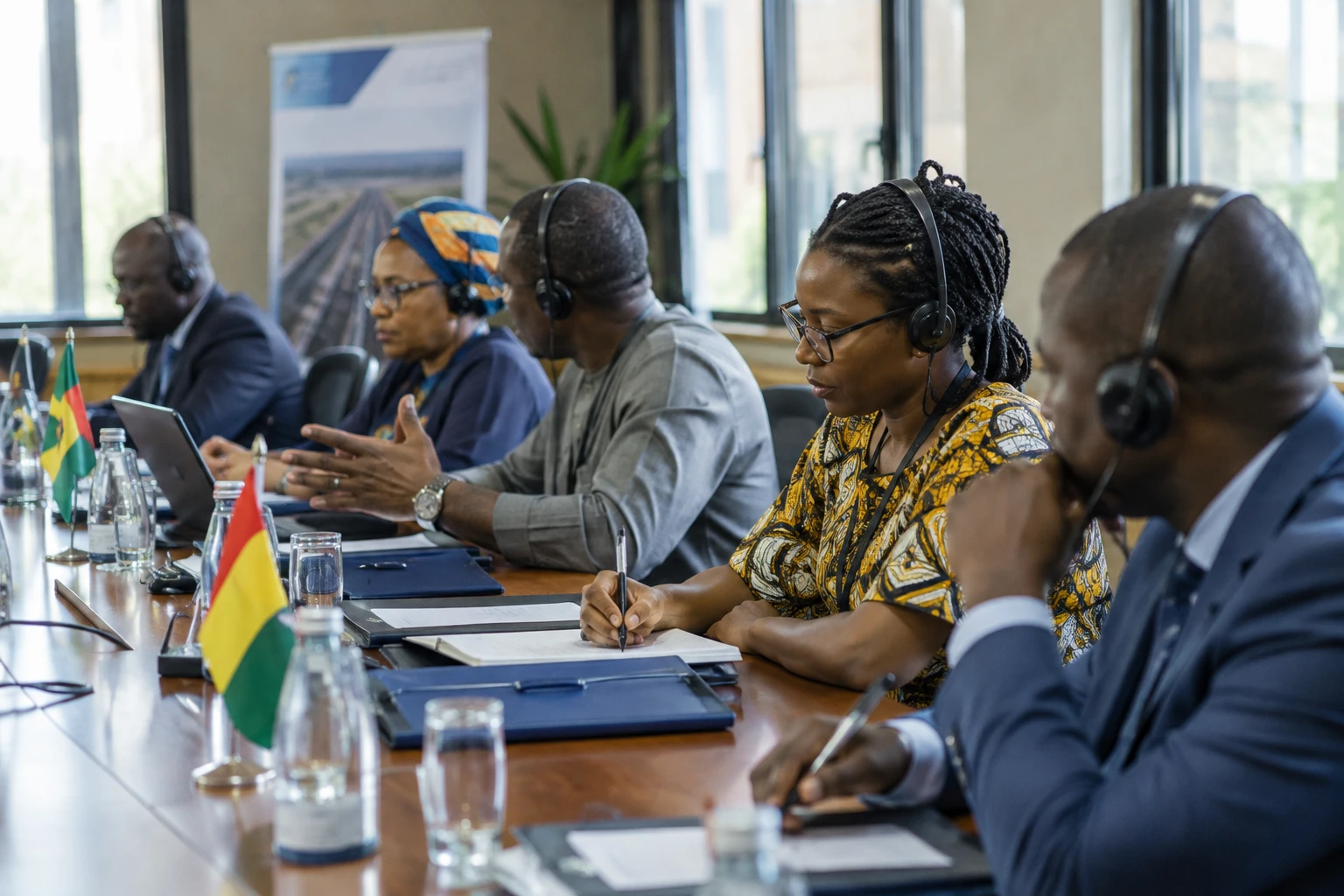
Training Guinean drivers for the TransGuinean raises a question that goes beyond recruitment: who will control the infrastructure built around Simandou’s ore in the future? The departure of 60 workers for China offers an initial answer. But training will have a lasting impact only if it leads to responsibilities, stable jobs and benefits beyond the mining corridor.
Training linked to the corridor’s start of operations
On 6 October 2026, a ceremony in Morébaya, in Forécariah prefecture, marked the departure of 60 Guinean workers for China. They are to undertake specialised train-driving training there. Djiba Diakité, minister and chief of staff to the presidency and chair of the Simandou Strategic Committee, presided over the event, according to the Guinean authorities. The Guinean Press Agency also reported on the departure.
The trainees are expected to drive locomotives on the TransGuinean, the railway infrastructure intended to link the Simandou deposits to the port of Morébaya. The announced route extends for more than 650 kilometres. The line is designed to transport ore, as well as passengers and goods. The Guinean presidency describes it as a multi-purpose network intended to connect several regions of the country.
The training is run by Simandou Academy, a programme attached to the Simandou 2040 initiative. The authorities say several participants come from communities along the route. However, in the information consulted, they have not published details on the selection criteria, the duration or cost of the training, or hiring commitments upon the trainees’ return. These details will make it possible to assess the programme’s scope more precisely.
Local content, beyond announcements
In the mining sector, “local content” refers to the jobs, purchases and skills developed in the country where extraction takes place. For Guinea, the challenge is not to limit its participation to supplying ore and providing temporary construction jobs. Training drivers is a concrete step towards national mastery of a technical occupation needed to operate the railway.
This progress is not, however, enough to show that Guineans will control the entire rail chain. Train operations also depend on maintenance, safety, traffic management, ongoing training and the ability to move into management roles. The effective sharing of responsibilities between Guinean workers and the project’s partners will therefore be as important as the number of people trained.
The challenge also concerns businesses. Supply contracts, technical services and subcontracting can create lasting opportunities, provided Guinean companies can meet requirements for quality, financing and volume. Without real access to these markets, local content risks remaining concentrated in a handful of salaried jobs, while specialised roles and the largest contracts elude national players.
A mining infrastructure, with uses to be secured
The TransGuinean crosses several areas and links an inland mining zone to the Atlantic coast. Its role in transporting passengers and goods could eventually support travel and trade between regions. But this stated purpose does not yet explain on what terms residents will be able to use the line, where trains will stop or what share will be set aside for non-mining freight.
The difference will be decisive for people living along the route. A corridor designed first and foremost to export ore can also support local trade, but this requires accessible services and connections with roads, markets and regional economic activity. Benefits will not automatically be shared between Conakry, the communities along the route and areas far from the infrastructure.
Benefits must also be tracked over time: permanent jobs after the major construction works, retraining for demobilised workers, opportunities for Guinean suppliers and consideration of communities’ concerns. In July 2026, the Guinean Agency for the Promotion of Employment and Entrepreneurship launched a workshop on retraining demobilised workers from the project. This initiative is a reminder that skills needs change between construction and operations.
What Guinea still needs to prove
The departure of the 60 trainees comes as Simandou enters a new phase. The official launch of ore production was announced on 11 November 2025 by Guinea’s Ministry of the Budget. Since then, attention has focused as much on production as on the country’s ability to turn investment into skills, economic activity and services that benefit its population.
This trajectory also matters to West Africa. Guinea is a member of ECOWAS, the Economic Community of West African States, and its choices on infrastructure and resource processing form part of regional debates on industrialisation and trade. The Simandou case illustrates a tension shared by several economies: exporting a resource can generate revenue, but the value created locally depends on processing, skills and markets accessible to businesses in the country.
To assess the results of Simandou Academy, it will therefore be necessary to look at what happens after the trainees’ time in China: whether they return, whether their qualifications are recognised, their assignments, career progression and the transfer of skills to other workers. It will also be necessary to check that passenger and commercial uses of the TransGuinean take shape, rather than remain a promise attached to the mining project. It is these results, more than the departure ceremony, that will determine the real place of Guineans at the controls.