Algeria
 Egypt
 Libya
 Morocco
 Sudan
 Tunisia
 Benin
 Burkina Faso
 Cabo Verde
 Côte d'Ivoire
 Ghana
 Guinea-Bissau
 Liberia
 Mali
 Mauritania
 Niger
 Nigeria
 Senegal
 Sierra Leone
 The Gambia
 Togo
 Cameroon
 Central African Republic
 Chad
 DR Congo
 Equatorial Guinea
 Gabon
 Republic of the Congo
 São Tomé and Príncipe
 Burundi
 Comoros
 Djibouti
 Eritrea
 Ethiopia
 Kenya
 Madagascar
 Malawi
 Mauritius
 Mozambique
 Rwanda
 Seychelles
 Somalia
 South Sudan
 Tanzania
 Uganda
 Angola
 Botswana
 Eswatini
 Lesotho
 Namibia
 South Africa
 Zambia
 Zimbabwe
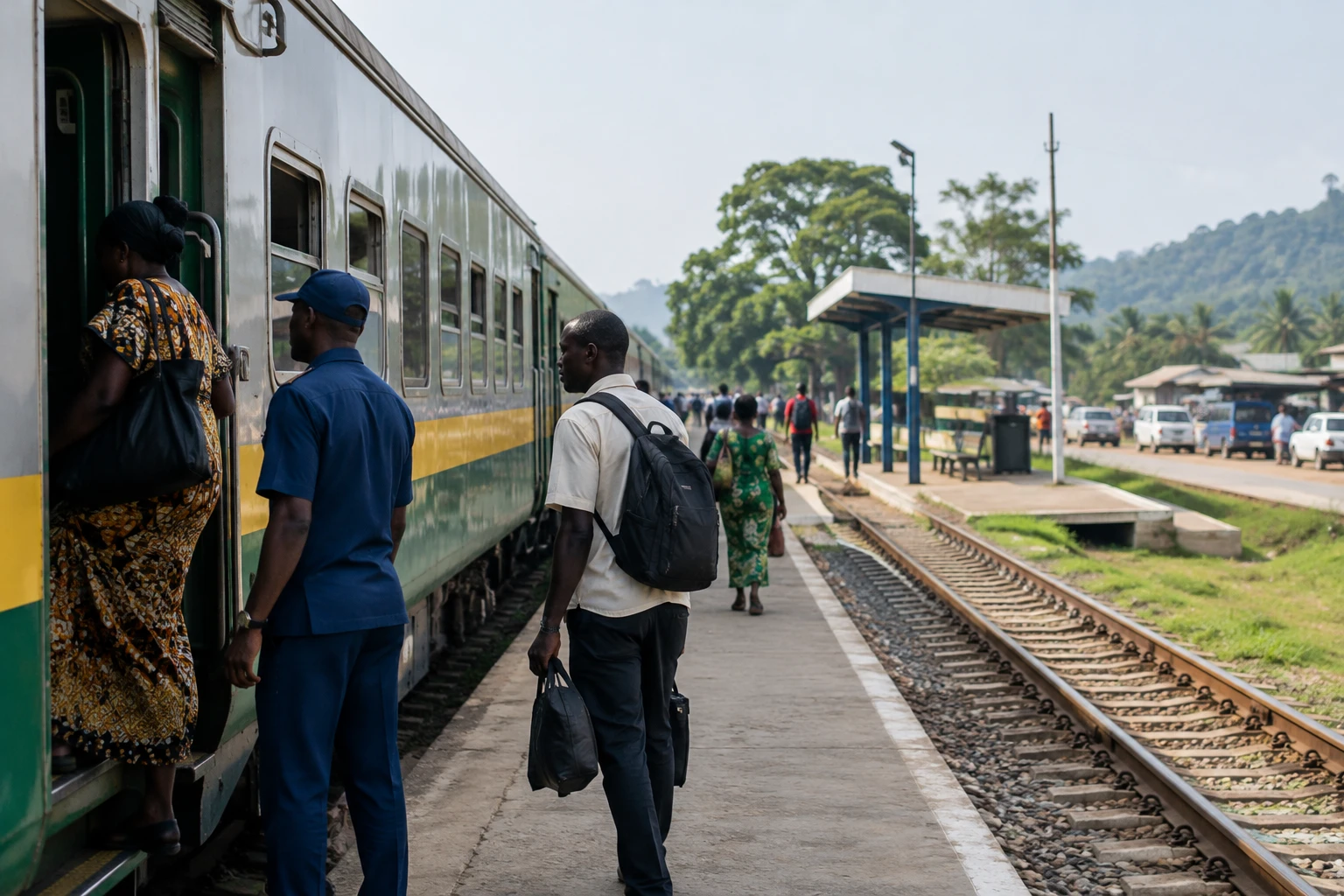
Between the Atlantic coast and the mining regions inland, Guinea’s new railway promises to carry more than ore. But a trial train does not yet constitute a public service: passenger access, stops and fares remain to be clarified.
From mining corridor to travel for Guineans
On 12 October 2026, President Mamadi Doumbouya took part in the inaugural journey of a passenger train operated by the Compagnie du TransGuinéen (CTG). It departed from the port of Moribaya, in Forécariah prefecture, south of Conakry. The Guinean Press Agency reported the launch and presented it as a step towards the train entering service.
The Simandou project had already reached a railway milestone on 11 November 2025, when partners launched ore operations and transport. The double-track network, more than 600 kilometres long according to Rio Tinto and about 650 kilometres according to Guinean authorities, is intended to link the south-eastern mining areas with the coast. It combines railway lines, port facilities and export logistics.
Its stated purpose is multiple: to carry iron ore, transport goods and, eventually, passengers. This shared use addresses a planning challenge: ensuring that major infrastructure does not serve only to link a mine to a port. However, this alone does not guarantee that the communities along the route will benefit from a regular or affordable service.
Accounts of the inaugural journey do not fully agree. The AGP confirms the trial departure from Moribaya, while another report describes a 148-kilometre journey to Kassa, in Mamou prefecture. The available information does not make it possible to independently confirm the entire route outlined in project presentations. It is therefore more prudent to distinguish this inaugural journey from the commercial launch of the service.
Turning infrastructure into a useful service
The line crosses several territories and could shorten journeys between the coast and the interior. For traders and agricultural producers, rail can improve access to markets and logistics hubs. For residents, its usefulness will depend above all on the location of stations, their road connections, ticket prices and train frequency.
The difference between the capital and the regions will be decisive. Conakry is home to the institutions and a significant share of economic activity. Communities far from the coast, meanwhile, will need practical connections to stations and timetables that fit their activities. Without these links, the corridor risks moving resources without bringing people sufficiently closer to services and markets.
The CTG brings together the Guinean state and industrial partners, including the groups associated with SimFer and Winning Consortium Simandou. According to Rio Tinto, the state holds a 15% stake in the company, with the two industrial partners sharing the remainder equally. This arrangement puts the question of benefits at the heart of the project: who will fund maintenance, who will set priorities for use, and how will revenue and skills be shared?
The training of Guinean staff is another test. The AGP reports that 60 CTG workers went to China for locomotive-driver training. This information, reported by the agency, illustrates the importance of skills transfer, but is not enough to gauge the share of local jobs in future operations. Maintenance, safety and traffic management will also require skilled teams over the long term.
Simandou, between national ambition and public responsibility
The government presents Simandou as a lever for economic transformation. The railway’s entry into service is part of that ambition, but mining investment does not automatically bring diversification. The impact will depend in particular on local procurement, public revenue, jobs created and the capacity to support other sectors along the corridor.
The milestone of 11 November 2025 shows that the network was designed primarily to transport ore for export. Passenger transport opens up a different possibility without changing that industrial priority. The two uses can coexist, provided that timetables, available capacity and safety rules are made public, and that mobility needs are not relegated to the background.
The authorities have also spoken of the gradual development of stations. Until their timetable, locations and access arrangements are specified, it is impossible to assess the real impact on communities along the route. The benefits could vary significantly between towns served by the railway, villages close to the line and areas away from access routes.
A West African issue that will play out over time
Guinea is a member of the Economic Community of West African States (ECOWAS), which also supports the monitoring of political and economic processes in the region. The TransGuinéen is not a cross-border line, but its operation could affect West African trade: it links mineral resources, port infrastructure and markets that extend beyond national borders.
For Guinea, the next measure of progress will therefore not simply be the running of a presidential train. It will be necessary to monitor the effective opening of stations, the regularity and cost of tickets, the share given to non-mining freight and the growth of skilled local employment. Only under these conditions will the corridor be able to demonstrate whether it can durably connect Guinean territories, beyond its export function.
Sources: Guinean Press Agency on the train launch, Teranga Times on the reported route, Guinea’s Ministry of the Budget on the launch of Simandou and Rio Tinto on the CTG structure and railway operations.