Algeria
 Egypt
 Libya
 Morocco
 Sudan
 Tunisia
 Benin
 Burkina Faso
 Cabo Verde
 Côte d'Ivoire
 Ghana
 Guinea-Bissau
 Liberia
 Mali
 Mauritania
 Niger
 Nigeria
 Senegal
 Sierra Leone
 The Gambia
 Togo
 Cameroon
 Central African Republic
 Chad
 DR Congo
 Equatorial Guinea
 Gabon
 Republic of the Congo
 São Tomé and Príncipe
 Burundi
 Comoros
 Djibouti
 Eritrea
 Ethiopia
 Kenya
 Madagascar
 Malawi
 Mauritius
 Mozambique
 Rwanda
 Seychelles
 Somalia
 South Sudan
 Tanzania
 Uganda
 Angola
 Botswana
 Eswatini
 Lesotho
 Namibia
 South Africa
 Zambia
 Zimbabwe
In Siguiri, the fight against illegal gold mining confronts Guinea’s authorities with a twofold challenge: protecting land and water while ensuring that questions of administrative responsibility and the rights of those tried are not left unanswered. The verdict handed down in Conakry on 16 November penalises both operators and 22 former local officials.
A verdict that distinguishes between responsibilities
The Court for the Repression of Economic and Financial Crimes (CRIEF), a Guinean court dealing notably with economic and financial cases, sentenced each of the 22 former administrators to two years in prison. It also imposed an individual fine of 10 million Guinean francs on each. The judges found them guilty of complicity in environmental degradation, various forms of destruction and water pollution.
However, the court acquitted them of charges of corruption of a public official, illicit enrichment and money laundering. The scope of the judgment is therefore limited: it establishes responsibility linked to environmental damage, but does not uphold the initial financial allegations. The lawyers said they would discuss with their clients whether to appeal. The special prosecutor, for his part, said he was satisfied with the decision.
The 202 miners prosecuted in the same case were each sentenced to three years in prison and ordered to pay a joint fine of 10 billion Guinean francs. However, reports published about the hearing state that they were not in the dock when the verdict was delivered. Their absence prompted objections from the defence. According to Guinean reports, the prosecution said they had been pardoned and then taken out of the country before the hearing. This sequence raises a question distinct from that of guilt: the conditions under which a sentence can be imposed in the absence of the people concerned.
A gold-producing region under intense pressure
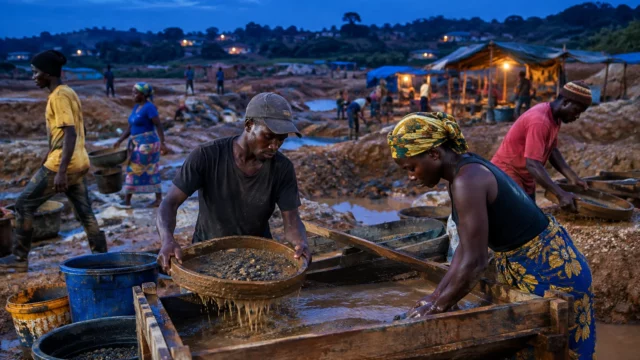
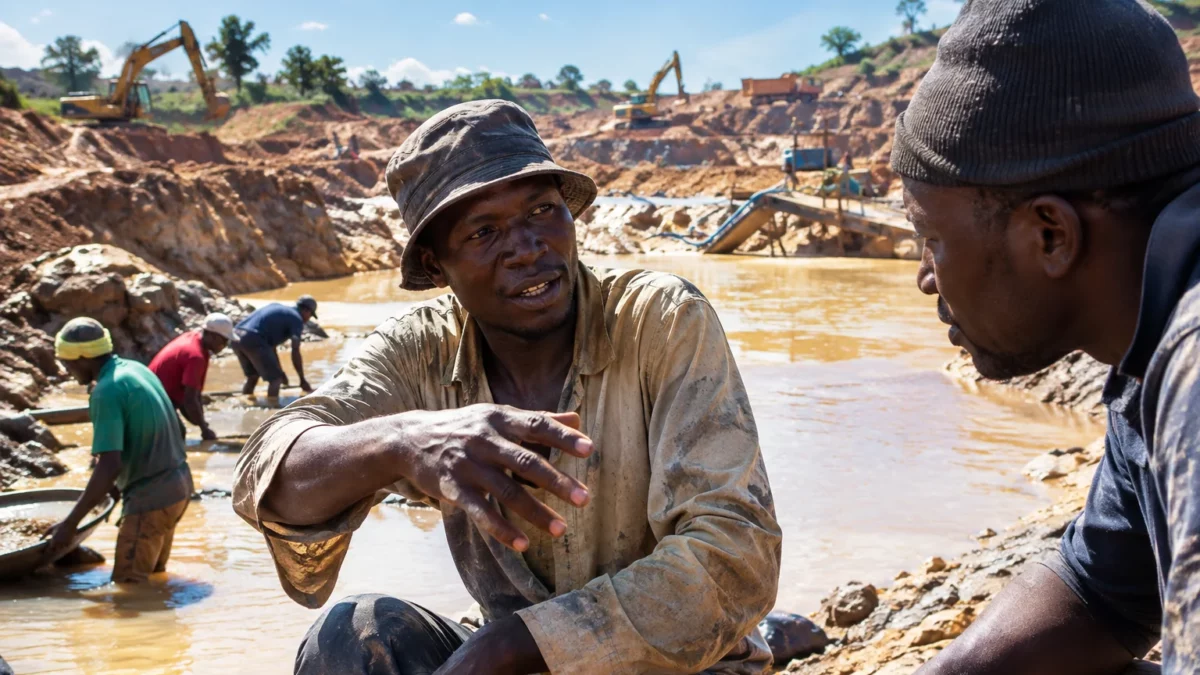
Siguiri, in north-eastern Guinea, is one of the country’s main gold-producing areas. Artisanal gold mining supports local communities and also attracts workers from other West African countries. But when it operates outside the rules, the use of heavy machinery and polluting substances can degrade farmland and contaminate waterways. The consequences therefore affect miners, families living nearby and activities that depend on water and soil.
The verdict comes as Conakry steps up controls on artisanal mining. A suspension of gold mining in Siguiri was announced on 29 October 2026, followed on 2 November by a security operation to enforce the ban on illegal activities. The government presents this policy as a way to protect the environment and better regulate the gold sector. At the same time, Guinea is seeking to process more of its gold domestically, notably with the announced opening of its first national refinery.
This strategy faces an economic reality: according to UN Environment, artisanal and small-scale gold mining supports the livelihoods of more than 300,000 people in Guinea. A ban without alternatives could therefore undermine incomes, particularly in areas where formal employment is limited. Conversely, allowing polluting practices to continue exposes people and land to lasting harm. The challenge is to enforce the law while making it possible to carry out declared, regulated and less harmful mining.
Gold-mining oversight is not decided in court alone
The proceedings also raise questions about the responsibility of local authorities. Before the judgment, several defendants disputed the accusations, arguing that they had held office for too short a time to be held responsible for earlier damage. According to an account of the hearings, the miners questioned did not name any administrator as having granted them illegal permission. The conviction for environmental complicity legally resolves the case against the officials, but the detailed grounds and any appeal will be important in understanding how the judges established individual responsibility.
The context is particularly tense. On 11 November, clashes broke out in Balato, in the Siguiri region, during a patrol tasked with enforcing the ban. The provisional toll announced by the Guinean government was ten dead and thirteen injured. The Associated Press also reported this toll, citing the authorities. The precise circumstances of the shooting and responsibility for it remain to be established by the investigations announced. The violence shows that enforcement is not solely a matter of mining-police operations: it also involves trust between communities, local authorities and security forces.
A Guinean issue with West African repercussions
The movement of workers and gold extends beyond national borders. Workers from several neighbouring countries are present in Guinea’s gold-mining areas, and enforcement measures may lead to movements into neighbouring countries. ECOWAS, the West African regional organisation, provides a framework for cooperation between states; it does not, however, replace national courts or the local mechanisms needed to monitor workers, the gold trade and cross-border environmental impacts.
For Guinea, the immediate next step is legal: the defence for the former administrators must decide whether to appeal, while objections to the judgment against the 202 absent miners call for clarification. On the ground, what happens next will depend on the authorities’ ability to monitor sites without fuelling further clashes, enforce environmental rules and offer workers legal alternatives. The credibility of Guinea’s mining policy will be measured as much by the protection of water and land as by the regularity of proceedings and the practical treatment of the communities concerned.
Guinean report on the CRIEF verdict · Prosecution and defence reactions · Debate over the miners’ absence from the hearing · Official statement on the clashes in Balato · Cross-checking the toll of the clashes and the mining context · Background on Guinea’s gold sector