Algeria
 Egypt
 Libya
 Morocco
 Sudan
 Tunisia
 Benin
 Burkina Faso
 Cabo Verde
 Côte d'Ivoire
 Ghana
 Guinea-Bissau
 Liberia
 Mali
 Mauritania
 Niger
 Nigeria
 Senegal
 Sierra Leone
 The Gambia
 Togo
 Cameroon
 Central African Republic
 Chad
 DR Congo
 Equatorial Guinea
 Gabon
 Republic of the Congo
 São Tomé and Príncipe
 Burundi
 Comoros
 Djibouti
 Eritrea
 Ethiopia
 Kenya
 Madagascar
 Malawi
 Mauritius
 Mozambique
 Rwanda
 Seychelles
 Somalia
 South Sudan
 Tanzania
 Uganda
 Angola
 Botswana
 Eswatini
 Lesotho
 Namibia
 South Africa
 Zambia
 Zimbabwe
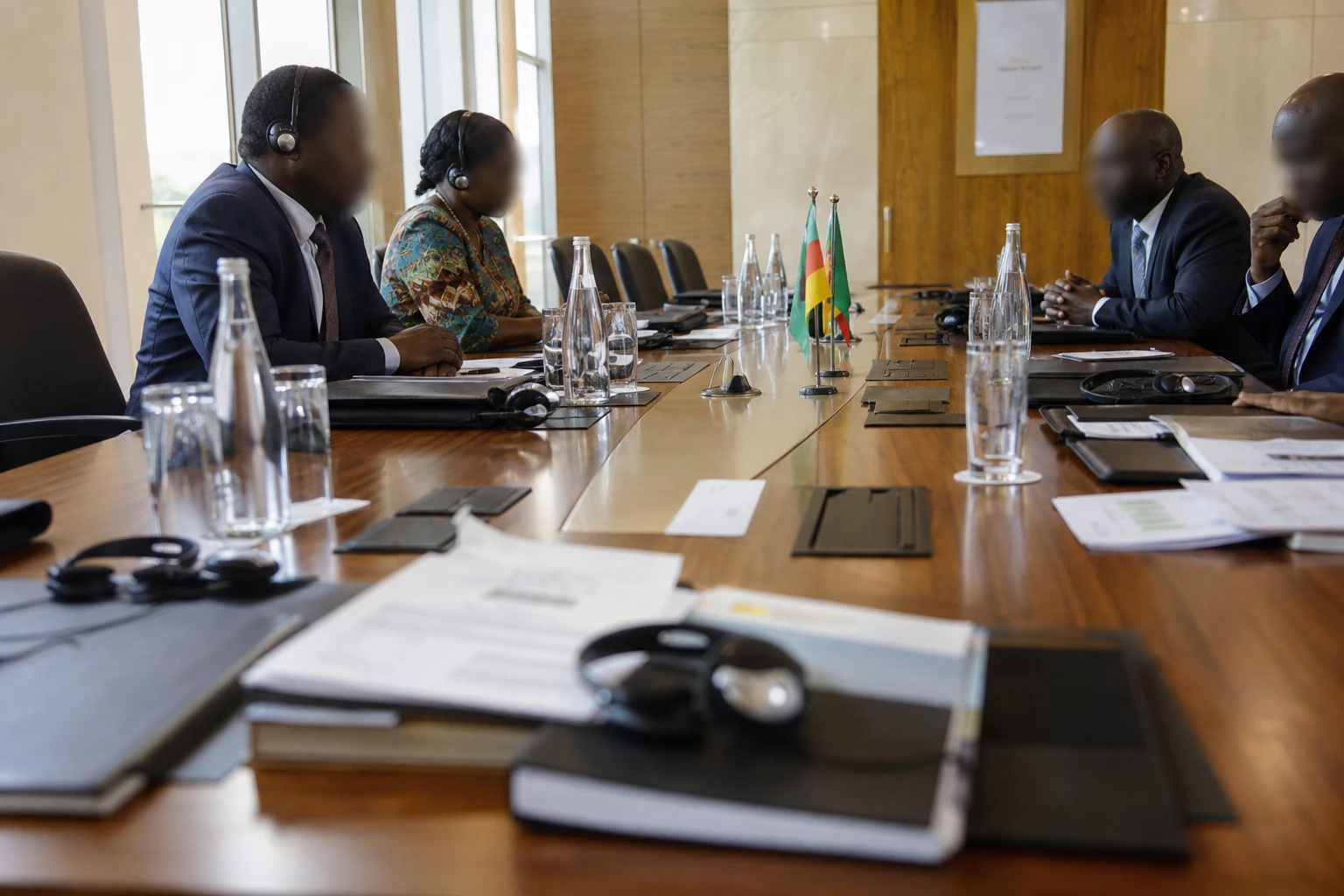
In Conakry, the battle for bauxite is no longer fought only in the mines
In Guinea, the question is no longer simply how to extract ore from the ground. It is also who sells it, on what terms, and how much of its value stays in the country. In a sector that accounts for a large share of public revenue and exports, this question is becoming strategic for Conakry, as well as for the mining areas of Boké, Kamsar and Tinguilinta, where bauxite flows for export are concentrated.
The current trajectory follows a clear direction advocated by the Guinean authorities since 2025: taking back control of the mining value chain, strengthening local content and encouraging more processing in the country. In recent months, the Ministry of Mines and Geology has sent repeated signals to this effect, speaking of a more responsible alumina industry, new agreements and the expansion of industrial projects linked to bauxite.
Nimba Mining Company seeks a stable market for rapidly rising output
Founded in 2025, Nimba Mining Company is described as a wholly Guinean mining company, tasked with operating the Tinguilinta mine and the port facilities at Kamsar. The company says it shipped 1,002,400 tonnes of bauxite in 2025, just a few months after beginning operations, and is targeting 10 million tonnes in 2026 and 14 million in 2027. Its own roadmap also refers to a distance of about 86 kilometres between the mine and the port, covered by shared rail infrastructure.
Against this backdrop, Nimba Mining is working to organise sales of its output through monthly tenders open to international traders. The idea is twofold: secure a trading partner for a minimum annual volume, then sell the surplus on the spot market. This structure is intended to reduce uncertainty over sales as the company rapidly ramps up production.
The idea has not come out of nowhere. In recent months, the Ministry of Mines itself has suggested that Guinea wants to better regulate its bauxite exports and capture more value. In March 2026, Bloomberg had already reported plans for stricter supply rules, promoted by Minister Bouna Sylla amid pressure on ore prices.
What Guinea’s case reveals: a more assertive state, still reliant on overseas markets
The Nimba Mining case first shows one simple thing: Guinea no longer wants to settle for being a raw-material supplier. The authorities are talking about industrialisation, alumina refineries and economic sovereignty. In 2025 and 2026, the ministry also highlighted several local processing projects, including studies, agreements and alumina-related works. But for now, the country remains heavily dependent on bauxite exports abroad, particularly to Asia.
The tension is familiar across Guinea’s mining corridor. On one side are the quick revenues from exports. On the other is the promise of greater added value if processing advances locally. For the state, the issue is budgetary. For operators, it is commercial. For people in the Boké area, it remains above all a practical matter: jobs, traffic, pressure on roads, access to water, management of rail corridors and local benefits.
The mining sector remains central to Guinea’s economy. According to the Extractive Industries Transparency Initiative, it accounted for about 20.1% of GDP and 93.2% of the country’s exports in 2023. These figures underline the sector’s enormous weight, but also the vulnerability of a model still highly exposed to global prices, port logistics and the purchasing decisions of major traders.
Nimba Mining’s expansion is also part of a broader reshaping of Guinea’s mining landscape. Since the review of some cases involving foreign operators and the state’s resumption of control over certain assets, Conakry has sought to prove that a national public-sector player can manage large volumes without waiting for external approval. The announced selection of Glencore as a potential buyer nevertheless shows that, even with a more assertive approach, Guinea’s strategy continues to depend on the major global trading networks.
Beyond Guinea: bauxite, industrialisation and regional leverage
Across West Africa, Guinea’s case matters as more than a simple mining deal. Bauxite feeds a significant part of the global aluminium supply chain, and Guinea remains the world’s leading exporter of the ore. Any reorganisation of sales, transport or processing in Conakry could therefore affect supplies to industrial customers, particularly in China, and shape how African states use their natural resources in economic negotiations.
The continental significance is clear: Guinea is testing a formula that combines public control, structured commercial contracts and industrial ambition. If it holds, it could fuel the African debate on local processing of raw materials, an issue that the African Union and several governments are now placing at the heart of development policy. If it falters, it will also highlight how difficult it is to turn mining rents into a complete industrial value chain without suitable energy, infrastructure and financing.
The focus over the coming months will be twofold. First, the signing of a lasting commercial framework for Nimba Mining’s bauxite. Second, the country’s real capacity to move local-processing rhetoric from announcements to operating plants. That is where the credibility of Guinea’s new mining direction will be tested, far beyond Conakry.